
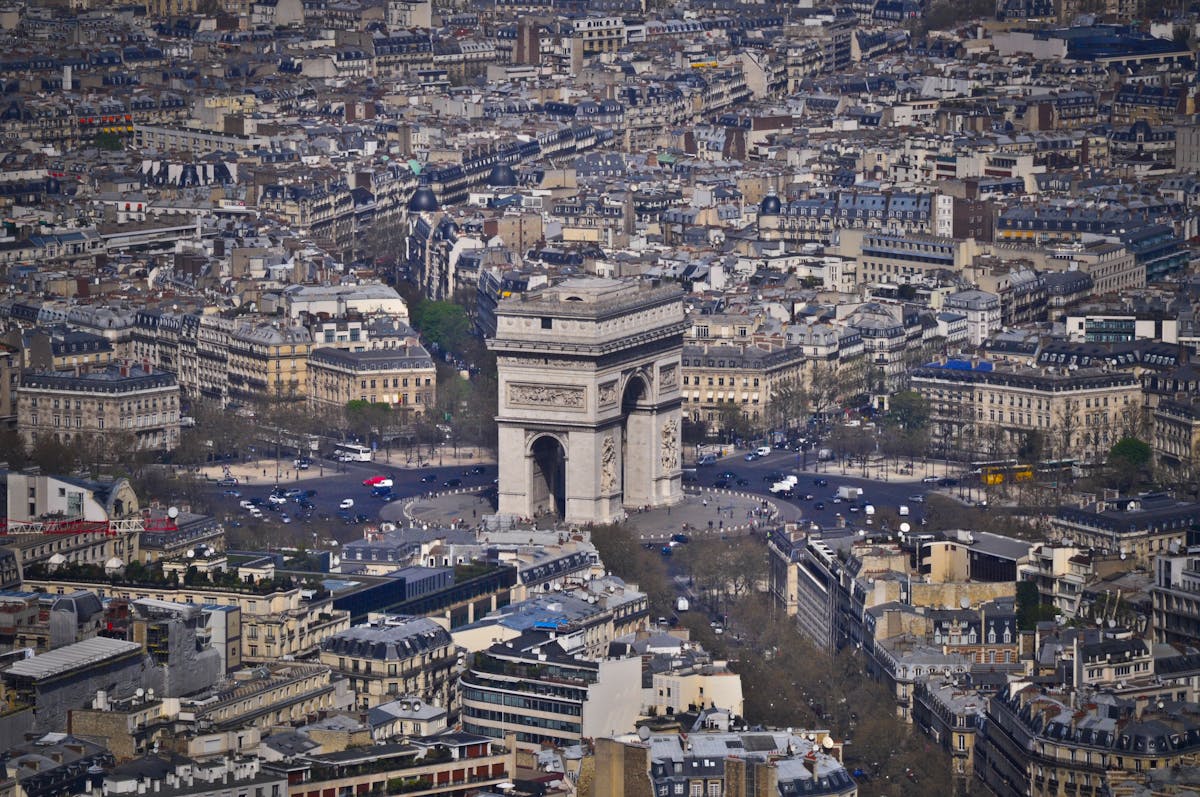
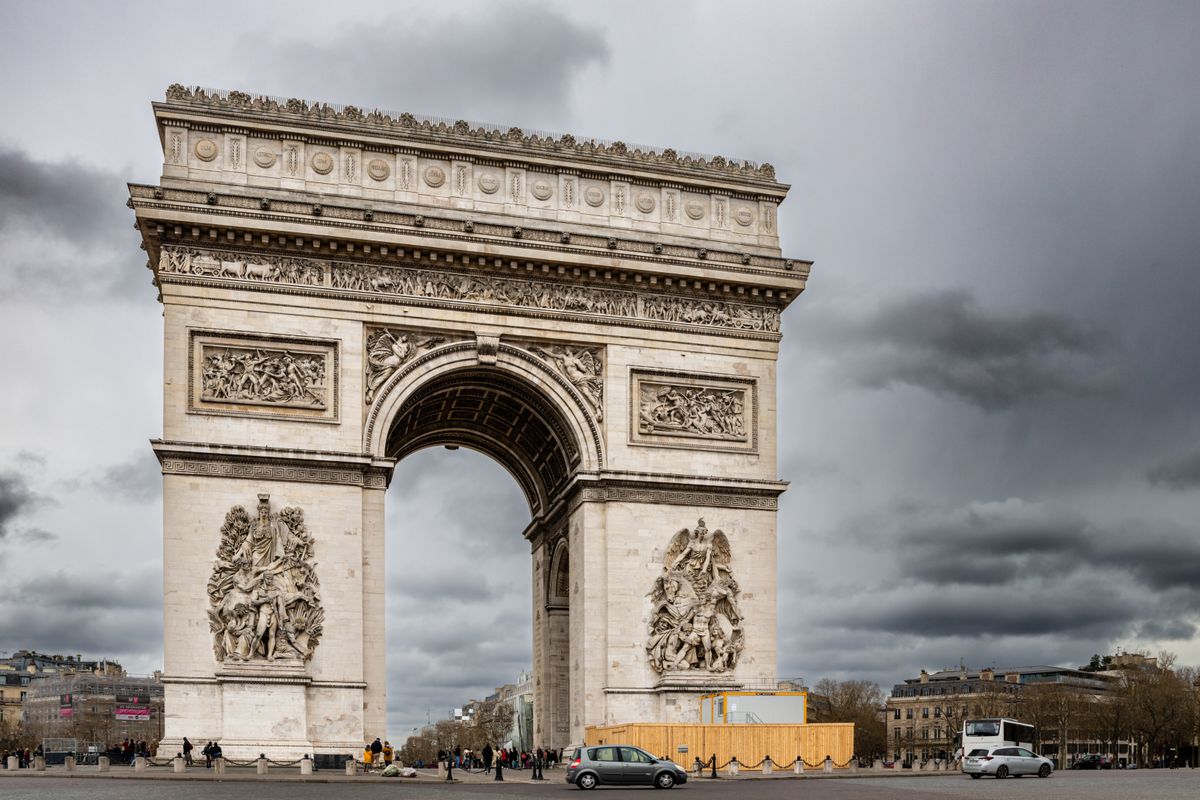
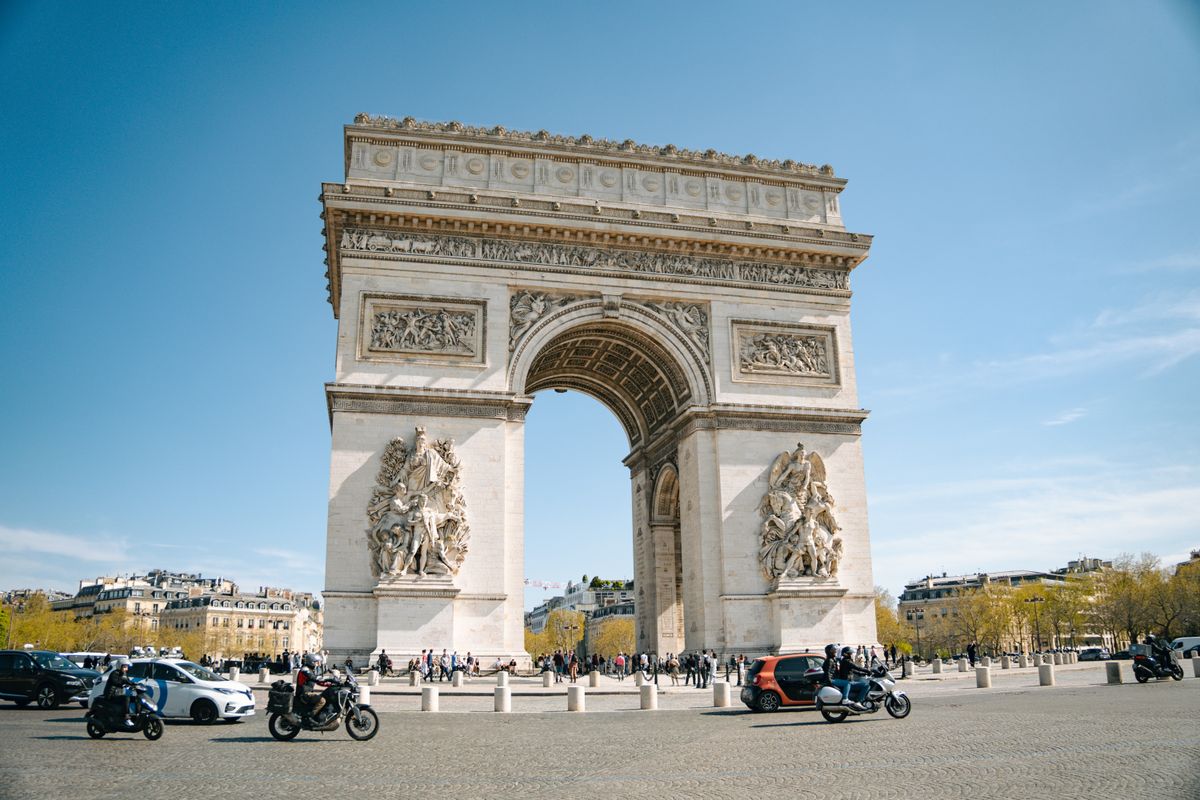
The Arc de Triomphe stands at the top of the Champs-Élysées like a full stop at the end of a sentence — 50 metres tall, 45 metres wide, and positioned so that twelve avenues radiate from it like the points of a star. It was Napoleon’s idea, commissioned in 1806 after his victory at Austerlitz, and it took thirty years to build. Napoleon was dead for fifteen of them. He never saw it finished.
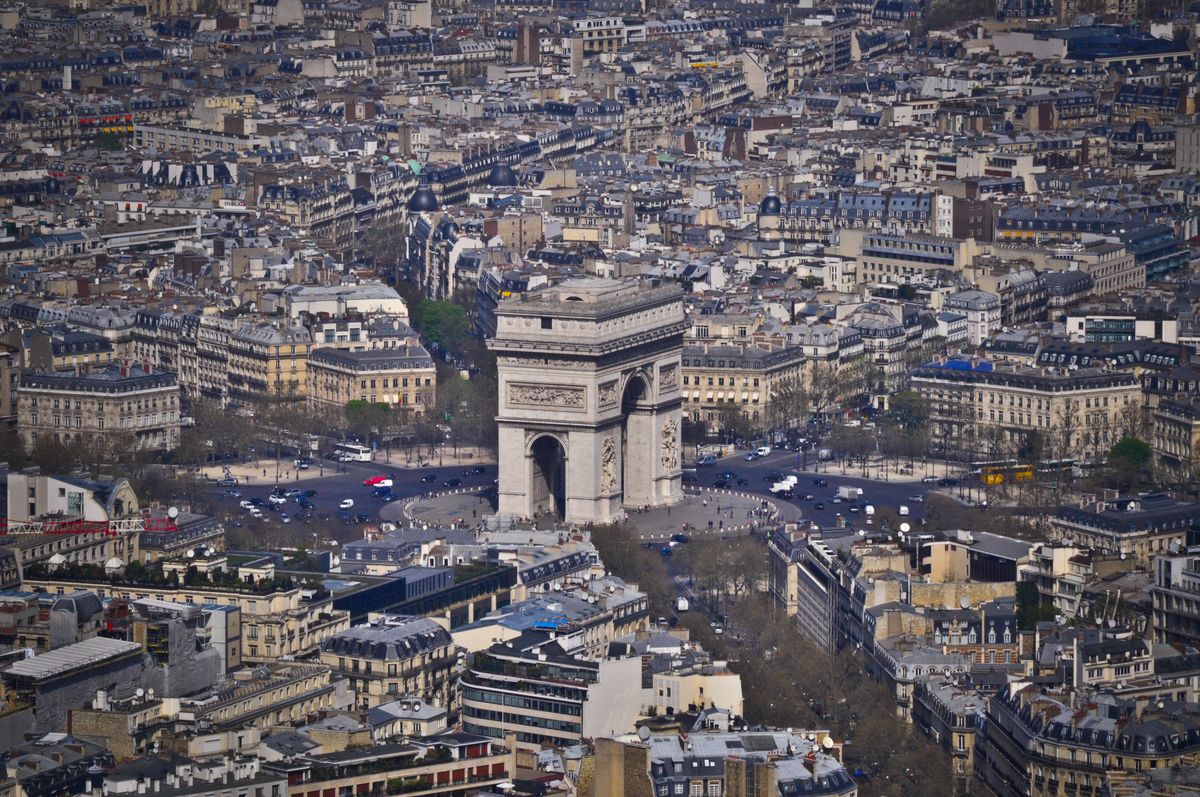
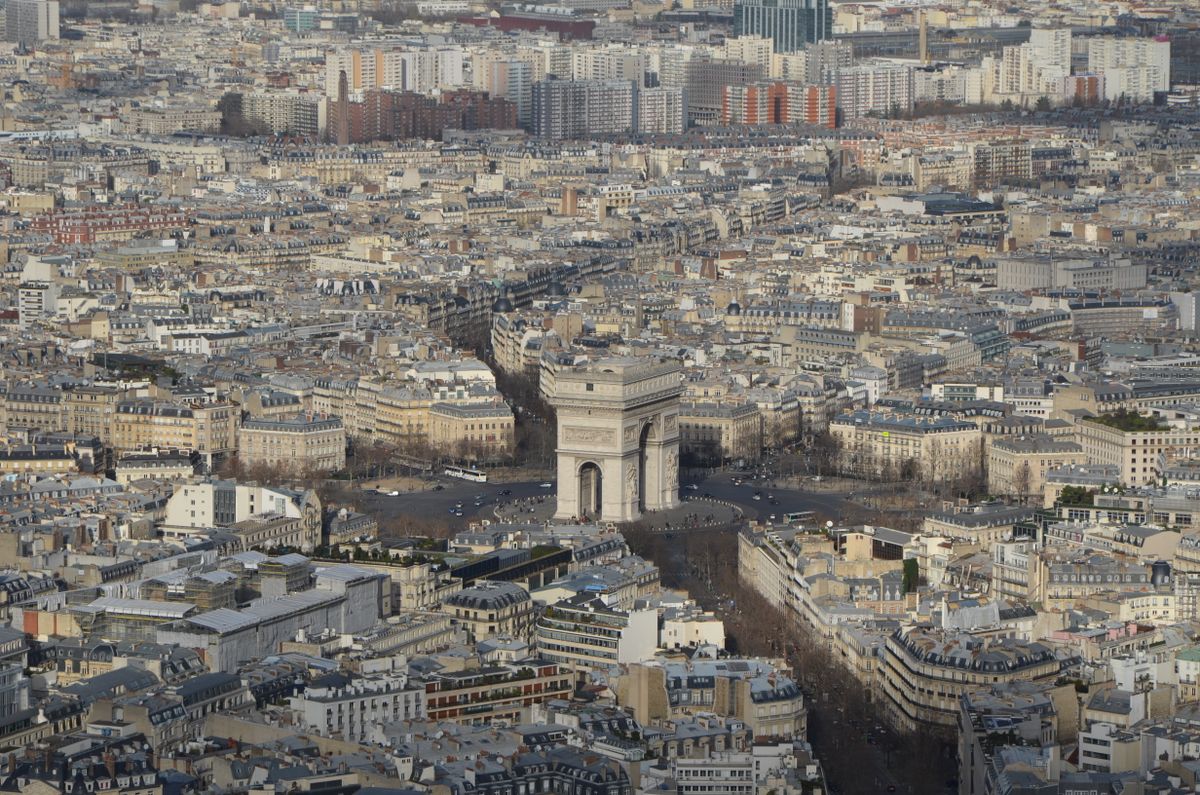
But the rooftop is why you’re here. The view from the top of the Arc de Triomphe is, by a comfortable margin, the best panoramic view in Paris. Not the Eiffel Tower (you can’t see the Eiffel Tower from the Eiffel Tower), not Montparnasse (too far from the action), not Sacré-Cœur (wrong angle). From the Arc’s rooftop, you look straight down the Champs-Élysées to the Place de la Concorde and the Louvre beyond. Turn around and the Grande Arche de la Défense frames the modern skyline. The Eiffel Tower rises to the southwest. And below you, the roundabout of the Place de l’Étoile swirls with traffic in a pattern that looks chaotic from above but somehow, impossibly, works.

I’ve compared the best ways to visit the Arc de Triomphe — from the standard rooftop ticket to combo packages with Seine cruises and hop-on hop-off buses. Here are the top picks, plus the remarkable stories that make this monument far more than just a rooftop viewpoint.
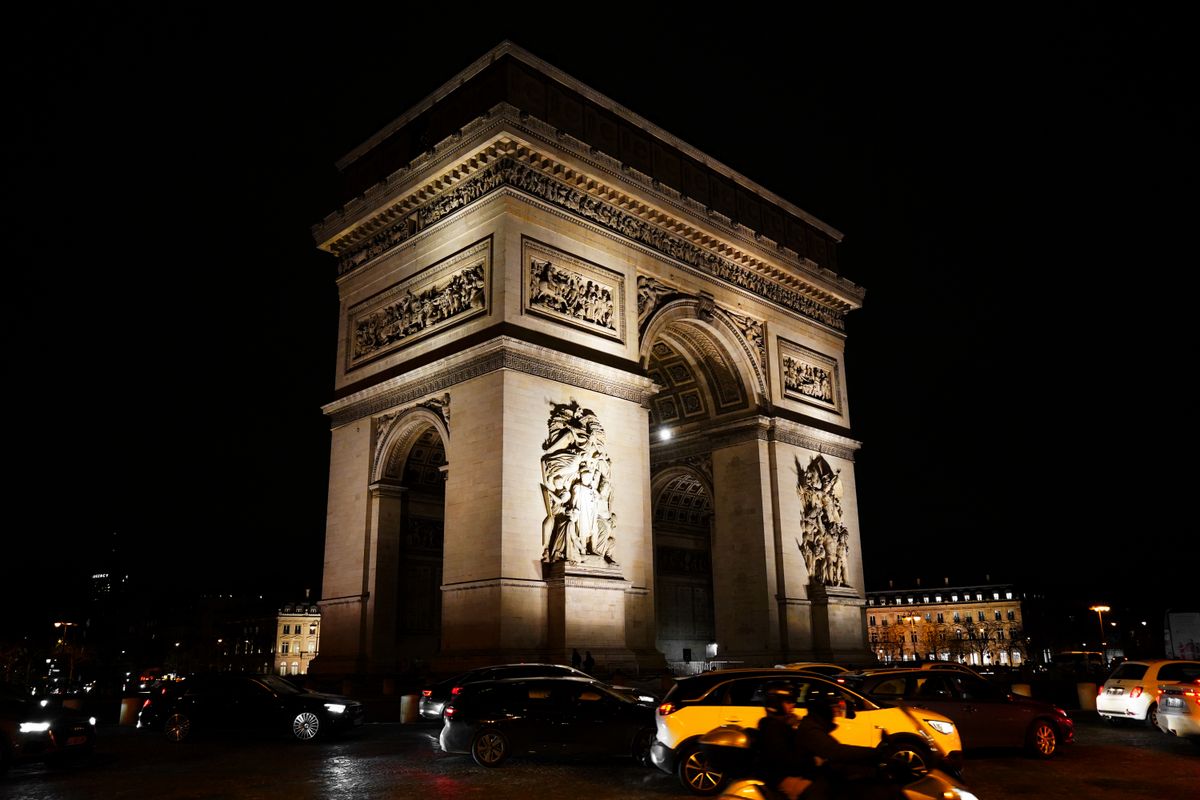
Short on time? Here’s what to book:
Standard ticket: Arc de Triomphe Rooftop Tickets — €18. Skip-the-line access to the rooftop via 284 steps. The best view in Paris for the price of a cocktail.
Best combo: Arc de Triomphe + Seine Cruise — €45. Rooftop access plus a Seine River cruise. Two of Paris’s best experiences in one ticket at a genuine saving.
Best full day: Arc de Triomphe + Hop-On Hop-Off Bus — €63. Rooftop access plus all-day bus pass. The most efficient way to combine the Arc with the rest of Paris.
- What to Know Before Visiting
- There are 284 steps and no lift
- Access the Arc through the underground tunnel
- Free on the first Sunday of every month (November to March)
- Sunset is the best time
- The Best Arc de Triomphe Tickets
- 1. Arc de Triomphe Rooftop Tickets — €18
- 2. Arc de Triomphe Entry with Seine Cruise — €45
- 3. Arc de Triomphe Priority Tickets with Optional Private Guide — €35
- 4. Arc de Triomphe + Big Bus Hop-On Hop-Off Tour — €63
- 5. Arc de Triomphe and Seine River Cruise — €45
- The Stories in the Stone
- The Man Who Flew Through It
- The Unknown Soldier: Chosen by Chance
- August 26, 1944: The Day Paris Was Free
- Visiting the Arc: Practical Details
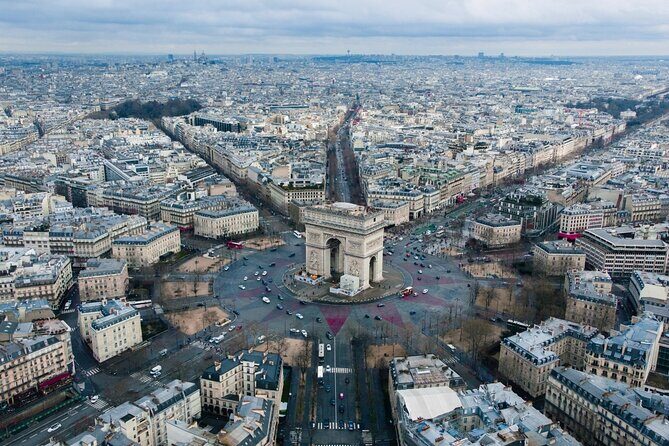
- The Twelve Avenues: What You See from the Top
- When to Visit
- Frequently Asked Questions
- Is the view better than the Eiffel Tower?
- Is there a lift?
- Can I see the Tomb of the Unknown Soldier without a rooftop ticket?
- How long do I need?
- Is it worth it with a Paris Museum Pass?
What to Know Before Visiting
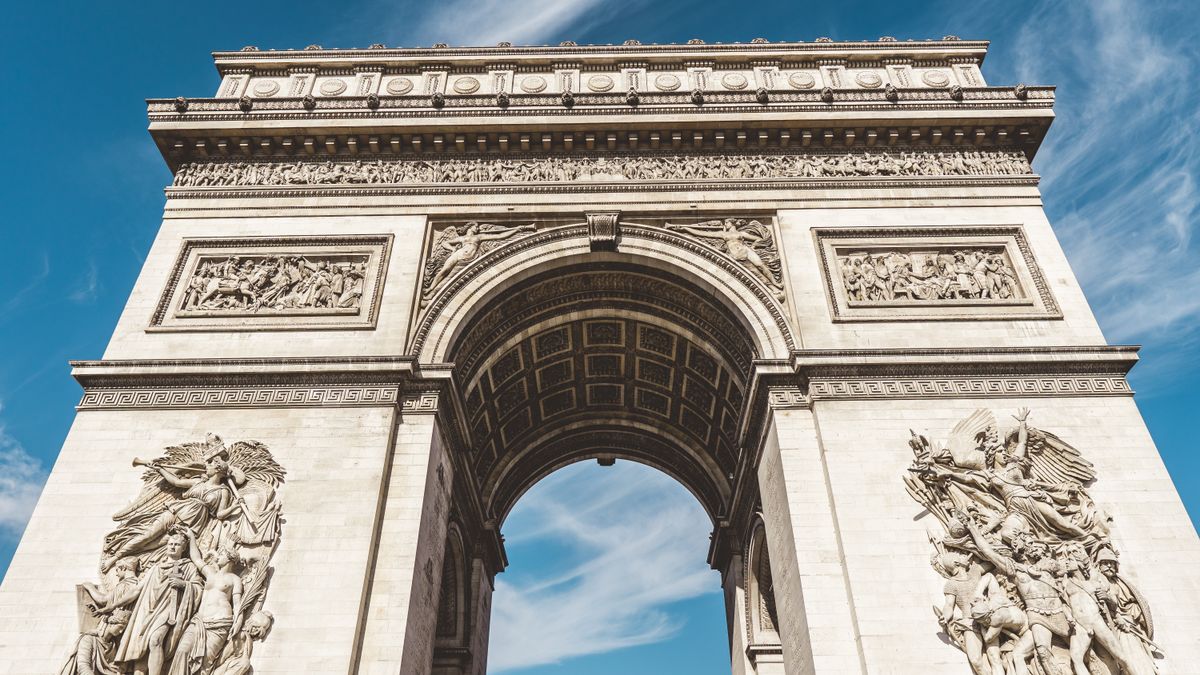
There are 284 steps and no lift
The only way to the rooftop is a tight spiral staircase inside the western pillar. 284 steps, no lift, no shortcuts. The staircase is narrow and can feel claustrophobic when crowded. If you have mobility issues, knee problems, or severe claustrophobia, this visit may not be for you. For everyone else, the climb takes about 10-15 minutes and the view justifies every step.
Access the Arc through the underground tunnel
Do not attempt to cross the roundabout on foot. The Place de l’Étoile has no pedestrian crossings — traffic circles continuously and does not stop. Access the Arc through the underground pedestrian tunnel that begins at the top of the Champs-Élysées (near the Metro exit). This is the only safe way to reach the monument.
Free on the first Sunday of every month (November to March)
The rooftop is free to enter on the first Sunday of each month from November through March. The queues on free days are longer, but the saving of €18 is significant if you’re on a budget. Under-18s and EU citizens under 26 enter free year-round.
Sunset is the best time
The view is spectacular at any time, but sunset transforms it. The golden light catches the Eiffel Tower, the Seine, and the limestone buildings along the Champs-Élysées. Arrive 30-60 minutes before sunset and stay until the city lights come on. The transition from daylight to illuminated Paris is one of those moments that makes you understand why people fall in love with this city.
The Best Arc de Triomphe Tickets
1. Arc de Triomphe Rooftop Tickets — €18
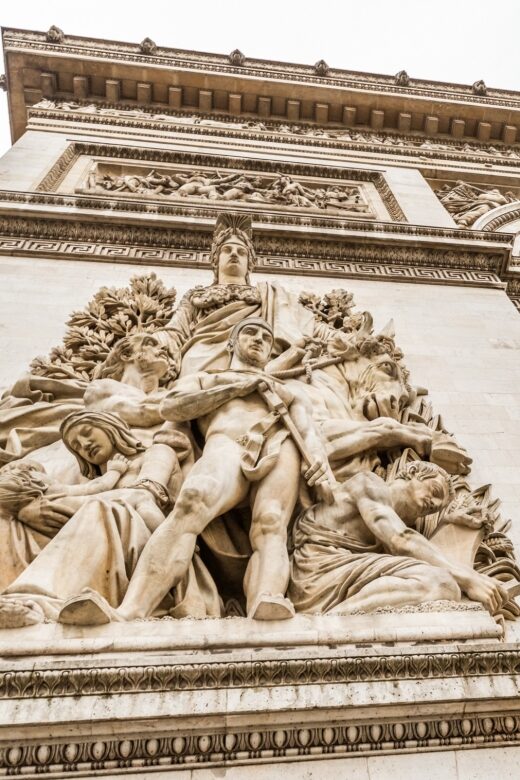
The standard ticket and all most visitors need. You get timed-entry access (which means shorter queues than walk-up), entry to the exhibition space inside the arch that tells the monument’s history, and rooftop access with the 360-degree panorama. The exhibition alone is worth 10 minutes — it covers the construction, the Unknown Soldier, and the monument’s role in French national identity with models, photographs, and artefacts.
At €18, this is one of the best deals in Paris. The Eiffel Tower summit costs €26-35. Montparnasse Tower is €22. The Arc gives you the best view of both those landmarks for less than either charges for entry. Book online for a timed slot — this avoids the walk-up queue that can stretch 30-45 minutes in summer.
What’s included: Rooftop access, exhibition space, timed entry
2. Arc de Triomphe Entry with Seine Cruise — €45
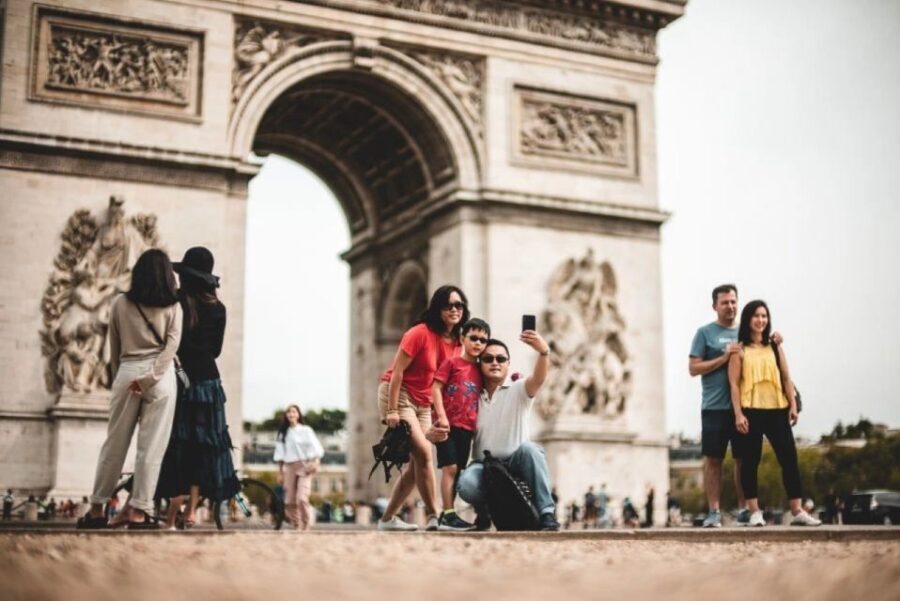
The smartest combo ticket in Paris. You get Arc de Triomphe rooftop access plus a one-hour Seine River cruise — the two experiences that, together, give you the most complete visual understanding of the city. The Arc shows you Paris from 50 metres above the Champs-Élysées. The cruise shows you Paris from water level, passing Notre-Dame, the Louvre, the Musée d’Orsay, and the Eiffel Tower.
At €45 for both, you’re saving compared to buying separately (rooftop €18 + cruise €20 = €38, but the combo includes a premium cruise route). The flexibility is good — use the Arc ticket on one day and the cruise on another if you prefer. For first-time visitors trying to fit Paris’s highlights into limited days, this combo is the efficient choice.
What’s included: Rooftop access, 1-hour Seine cruise, flexible scheduling
3. Arc de Triomphe Priority Tickets with Optional Private Guide — €35
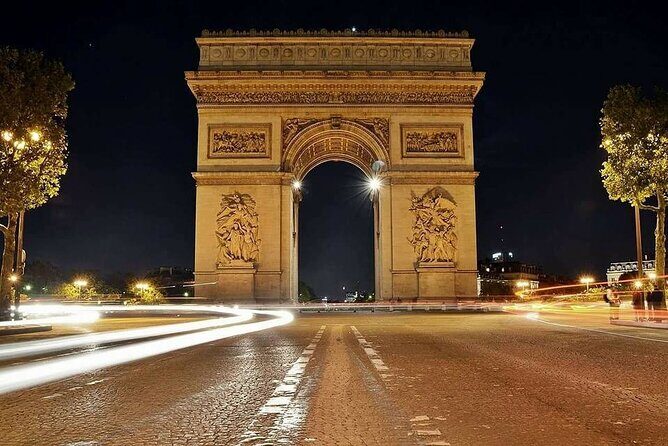
For visitors who want more than just the view. This ticket includes priority access (minimal waiting) plus the option to add a private guide who meets you at the base and explains the monument’s history, the sculptural reliefs, the inscriptions, and the stories behind the Unknown Soldier as you climb. The guide points out details you’d walk past without knowing — the bullet marks from the Liberation, the names of generals arranged by battle, the engineering that keeps the structure stable despite the vibrations from the traffic below.
At €35 for priority entry alone, or more with the guide, it’s double the standard ticket. The priority access is worth it during peak summer when walk-up queues exceed 30 minutes. The guide is worth it if you’re the kind of visitor who wants to understand what you’re looking at, not just photograph it.
What’s included: Priority entry, rooftop access, optional private guide
4. Arc de Triomphe + Big Bus Hop-On Hop-Off Tour — €63
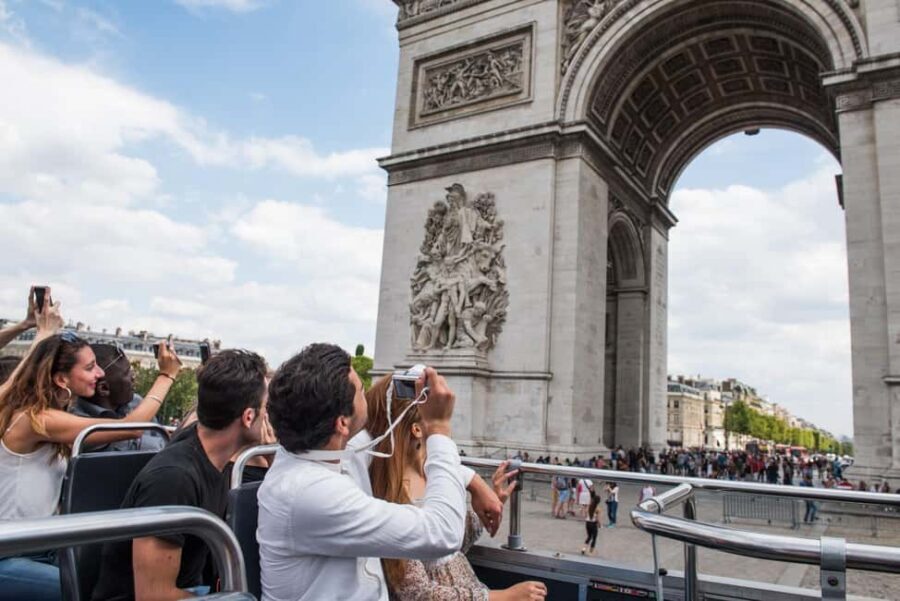
The full-day orientation package. The hop-on hop-off bus covers all of Paris’s major landmarks over a looping route, and the Arc de Triomphe rooftop access lets you see everything you’ve just driven past from 50 metres up. It’s an efficient first-day strategy: ride the bus to get your bearings, then climb the Arc to see the layout from above.
At €63, this is more than the standard ticket but includes a full day of bus transport that would cost €40+ alone. The bus route passes the Eiffel Tower, Notre-Dame, the Louvre, Sacré-Cœur, and the Marais — with audio commentary in multiple languages. For visitors with limited time who want to see everything, this combo covers more ground than any other single-day option.
What’s included: Rooftop access, all-day hop-on hop-off bus pass
5. Arc de Triomphe and Seine River Cruise — €45
The Viator-listed version of the Arc de Triomphe and Seine cruise combo. The experience is essentially identical to option #2 — rooftop access plus a one-hour sightseeing cruise. The main reason to consider this alongside the GYG combo is availability: on busy days when one platform shows sold out, the other may still have slots.
The cruise departs from near the Eiffel Tower and passes all the major riverside landmarks. Audio commentary is available in multiple languages. The flexibility to use the two elements on different days makes scheduling easy — do the Arc at sunset and the cruise on a different morning if you prefer.
What’s included: Rooftop access, 1-hour Seine cruise
The Stories in the Stone

Napoleon ordered the Arc de Triomphe built on December 2, 1806 — exactly one year after his victory at Austerlitz, the battle he considered his masterpiece. He chose the architect Jean-François Chalgrin, who designed a monument modelled on the ancient Roman Arch of Titus but scaled up to dimensions that would make it the largest triumphal arch in the world.
The problem was that Napoleon’s empire didn’t last as long as Roman ones. Construction was barely underway when the architect died in 1811. Napoleon abdicated in 1814 and died in exile on St. Helena in 1821. The restored Bourbon monarchy briefly considered demolishing the half-built arch, then decided to repurpose it. The monument was eventually completed in 1836 under King Louis-Philippe — thirty years after Napoleon commissioned it, dedicated not just to Napoleon’s victories but to all French armies.
Napoleon got his moment at the arch posthumously. In 1840, his remains were returned from St. Helena and paraded under the Arc de Triomphe on a freezing December day before being laid to rest at Les Invalides. The man who ordered the monument built finally passed through it — in a coffin, nineteen years after his death.

The Man Who Flew Through It
On August 7, 1919, three weeks after the Bastille Day victory parade marking the end of World War I, a French pilot named Charles Godefroy flew a biplane through the Arc de Triomphe. The gap between the pillars is about 14.5 metres wide and 29 metres high. Godefroy’s Nieuport fighter had a wingspan of about 8 metres. He did it to honour the French aviators who died in the war — a gesture that was never officially sanctioned, technically illegal, and instantly legendary. He wasn’t punished. The flight was filmed, and the footage still exists. It remains one of the most audacious aerial stunts in history, and Godefroy did it purely as a tribute to his dead friends.
The Unknown Soldier: Chosen by Chance

On November 11, 1920, the body of an unidentified French soldier was buried beneath the Arc de Triomphe. The selection process was deliberately random: eight coffins containing the remains of unidentified soldiers from eight different battlefields of World War I were brought to the Citadel of Verdun. A 21-year-old private named Auguste Thin — chosen because he was the youngest soldier present — was asked to place a bouquet on one of the coffins. The coffin he chose became the Unknown Soldier.
The eternal flame was added in 1923 and has been re-lit every evening at 6:30 PM since — a ceremony performed by veterans’ associations that rotates between different groups. The flame was not extinguished during the German occupation of Paris (1940-1944). German officers in Paris during the occupation reportedly saluted the flame when passing. The tradition of the daily re-lighting has never been broken in over a century.
August 26, 1944: The Day Paris Was Free

The day after the German garrison surrendered Paris on August 25, 1944, Charles de Gaulle led a victory procession from the Arc de Triomphe down the Champs-Élysées to Notre-Dame. The streets were lined with hundreds of thousands of Parisians who had lived under four years of occupation. Snipers — possibly Vichy collaborators, possibly remaining German soldiers — opened fire from rooftops during the procession. De Gaulle continued walking. The footage of that walk — straight-backed, unflinching, with bullets cracking overhead — became one of the defining images of the Liberation.
When you stand at the top of the Arc today and look down the Champs-Élysées, you’re looking at the exact route de Gaulle walked. The avenue hasn’t changed. The perspective hasn’t changed. The only thing that’s changed is what marches down it — instead of troops, it’s travelers, and instead of gunfire, it’s the sound of traffic.

Visiting the Arc: Practical Details
Getting there: Metro Line 1, 2, or 6 to Charles de Gaulle-Étoile. Exit toward the Champs-Élysées and look for the underground tunnel entrance on the right side of the avenue. RER A also stops here.
Opening hours: Daily 10 AM – 11 PM (April to September), 10 AM – 10:30 PM (October to March). Last entry 45 minutes before closing. Closed January 1, May 1, May 8 (morning), July 14 (morning), November 11 (morning), December 25.
The climb: 284 steps in a tight spiral staircase. There is an exhibition space at the intermediate level (about halfway up) where you can rest and learn about the monument’s history. The staircase narrows near the top. Claustrophobic visitors should be aware of the enclosed, spiral nature of the climb.
Time needed: Allow 45 minutes to an hour total — 15 minutes climbing up, 20-30 minutes on the rooftop (you’ll want to circle it multiple times as the light changes), 5 minutes in the exhibition, 10 minutes descending.

The Twelve Avenues: What You See from the Top
Southeast — the Champs-Élysées: The avenue runs perfectly straight to the Place de la Concorde (where the guillotine stood during the Revolution) and beyond to the Tuileries and the Louvre. This is the most famous view from the rooftop — the axis that defines central Paris.
Southwest — the Eiffel Tower: Visible over the rooftops of the 16th arrondissement. At sunset, the tower catches the golden light and glows against the sky. When the hourly sparkle begins after dark, the view from the Arc is better than the view from any other monument.
Northwest — La Défense: The Grande Arche de la Défense (completed 1989) frames the modern business district. It’s positioned on the same axis as the Arc de Triomphe and the Louvre, creating a historical line that stretches from the medieval palace to the 20th-century skyscrapers — 800 years of Paris in a single sightline.
North — Sacré-Cœur: The white basilica on Montmartre hill is visible on clear days, gleaming above the rooftops. The contrast between the limestone of the Arc and the white travertine of Sacré-Cœur frames the two sides of Paris — imperial grandeur and bohemian hilltop.

When to Visit

Best time of day: Sunset, without question. Arrive 30-60 minutes before the sun goes down. The light on the Champs-Élysées turns golden, the Eiffel Tower catches the last rays, and then the city lights come on. The transition is magical. Nighttime visits (the Arc is open until 11 PM in summer) give you illuminated Paris — the Eiffel Tower sparkle, the lit boulevards, the car headlights streaming below.
Best months: April through October for warm evenings and late sunsets. June has the longest days — the sun doesn’t set until nearly 10 PM, giving you an extended golden hour from the rooftop.
Peak crowds: July and August, especially midday. Late afternoon and evening visits are less crowded. The first-Sunday-free months (November-March) draw big crowds on those specific days but are otherwise quieter than summer.
Special dates: July 14 (Bastille Day) sees a military parade pass under the Arc — spectacular but the rooftop may close for parts of the morning. November 11 (Armistice Day) features a ceremony at the Tomb of the Unknown Soldier. December 31 brings massive New Year’s Eve crowds to the Champs-Élysées — the Arc is the focal point of the celebrations.

Frequently Asked Questions
Is the view better than the Eiffel Tower?
Different, not better. The Eiffel Tower is higher (276 metres to the summit vs 50 metres) but you can’t see the Eiffel Tower from the Eiffel Tower. The Arc de Triomphe gives you the Eiffel Tower in your panorama, plus the straight-line view down the Champs-Élysées that is arguably the most iconic urban view in the world. For photography, the Arc wins. For altitude and wow factor, the Eiffel Tower wins.
Is there a lift?
No. The only access is 284 steps in a spiral staircase. There is no alternative for mobility-impaired visitors, unfortunately. The staircase is the original 19th-century design and cannot be retrofitted with a lift without structural changes to the monument.
Can I see the Tomb of the Unknown Soldier without a rooftop ticket?
Yes. The Tomb and the eternal flame are beneath the arch at ground level and are free to visit. You can walk through the underground tunnel to the base of the Arc and view the Tomb without buying a rooftop ticket. The daily flame ceremony at 6:30 PM is also free to watch.
How long do I need?
45 minutes to an hour. The climb takes 15 minutes, the rooftop deserves 20-30 minutes, and the exhibition space is worth a quick look. If you’re there for sunset, budget 90 minutes to enjoy the changing light.
Is it worth it with a Paris Museum Pass?
The Arc de Triomphe is included in the Paris Museum Pass (€62 for 2 days). If you’re visiting 3+ museums in two days, the pass saves money. If the Arc is your only museum visit, buy the standalone €18 ticket. For a full breakdown of whether the pass is worth it, see our Paris Museum Pass guide.
The Arc de Triomphe is one anchor of the Paris experience. Down the Champs-Élysées, the Louvre Museum holds 35,000 works of art behind a glass pyramid. Across the river, the Musée d’Orsay has the world’s greatest collection of Impressionist paintings in a converted railway station. And the monument that competes with the Arc for the title of best view in Paris — the Eiffel Tower — is a 20-minute walk across the Seine, offering its own entirely different perspective on the city. For a deeper exploration of the city’s best-kept culinary secrets, a Paris food tour takes you through the neighbourhoods that no rooftop panorama can reveal.