
Joseph Haydn walked into this first-floor drawing room in 1785, listened to six string quartets played by Mozart and three friends, and turned to Leopold Mozart afterwards with the line every Mozart biography quotes: “your son is the greatest composer known to me either in person or by reputation.” The room is still here — behind St. Stephen’s Cathedral, four floors up at Domgasse 5, the only one of Mozart’s eleven Vienna apartments that survived. €18 puts you in it.
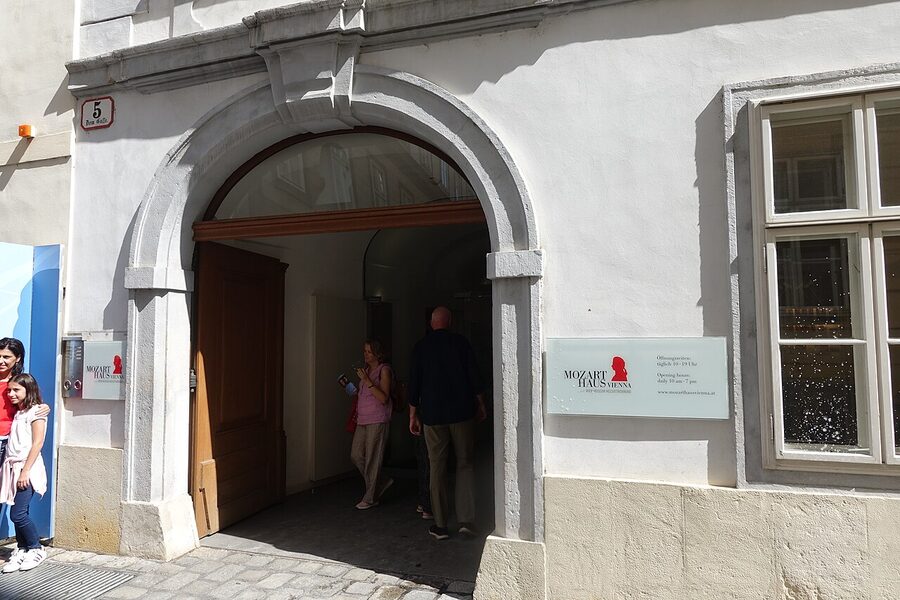

The building is now a museum — four floors covering Mozart’s life, his Vienna, and the specific period he spent at this address. Standard admission is €13.50 adult, €4 for children 6-18. A visit takes 60-90 minutes. This guide covers what you’ll actually see, whether it’s worth it compared to Salzburg’s Mozart sites, and how to pair it with Vienna’s other Mozart venues.
In a Hurry? The Three Mozarthaus Options
- Best overall: Mozarthaus Vienna with Audio Guide — $18, 60-90 min, 2,344+ reviews. Standard museum entry.
- Best immersive: Mythos Mozart Experience — $27, 60 min, multimedia journey through Mozart’s life. Nearby, not the same building.
- Best for concert fans: Concert at Mozart’s First House — $67, 90 min live chamber music. Different Mozart residence (Kurrentgasse).
- In a Hurry? The Three Mozarthaus Options
- Which Ticket to Book
- 1. Vienna: Tickets for Mozarthaus Vienna with Audio Guide — from
- 2. Vienna: Mythos Mozart Experience — from
- 3. Vienna: Classical Concert at Mozart’s First House — from
- What the Mozarthaus Museum Actually Is — Floor by Floor
- What Mozart Did Here — 1784 to 1787
- Is It Worth Visiting If You’re Going to Salzburg?
- Why This Apartment and Not the Others
- When to Go
- Mozart’s 11 Vienna Addresses — A Short Walking Tour
- Getting There
- Combining with Other Vienna Sites
- Practical Details
- Common Mistakes
- The Short Version
- What Happens at a Mozarthaus Sommerkonzerte Performance
Which Ticket to Book
1. Vienna: Tickets for Mozarthaus Vienna with Audio Guide — from $18
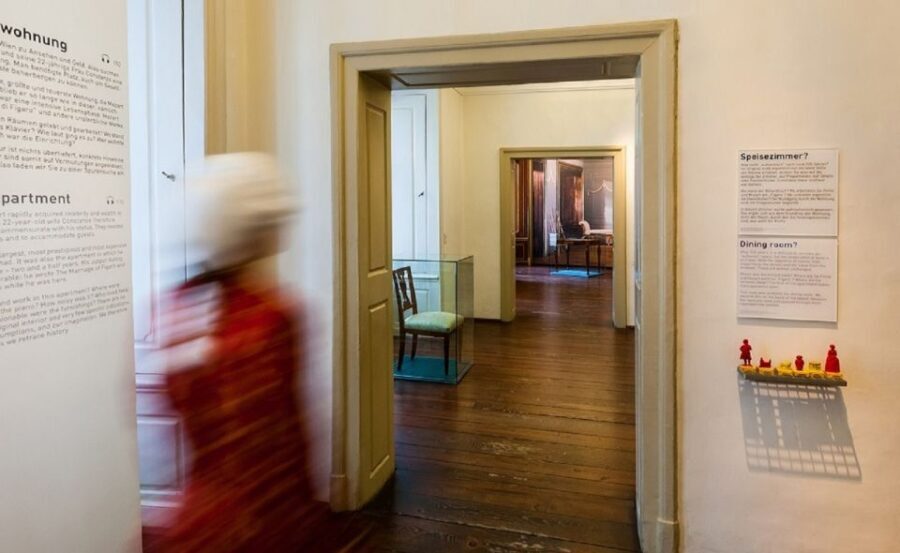
The default Mozarthaus ticket. €13.50 gets you all 4 floors with audio guide (in 10+ languages). You’ll spend 15-20 minutes on the Mozart apartment floor (the only original preserved spaces), 20-30 minutes on the life-and-music floor, and the rest in the Vienna-era context floors. Skip-the-line — you don’t need the skip, the queue is never that long. Our full review has the floor-by-floor guide.
2. Vienna: Mythos Mozart Experience — from $27
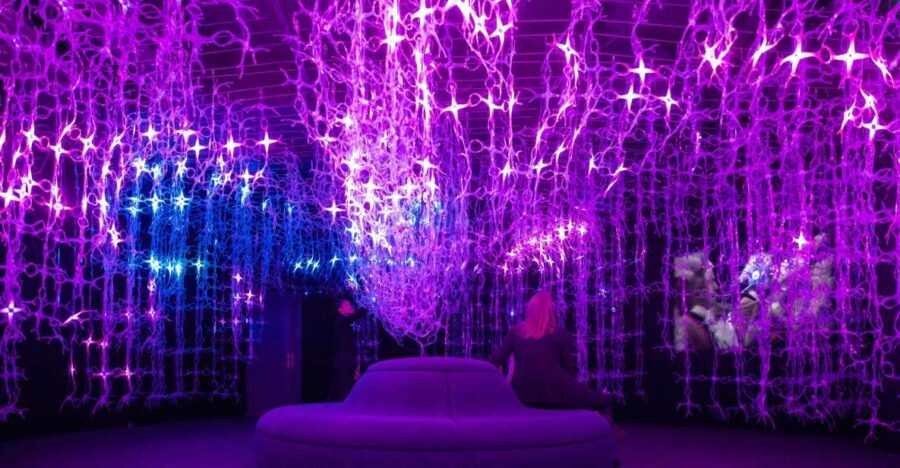
The immersive experience, not a house museum. 60 minutes of projected visuals, synchronised Mozart music, and guided narrative through key moments in his life. At Lobkowitzplatz (different address from the Mozarthaus). Works best for visitors who find historical museums dry or for families with kids 10+. Doesn’t replace the Mozarthaus visit — it’s a separate product offering a different kind of engagement with the same story.
3. Vienna: Classical Concert at Mozart’s First House — from $67
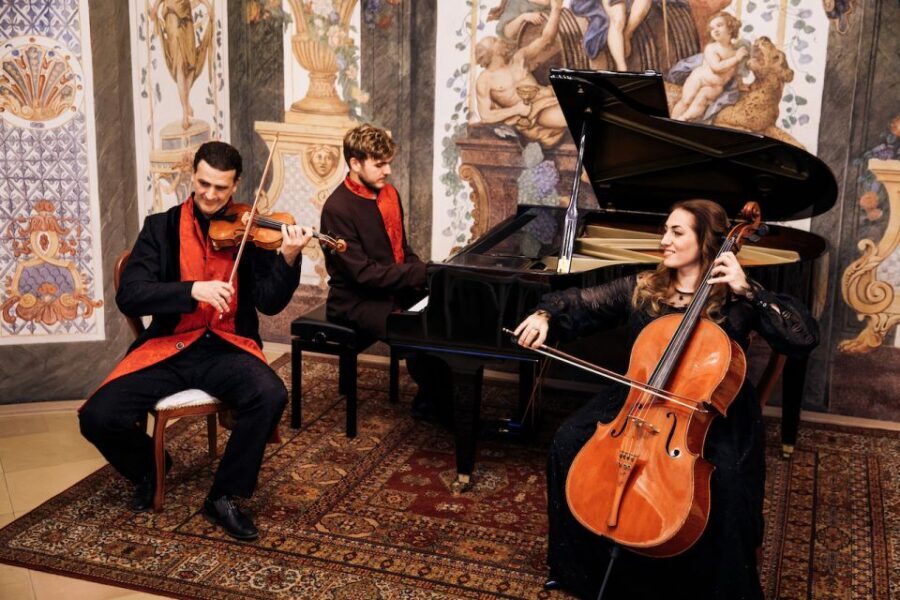
The concert option — confusingly named because it’s not at the Mozarthaus museum. This is a different Mozart address (Kurrentgasse 12), the apartment he shared with Constanze in his first months in Vienna (1781-1782). The space has been restored and now hosts a nightly 90-minute Mozart chamber concert for about 40 people. The historic setting is genuine; the music is good. Best for visitors who want a Mozart-site concert rather than the tourist-circuit Mirabell concerts in Salzburg.
What the Mozarthaus Museum Actually Is — Floor by Floor
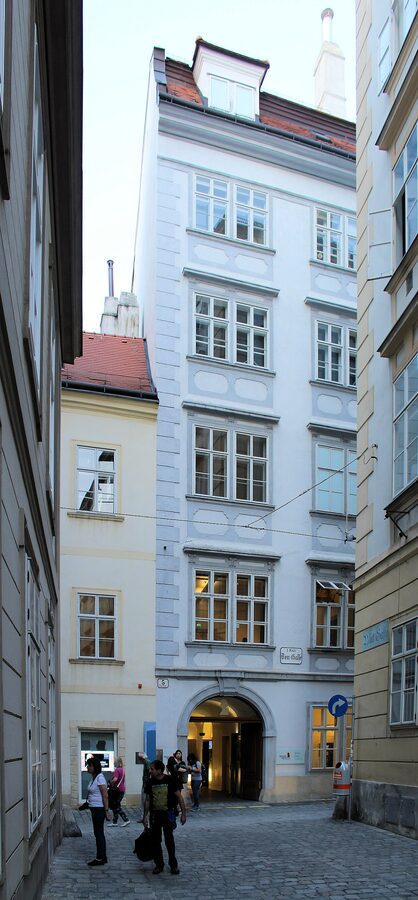

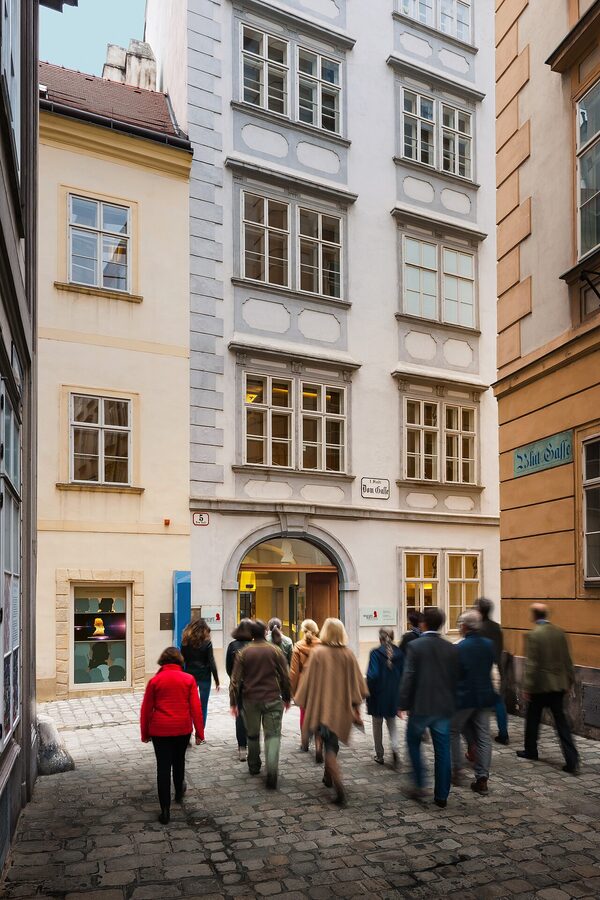
The museum spans four floors of a 17th-century townhouse. The first floor is the historic apartment; the other three are modern exhibition spaces.
Ground floor / lobby: ticket office, museum shop, coatroom, audio guide pickup. Photo opportunity with the Mozart bust in the entrance.
First floor — Mozart Apartment (the historic rooms). The actual four-room apartment Mozart rented. The rooms are small by modern standards — about 145 m² total — but for Vienna in 1784 this was a substantial middle-class residence. The layout is original (kitchen, dining room, study, bedroom, a small servant’s room). Furniture is period-appropriate but not Mozart’s own (none survives). The one object that’s indisputably connected to Mozart is a pianoforte he is likely to have played. The atmosphere is the point: you’re standing in the room where Figaro was composed.
Second floor — Mozart’s Music. Exhibits on Mozart’s compositional output during his Vienna years. Original manuscripts (facsimiles; the originals are in the Austrian National Library), opera costumes from Figaro and Don Giovanni productions, and audio stations where you can hear the music being played. 20-30 minutes well spent.
Third floor — Mozart’s Vienna. Context floor. 1780s Vienna — political, social, musical. Emperor Joseph II’s reforms, the Enlightenment debates, the coffeehouse culture Mozart frequented. Interesting if you haven’t studied the period; skippable if you have.
Top floor — temporary exhibitions. Rotating shows on Mozart-adjacent topics (current show varies — recent ones have been on Salieri, Haydn, the Magic Flute’s masonic symbolism). 15-20 minutes.

What Mozart Did Here — 1784 to 1787
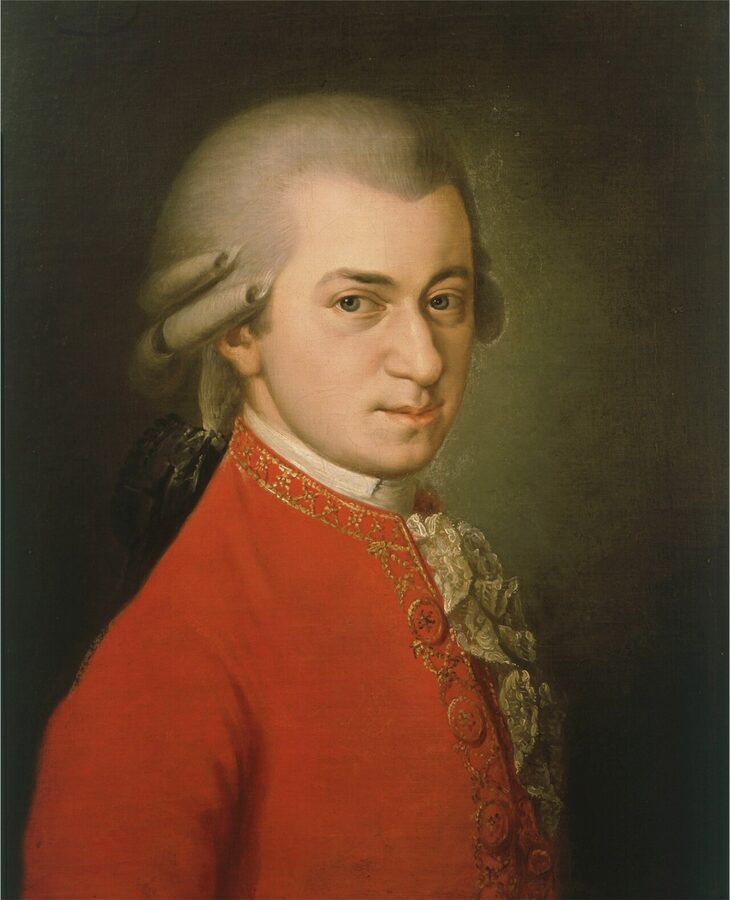

Mozart moved into Domgasse 5 in September 1784, at age 28. He’d been in Vienna since 1781 — after the famous kicked-down-the-stairs departure from the Salzburg court — and was finally earning enough to afford a proper apartment in the inner city. The 460 florins annual rent was his biggest-ever commitment to a single address.
Major works composed here:
– The Marriage of Figaro (1785-86) — premiered in Vienna May 1786
– Six “Haydn” string quartets (Op. 10)
– Piano concertos K.488, K.491, K.503
– Symphony No. 38 (“Prague”)
– Much of Don Giovanni (completed in Prague but started here)
Joseph Haydn visited here in 1785 to hear the string quartets Mozart had dedicated to him. The recorded exchange — Haydn telling Mozart’s father Leopold that “your son is the greatest composer known to me either in person or by name” — happened in this apartment.
Mozart hosted chamber music evenings several times a week. The drawing room would hold 15-20 guests for string quartet performances. Constanze played keyboard; Wolfgang played viola (his preferred instrument for chamber work, despite his piano virtuosity).
Money: at the peak of his Vienna success. He earned roughly 3,000-4,000 florins per year here (through teaching, commissions, and concerts) — equivalent to a senior court official’s salary. He also spent it fast: he and Constanze employed two servants, kept a horse, and threw parties.
Why he moved out: in April 1787 Mozart left Domgasse for a cheaper apartment on the Landstraße. Historians debate why — financial strain after a run of underperforming concerts, or a desire for less hectic social demands. Either way, his luck turned almost immediately. The Vienna musical elite began losing interest; his concerts drew fewer subscribers; his income collapsed by 1789. By the time he died in December 1791, he was deep in debt and living in a cheap suburb.
Is It Worth Visiting If You’re Going to Salzburg?

Most visitors do one or the other, not both. A short comparison:
Salzburg’s Mozart Birthplace (Mozarts Geburtshaus): childhood home, where he lived 0-17. Tourist-central Getreidegasse location. More crowded. More toys, childhood violins, child-prodigy-era letters. €13, 60-90 minutes. Our Salzburg Mozart concert guide has context on the Salzburg sites.
Salzburg’s Mozart Residence (Mozart-Wohnhaus): family home 1773-1787, where Mozart lived 18-25. Quieter than the Birthplace. Better exhibits on his father Leopold and sister Nannerl. €13.
Vienna’s Mozarthaus: adult residence 1784-87, where he composed his mature masterpieces. Less crowded than the Salzburg sites. Focus on the Figaro/quartets period — his professional peak.
Verdict: if you’re a serious Mozart fan, visit all three. If you have to pick one, the choice depends on what you’re drawn to — Salzburg’s Birthplace is better for the “child prodigy” story, Vienna’s Mozarthaus is better for the “mature composer” story. Both are worth 60-90 minutes.
The Mozarthaus Vienna is also less crowded and better-organised than the Salzburg Birthplace. If you’re making Vienna a main destination anyway, the Mozarthaus is one of the city’s easy-to-hit Habsburg/Enlightenment-era sites.
Why This Apartment and Not the Others
Historians sometimes describe Mozart’s Vienna apartments in terms of class markers. Domgasse 5 was the only apartment he rented at “court composer” rates — the kind of address a Habsburg middle-class family would have taken. The earlier Graben and Kurrentgasse flats were smaller; the later Landstraße and Rauhensteingasse apartments were visibly downmarket.
What made Domgasse the apex wasn’t luxury but proximity. From his front door, Mozart could walk to St. Stephen’s Cathedral in 2 minutes, the Hofburg Imperial Palace in 8, the Burgtheater (where Figaro premiered) in 10, the coffee houses on the Graben in 5. This was the geographic centre of Vienna’s musical and political life in 1785 — and he paid 460 florins a year for the location.
The apartment also mattered professionally because of the private concerts it hosted. In 1780s Vienna, elite chamber music happened in private salons rather than public halls. Mozart’s Domgasse drawing room held three to four subscription concert series between 1784-87 — the string quartet premieres, piano concerto run-throughs, and opera preview sessions that kept him financially afloat. The floor plans preserved in the museum show the drawing room’s exact dimensions; historians have used them to calculate the acoustics and estimate audience sizes.
After Mozart moved out in 1787, his luck turned almost immediately. Apartments got cheaper. Subscribers dropped out. He stopped giving private concerts at scale. The Domgasse years were the only period when he consistently earned more than he spent — and the fact that one of those rooms is still walkable today, with the period furniture restored and the ceiling exactly as he would have seen it, is the specific value proposition of the museum.
When to Go
Best time of day: mid-morning (11am-12pm). The museum opens at 10am; it rarely gets crowded except at weekends.
Best day of week: Tuesday-Thursday. Weekends see classical-music tour groups in the morning.
Best season: October-March. The museum has no outdoor component, so weather doesn’t affect the visit — go in the off-season when Vienna is cheaper and less crowded generally.
During Mozartwoche (late January): Mozart’s birthday week. The museum hosts special exhibits and occasional live performances. Tickets slightly more expensive but the atmosphere is richer.
Avoid: Sunday afternoons in summer, when multiple tour operators bring groups.
Mozart’s 11 Vienna Addresses — A Short Walking Tour
Mozart moved 11 times during his 10 years in Vienna. Only the Domgasse apartment survives as a museum, but several of the other addresses are still standing and marked with plaques. If you’re a serious fan, the Mozart Vienna walking circuit covers the key ones:
Graben 17 (“To the Eye of God”): Mozart’s first Vienna apartment (1781). He lodged with the Weber family here — future father-in-law Fridolin Weber had recently died, and Mozart moved in with Constanze’s mother. The building is still there; plaque on the facade. 5 minutes’ walk from the Mozarthaus.
Kurrentgasse 12: Mozart and Constanze’s first married apartment (1782). Now the concert venue “Mozart’s First House” (see the concert option above). Still a residential building on the upper floors.
Wipplingerstrasse 19: 1783 address. Mozart wrote several piano sonatas here. Plaque on the facade.
Domgasse 5 (the museum): 1784-87. The productive peak years.
Landstraßer Hauptstraße 75-77: 1787-88. After the Domgasse luxury, a cheaper suburban apartment. Building was demolished; plaque on the replacement.
Währinger Strasse 26: 1789. Another cheap lodging. Still standing.
Rauhensteingasse 8: 1790-91. Mozart died here on 5 December 1791, aged 35, working on the Requiem. The original building was demolished in 1847; a department store (Steffl) now occupies the site. Plaque at the entrance.
St. Marx Cemetery grave: not an apartment, but the final address. Mozart’s body was buried in a communal grave at St. Marx Cemetery (3 km southeast of central Vienna). The exact location was lost within years of his burial; a memorial stone marks the approximate spot. The cemetery is a 10-minute U3 ride from Stephansplatz and genuinely atmospheric — the Mozart grave sits in a neglected 18th-century graveyard, surrounded by the ordinary dead of his era.
A full Mozart-in-Vienna walking tour covering these 8 sites takes 3-4 hours. The Mozarthaus museum plus Stephansdom plus St. Marx grave is a tight half-day that covers the essentials.
Getting There
The Mozarthaus is at Domgasse 5, in the inner city directly behind St. Stephen’s Cathedral.
U-Bahn: U1 or U3 to Stephansplatz. Exit “Stephansplatz” — the Mozarthaus is 200 metres east of the cathedral, signposted.
On foot from Graben/Kohlmarkt: 5 minutes.
On foot from the Hofburg: 10 minutes.
Tram: no direct stops in the inner city (it’s a pedestrian zone). Tram 1 or 2 to Schwedenplatz and walk 10 minutes.
Address to enter in Google Maps: “Mozarthaus Vienna, Domgasse 5, 1010 Wien.”
Combining with Other Vienna Sites
The Mozarthaus is a 60-90 minute stop. It pairs naturally with:
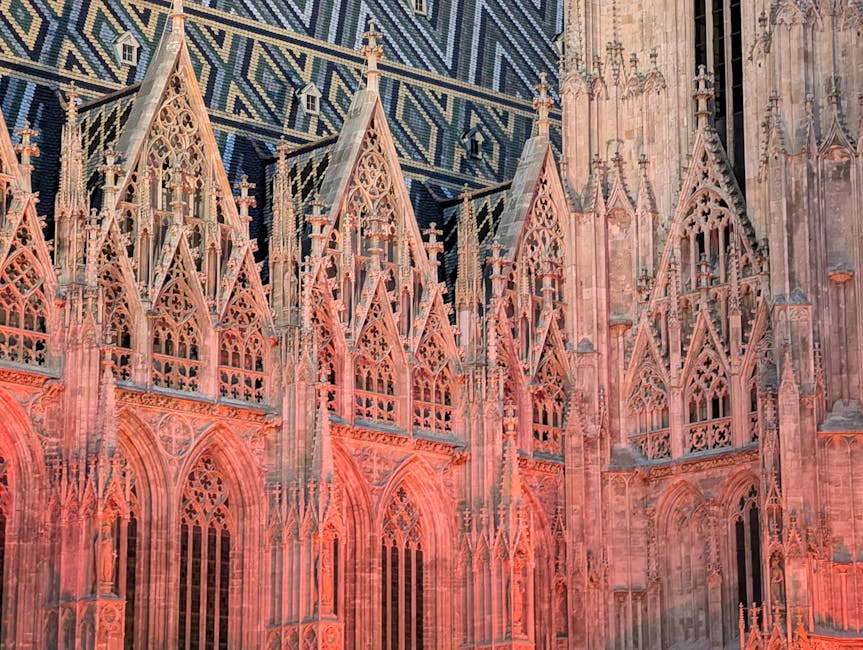
St. Stephen’s Cathedral (Stephansdom): 2 minutes on foot. Free entry to the nave, €6 for the tower climb. Mozart was married here in 1782. 30-45 minutes.
Hofburg Palace / Imperial Treasury: 10 minutes on foot. Our Hofburg guide has the ticket details. Full half-day.
Kunsthistorisches Museum: 15 minutes on foot. Our KHM guide. 3-4 hours.
Haus der Musik: 10 minutes on foot. Sound-focused interactive museum including a Vienna Philharmonic room. Good companion to the Mozarthaus.
Albertina: 8 minutes on foot. Art museum with Dürer and Klimt highlights. Half-day.
Evening Vienna classical concert: Mozarthaus 11am-12:30pm, lunch, Hofburg afternoon, evening concert — a full one-day itinerary.
Practical Details
Hours: daily 10am-6pm. Open most public holidays.
Admission: €13.50 adult, €4 child 6-18. Annual Vienna residents’ discount available.
Audio guide: included in the ticket. 10+ languages. Roughly 60 minutes of commentary.
Photography: allowed in most rooms. No flash in the original apartment.
Wheelchair access: partial. Ground floor and first floor accessible; upper floors via lift. Wheelchair loan available.
Gift shop: small but good. Mozart score reproductions, recordings, themed items.
Café: no on-site café. Café Korb and Café Hawelka are 3-5 minutes on foot.
Vienna Pass / City Card: Vienna PASS includes free entry. Vienna City Card offers 10% discount.
Common Mistakes
Expecting an original-artefact museum. Only the apartment rooms and architecture are original. Furniture, instruments, and decorations are period-appropriate reproductions.
Confusing it with the “Mythos Mozart” experience. Different venue (Lobkowitzplatz), different product. If you want the historical apartment, book the Mozarthaus specifically.
Confusing it with the “Mozart’s First House” concert venue. Different building (Kurrentgasse). Both are genuine Mozart addresses but the museum and the concert venue are separate products.
Skipping the audio guide. The exhibits don’t have strong signage — the audio guide is where the story lives. Use it.
Rushing the apartment floor. The original rooms are the point. Spend 15+ minutes there, not 5.
Expecting Salzburg-level crowds. It’s quieter. Often you’ll have the apartment rooms to yourself for minutes at a time.
The Short Version
Book the €18 Mozarthaus Vienna with Audio Guide. Arrive mid-morning, spend 15-20 minutes in the original apartment, 30-40 minutes on the upper exhibit floors. 60-90 minutes total. Pair with St. Stephen’s Cathedral (2 minutes away) for a half-day of Mozart-era Vienna.
If you’re doing Salzburg as well, visit both — they tell different halves of the same story. If you have to pick one, the Mozarthaus Vienna is quieter, better-organised, and covers Mozart’s mature professional peak. The Salzburg Birthplace is better for the child prodigy years.
What Happens at a Mozarthaus Sommerkonzerte Performance
During summer (late June-early September), Mozarthaus Vienna hosts the Sommerkonzerte series — chamber music performances inside the apartment itself, in the actual rooms Mozart composed in. Tickets are €35-55, audience capped at 40 people, programme rotates weekly. Not always available through GetYourGuide; book direct via mozarthausvienna.at.
The setting is the central draw: you’re sitting in the drawing room where Mozart rehearsed the “Haydn” quartets with Joseph Haydn. Sound is intimate. The musicians are Mozarteum graduates. Programme typically includes one quartet, one piano trio, and one solo piano work — mostly Mozart, occasionally with a Haydn or Schubert companion piece.
When not to book this: if you don’t like small, silent, formal concert settings. The room doesn’t allow for much casual engagement; you sit, listen, applaud, leave.
When to book: if you’re a serious fan who wants the single most historically grounded Mozart experience available anywhere. The Mirabell and Fortress concerts in Salzburg are well-played but set in venues Mozart barely used. The Sommerkonzerte are set in the room he actually worked in.
Affiliate disclosure: Some links in this article are affiliate links. If you book through them we may earn a small commission at no cost to you. All recommendations are based on my own visit.