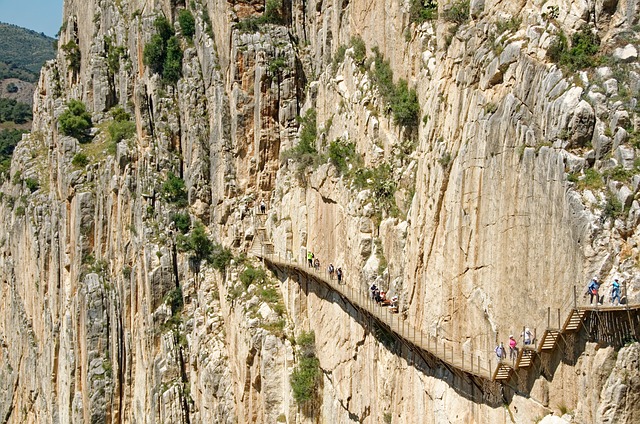
People died on the old Caminito del Rey. Not a figure of speech — the original concrete walkway, built in 1905 for hydroelectric workers, deteriorated so badly over the decades that sections simply fell away. Thrill-seekers kept climbing it anyway, and after several fatal accidents the Spanish government sealed it off entirely in 2000. It sat there for 15 years, a crumbling ghost of a path bolted to 100-meter cliffs, until Andalusia spent 5.5 million euros rebuilding the whole thing. The new walkway opened in 2015, and it has been one of Spain’s most popular outdoor attractions ever since.
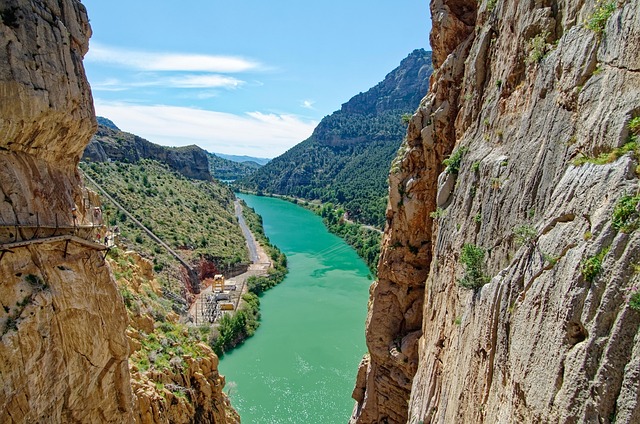
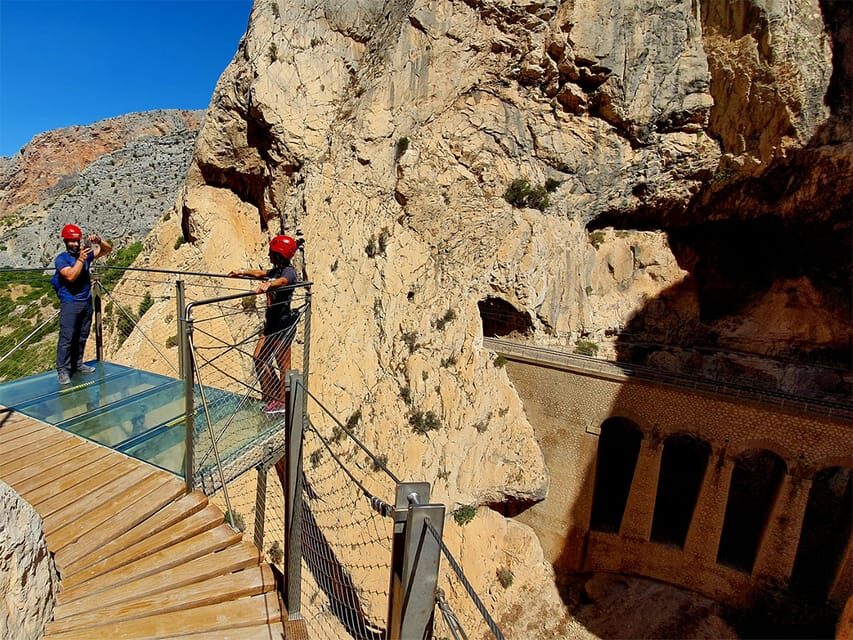
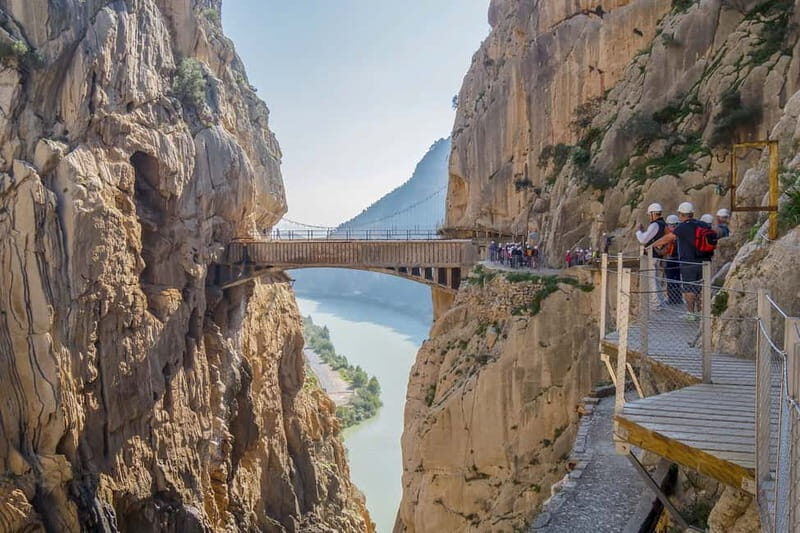
The name means “The King’s Little Path” — King Alfonso XIII walked it in 1921 to inaugurate a dam, and the name stuck. Today you walk 7.7 kilometers through the Gaitanes Gorge, where the limestone walls rise up to 700 meters on either side and the boardwalk sections hang right off the cliff face. One stretch has a glass-bottom panel so you can look straight down to the river. The walk is one-way, takes about two to three hours, and is genuinely one of the most dramatic hikes in Europe.
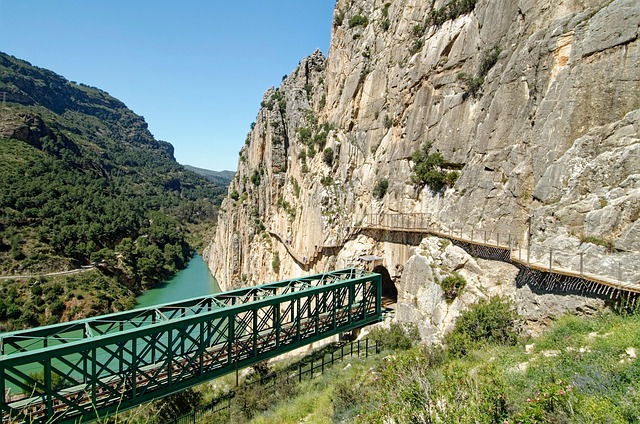
But visiting takes some planning. Tickets sell out, the walk is one-way (so you need shuttle logistics), and the site is an hour from Malaga with no public transit to speak of. I’ve broken down every option below — from the cheapest DIY approach to full-day guided tours that handle everything.
In a Hurry? My Top Picks
- Best full-day from Malaga: Guided Tour & Welcome Pack from Malaga — $70 per person. Seven hours with transport, guided walk, and a welcome pack. They handle the shuttle logistics so you just show up in Malaga. Book this tour
- Best budget option (walk only): Guided Tour and Entry Ticket — $35 per person. Two hours on the trail with a local guide. No transport included, so you drive yourself to El Chorro — but the price is hard to beat. Book this tour
- Best value mid-range: Tour with Official Guide and Drink — $34 per person. Three hours with a guide and a cold drink at the end. Solid pick if you have your own transport to El Chorro. Book this tour
- Best combo experience: White Village Tour with Tapas from Malaga — $73 per person. Caminito plus a visit to a traditional Andalusian white village and a tapas lunch. Makes a proper day of it. Book this tour
- In a Hurry? My Top Picks
- How the Walk Actually Works
- DIY vs. Guided Tour — Which Makes Sense
- Best Tours for Visiting Caminito del Rey
- 1. Guided Tour & Welcome Pack from Malaga —
- 2. Guided Tour and Entry Ticket —
- 3. Tour with Official Guide and Drink —
- 4. From Seville: Caminito del Rey Hike Day Trip — 7
- 5. White Village Tour with Tapas from Malaga —
- When to Visit Caminito del Rey
- What to Wear and Bring
- What You Will See on the Walk
- More Malaga Guides
How the Walk Actually Works
The Caminito del Rey is a one-way path. You enter from the north access (near Ardales) and exit at the south (near El Chorro train station), or vice versa depending on your assigned time slot. The total distance is about 7.7 kilometers, of which roughly 2.9 kilometers are the boardwalk sections bolted to the cliff face. The rest is a regular trail through the gorge.
The walk itself takes most people two to three hours at a comfortable pace. There are no shortcuts or detours — once you start, you walk the whole thing. The path is flat and well-maintained, with sturdy handrails on the boardwalk sections. The scariest part is probably the glass-bottom panel about halfway through, where you can see straight down to the river roughly 100 meters below. It’s perfectly safe. Your knees may disagree with your brain on that point.
The shuttle bus situation: Because the walk is one-way, you need to get back to where you parked or were dropped off. A shuttle bus runs between the north and south access points, and it’s included in the official entry ticket price. The bus runs about every 20 minutes. If you arrive by car, park at one end, take the shuttle to the other, walk through, and your car will be waiting. If you’re on a guided tour from Malaga, the tour handles all of this — you just walk.
Time slots are strict: Your ticket has a specific entry time, and they enforce it. Show up more than 30 minutes late and you lose your slot. The site processes visitors in timed batches to avoid overcrowding on the boardwalks, which is actually one of the best things about the system — you never feel packed in, even on busy days.
DIY vs. Guided Tour — Which Makes Sense
Two ways to do this. Buy official tickets yourself and drive out, or book a guided tour that includes transport from Malaga or the Costa del Sol.
DIY approach: Official tickets cost 10 euros through the Caminito del Rey website (caminitodelrey.info). They go on sale a few weeks in advance and sell out fast for weekends and peak season. You drive to the access point (about 60 minutes from Malaga), park, take the shuttle, walk, and drive home. Total cost for two people: about 20 euros for tickets plus fuel. The downside: you need a car, parking can be chaotic on busy days, and you miss the geological and historical context that a guide provides. The gorge has 300 million years of geological history compressed into its walls, and without someone explaining what you’re looking at, it just looks like rock.
Guided tours: These run $34 to $117 depending on whether transport is included and where you’re departing from. The walk-only guided tours ($34-44) meet you at the access point and walk you through with commentary — you still need your own transport. The full-day tours from Malaga ($70-89) include hotel pickup, the drive out, the guided walk, the shuttle, and the drive back. For most visitors staying in Malaga, the full-day tours are the better deal when you factor in car rental, fuel, parking stress, and the shuttle logistics.
My recommendation: if you have a rental car and enjoy figuring things out yourself, go DIY and save the money. If you flew into Malaga and this is a day trip from your hotel, book a guided tour with transport. The price difference is modest compared to the hassle you avoid.
Best Tours for Visiting Caminito del Rey
Five tours from the database covering different budgets and departure points. A budget walk-only option, two mid-range picks, a full-day from Malaga, and a day trip from Seville for travelers based further north.
1. Guided Tour & Welcome Pack from Malaga — $70
Duration: 7 hours | Price: $70 per person | Type: Full-day guided tour with transport from Malaga
This is the one I would point most first-timers toward. Hotel pickup in Malaga, an hour drive to the gorge with your guide setting the scene along the way, the full Caminito walk with geological commentary, the shuttle transfer handled for you, and the drive back. The welcome pack includes a cap, a small snack, and a bottle of water — small touches, but you will want that water.
The guide makes a real difference here. The Gaitanes Gorge is a geological time capsule — Jurassic-era limestone carved by the Guadalhorce River over millions of years. Without someone pointing out the fossil beds, the fault lines, and the layers of sediment that tell the story of an ancient sea, you are just walking through a canyon. With a guide, you are walking through 300 million years of Earth’s history.
At $70, the math works out well. A rental car for the day would cost $30-40, plus fuel, plus parking fees, plus the 10-euro entry ticket. By the time you add it up, the guided tour costs barely more than DIY — and you get expert commentary and zero logistics stress.
2. Guided Tour and Entry Ticket — $35
Duration: 2 hours | Price: $35 per person | Type: Guided walk with entry (no transport)
The budget pick for anyone with their own wheels. You drive to the north access point near Ardales, meet your guide, and walk the full Caminito with expert commentary. Two hours of focused gorge time without the transport padding.
This works best for travelers who are already exploring the Malaga province by car. You can combine it with a morning at the Caminito and an afternoon in Antequera or the El Torcal rock formations — both are within 30 minutes of the gorge. The $35 price includes your entry ticket and a local guide, which is only $25 more than doing it completely solo.
The trade-off: no hotel pickup, no shuttle logistics handled for you (though the guide will explain the shuttle system), and a shorter experience overall. But if you are the kind of traveler who prefers driving yourself and keeping the day flexible, this is the right option.
3. Tour with Official Guide and Drink — $34
Duration: 3 hours | Price: $34 per person | Type: Guided walk with entry and drink (no transport)
Nearly identical in price to the two-hour option above, but with an extra hour of walking time and a cold drink at the finish. That extra hour matters. The guides on the three-hour tours tend to stop at more viewpoints, spend longer explaining the geology at the narrowest sections of the gorge, and generally let the experience breathe rather than power-walking through it.
The drink at the end is a small thing, but after two-plus hours of walking through a gorge in Andalusian sunshine, a cold beer or agua con gas at the endpoint bar hits differently. Think of it as a built-in reward for finishing the walk.
Same caveat as the budget option: you need your own transport to reach the access point. But at $34 for a three-hour guided experience including entry, this is arguably the best value on the list for anyone with a rental car.
4. From Seville: Caminito del Rey Hike Day Trip — $117
Duration: 10 hours | Price: $117 per person | Type: Full-day trip with transport from Seville
This exists for travelers who are based in Seville and want to do the Caminito without adding a separate Malaga stop to their itinerary. The drive from Seville to the gorge is about two and a half hours each way, so yes, you spend a lot of time in a vehicle. But the alternative — renting a car, driving yourself, navigating rural Andalusia roads, dealing with parking and shuttles, then driving back tired — is worse.
At $117, it is the most expensive option on this list by a wide margin. That premium is almost entirely the transport cost. The actual walk and guide are the same quality. If you are spending multiple days in Seville and the Caminito is on your bucket list, this makes more sense than restructuring your whole trip around a Malaga stopover.
One honest note: ten hours is a long day. You leave Seville early morning and get back in the evening. Pack snacks, bring a book for the drive, and do not plan anything else for that evening. You will be tired.
5. White Village Tour with Tapas from Malaga — $73
Duration: 10.5 hours | Price: $73 per person | Type: Full-day combo tour with transport from Malaga
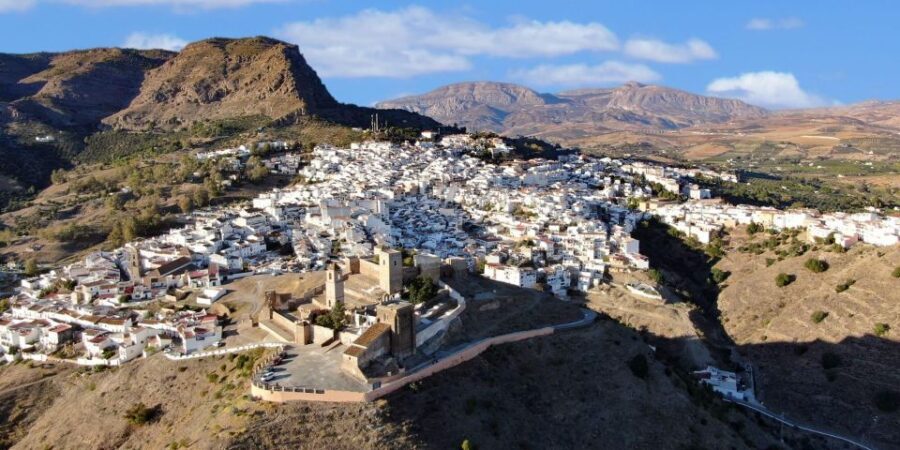
This is my personal favorite on the list, and here is why: the Caminito del Rey is spectacular, but it is essentially a three-hour walk through a gorge. Once it is done, the day is young. This tour fills the rest of it with a visit to one of Andalusia’s famous pueblos blancos — the whitewashed villages that cling to hilltops throughout the region — followed by a tapas lunch in a local restaurant.
The combination works because the village and the food ground the Caminito experience in something broader. You are not just seeing a gorge; you are getting a slice of rural Andalusia. The white villages have their own charm — narrow cobbled lanes, flower-covered balconies, old churches, and views that stretch across olive groves to the mountains. And the tapas lunch is real regional food, not tourist-menu sandwiches.
At $73, it is only three dollars more than the standard full-day Malaga tour. For that extra three dollars you get an additional village visit and a tapas lunch included. The value proposition here is hard to argue with.
When to Visit Caminito del Rey
The Caminito is open year-round except for occasional closures due to heavy rain (the gorge can flash-flood, and they take no chances). But some months are dramatically better than others.
Best months: March, April, May, October, November. Spring is the sweet spot. Temperatures hover around 20-25 degrees Celsius, the reservoir below the gorge is full and turquoise from winter rains, wildflowers bloom along the trail sections, and the light in the gorge is spectacular. October and November offer similar temperatures with the bonus of smaller crowds — the summer travelers have gone home but it hasn’t gotten cold yet.
Summer (June to September): It gets hot. Not “warm afternoon” hot — genuinely uncomfortable hot. The gorge walls trap heat, and there is zero shade on the boardwalk sections. Temperatures above 35 degrees are common, and the walk feels twice as long when you are baking. If summer is your only option, book the earliest morning slot available. By noon the gorge becomes an oven. Bring at least a liter of water per person.
Winter (December to February): Cooler temperatures make the walk pleasant, but rain closures become more frequent. The gorge is prone to flash flooding after heavy rainfall, and the site will close with little notice. If you are visiting in winter, keep your schedule flexible and have a backup plan for rainy days. On clear winter days, though, the gorge is almost empty and the low-angle sunlight creates shadows on the cliff faces that you will not see at any other time of year.
Time of day: Book the earliest slot you can get. The morning light is best for photos (the sun hits the eastern cliff face first), the air is cooler, and you will finish the walk before the afternoon crowds arrive. The first slots of the day also tend to have the smallest groups.
What to Wear and Bring

This is not a technical hike. The boardwalks are flat and well-maintained, and the trail sections are compacted gravel. But a few things make the experience notably better:
Shoes: Closed-toe shoes are mandatory. They will not let you in with sandals, flip-flops, or open-toe anything. Sneakers or light hiking shoes work perfectly. You do not need hiking boots unless it has rained recently and the trail sections might be muddy.
Sun protection: Hat, sunscreen, sunglasses. The boardwalk sections have zero shade, and the reflected light off the white limestone walls intensifies the UV exposure. In spring and summer, you will burn faster than you think.
Water: Bring at least one liter per person. There are no water fountains or shops along the route. In summer, bring two liters. Dehydration in a gorge with no shade and no exit for two hours is not something you want to experience.
Helmet: The site provides a hard hat at entry, and wearing it is required. It is not about falling rocks — the modern path is well-protected — but it is regulation and they enforce it. The helmets are one-size-fits-most and go over hats, so plan your head layers accordingly.
Camera: Obviously. But consider that your phone camera handles this perfectly well. The gorge is so photogenic that nearly every shot looks good. If you bring a bulky DSLR, make sure it fits in a daypack — you want your hands free for the handrails.
What NOT to bring: Selfie sticks are banned. Drones are banned. Large backpacks (bigger than a daypack) are not allowed. Umbrellas are prohibited because of the narrow walkways. Strollers cannot navigate the path. Children must be at least eight years old (under-18s need a guardian).
What You Will See on the Walk
The walk breaks into three distinct sections, each with its own character.
The approach trail: The first section is a regular hiking path through Mediterranean scrubland and pine forest. It follows the old railway line that was built to service the hydroelectric dam. You will pass through a short tunnel (lit, no headlamp needed) and along a section overlooking the reservoir. This part is peaceful and scenic but relatively tame — it is the warm-up act.
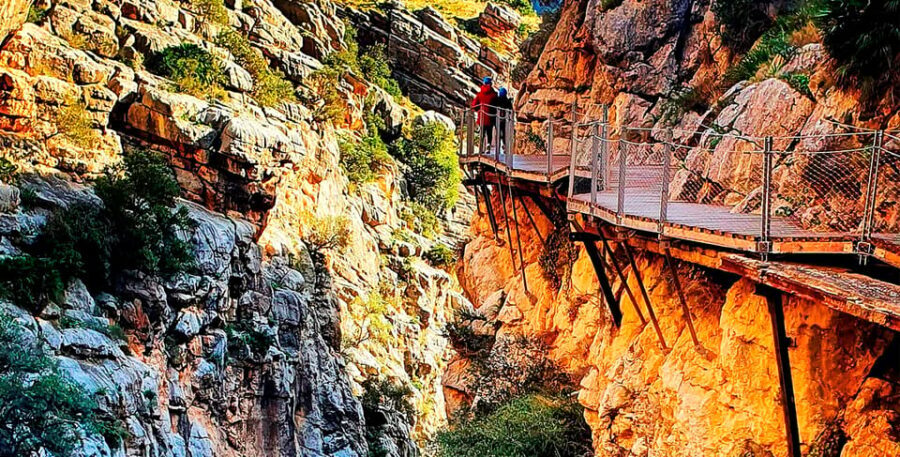
The boardwalk sections: This is what you came for. The modern boardwalk is pinned to the gorge wall, hanging 100 meters above the river. The path is about one meter wide with sturdy metal handrails on both sides. At the narrowest point of the gorge — the Garganta del Chorro — the walls close to barely 10 meters apart while towering hundreds of meters overhead. The sense of scale is overwhelming and no photo does it justice. About halfway through the boardwalk section, there is a glass-bottom panel. You will know it when you reach it because everyone suddenly stops and looks down.
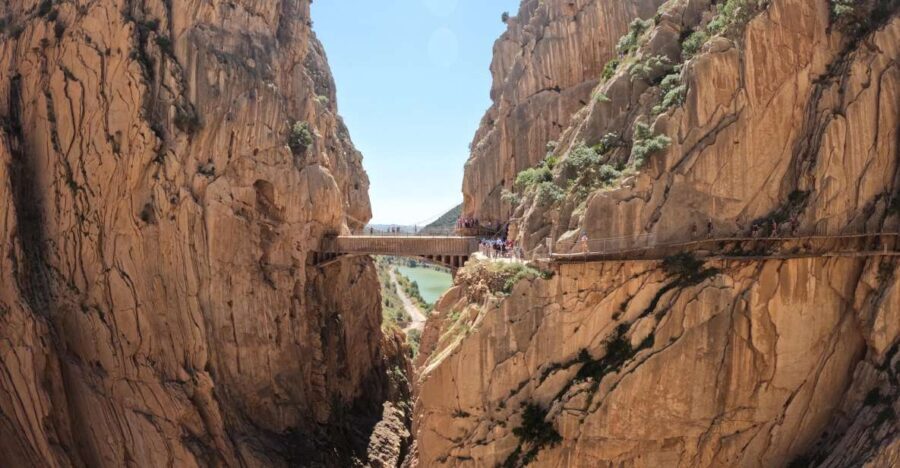
The hanging bridge: Near the end, a suspension bridge crosses the gorge at its widest point. It sways slightly in the wind. The view from the middle — looking down the length of the gorge in both directions with the boardwalk visible on the cliff face behind you — is the signature moment of the whole walk. Take your time here.
The exit trail winds down to the south access point where the shuttle buses wait. The walk from the bridge to the buses takes about 15 minutes and offers a few final viewpoints over the valley.