
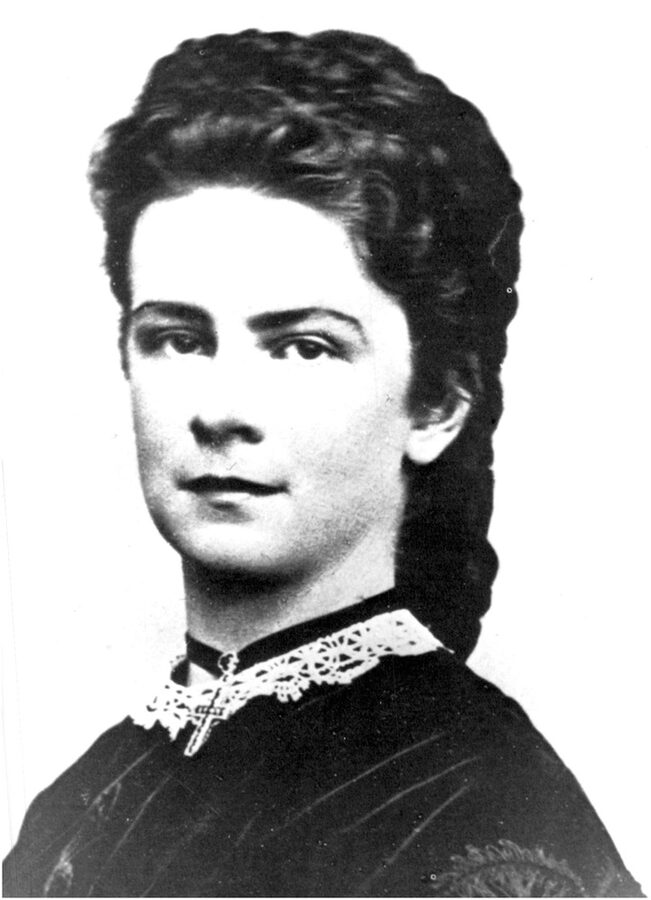
When Empress Elisabeth was assassinated in 1898, Habsburg tradition required her body to be split three ways: intestines into a bronze urn at St. Stephen’s Cathedral, heart into a silver urn at the Augustinian Church a kilometre away, body into the Capuchins Crypt with the 150 other dead Habsburgs. All three places are still accessible. Nobody walks into Sisi’s cathedral urn expecting what’s inside, which is partly the point.

This guide covers the three “Vienna below ground” tickets most visitors combine: the Capuchins Crypt (Kaisergruft, where the Habsburg emperors are buried), the Viennese Underworld Walking Tour (WW2 bunkers, medieval plague cellars, Roman foundations), and a shorter 90-minute Underground Walk for visitors with less time. All three are inner-city, walkable between each other, and together make a single memorable half-day — or a full day if you combine them with the Augustinerkirche Herzgruft where Sisi’s heart actually is.

In a Hurry? The Three Vienna Underground Tickets
- Best for dark history: Viennese Underworld Guided Walking Tour — $37, 2.5 hours. WW2 bunkers, medieval cellars, Roman foundations, 1,865+ reviews.
- Shorter version: 1.5-Hour Underground Walking Tour — $32, 90 minutes. Same basic route, less time underground, skips the WW2 bunkers.
- Habsburg crypt only: Capuchins Crypt Entrance Ticket — $17, self-guided 45-60 min. 150+ Habsburg coffins including Sisi, Franz Joseph, Maria Theresa.

- In a Hurry? The Three Vienna Underground Tickets
- Which Ticket to Book
- 1. Vienna: Viennese Underworld Guided Walking Tour — from
- 2. Vienna: 1.5-Hour Underground Walking Tour — from
- 3. Vienna: Capuchins Crypt Entrance Ticket — from
- What’s Inside the Capuchins Crypt
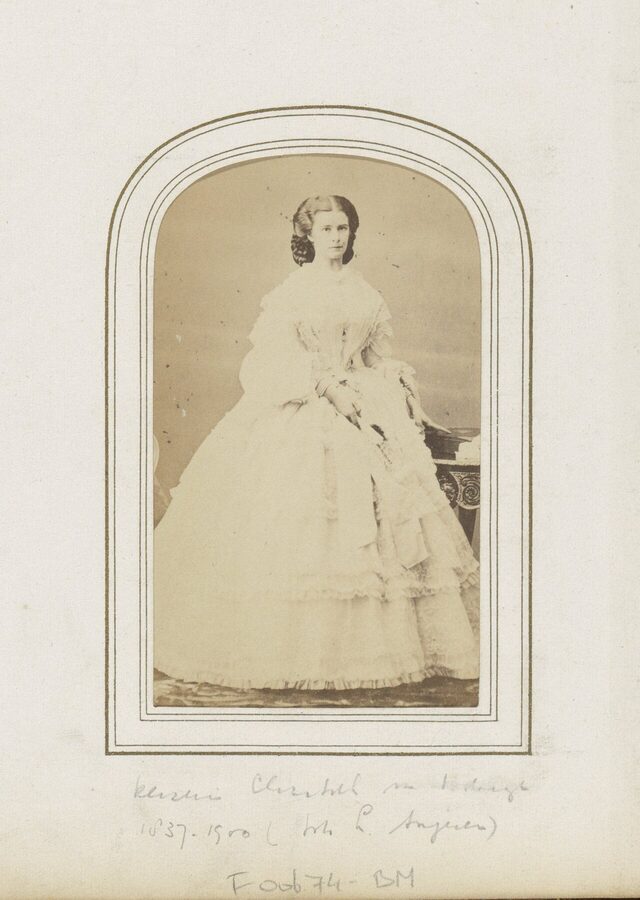
- Sisi’s Heart — The Augustinerkirche
- What the Underground Walking Tours Actually Show
- When to Go
- Getting to Each Site
- Combining with Your Vienna Day
- A Short History of Habsburg Burial Customs
- Common Mistakes
- Practical Details
- The Short Version
Which Ticket to Book
1. Vienna: Viennese Underworld Guided Walking Tour — from $37
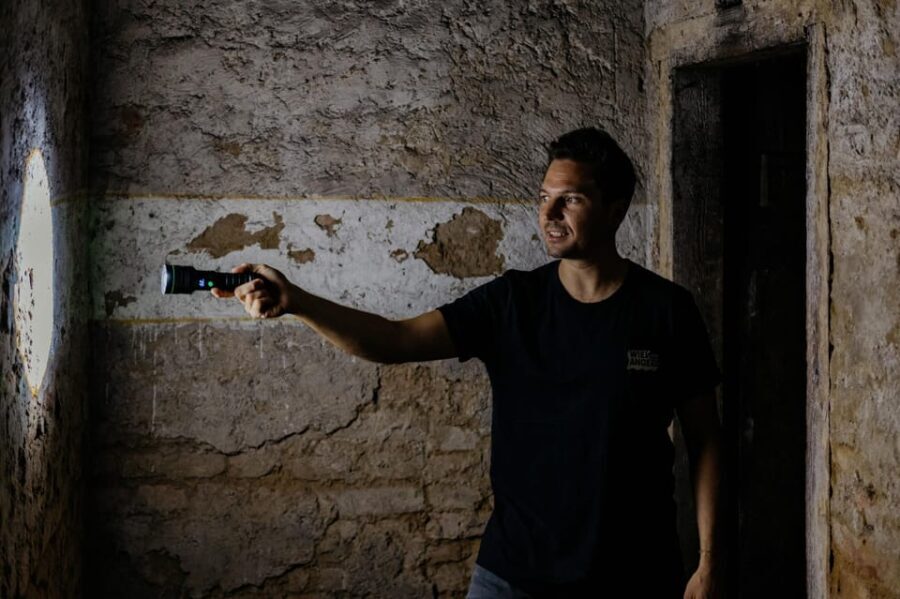
The full-length underground tour. 2.5 hours, mixed above-ground walk and 3-4 below-ground descents. Stops include a medieval plague cellar near Hoher Markt, the Roman military camp ruins under the square (Vienna was Vindobona in AD 15), an 18th-century Enlightenment-era coffeehouse basement, and a WW2 flak-tower air-raid shelter. Groups 12-15, English + German. Guide commentary is genuinely good — tour operator Ursula Klemm-Feurenbach runs this with proper historical rigour. Our full review has the route map.
2. Vienna: 1.5-Hour Underground Walking Tour — from $32
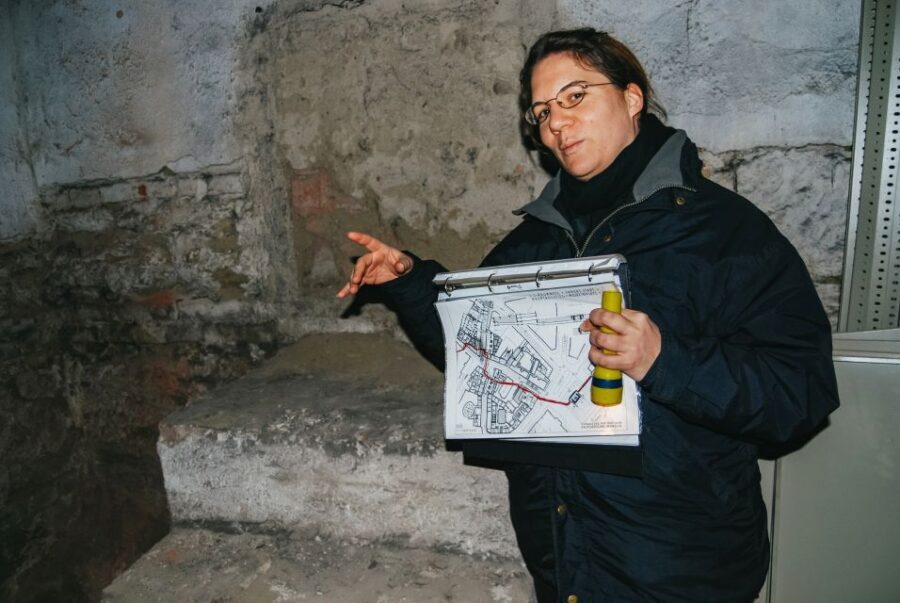
The compressed version of Option 1. 90 minutes total — about 60% of the route but with the 2 most visually interesting descents (medieval cellar + plague-era chamber). Skips the WW2 bunker. €5 cheaper. Best for visitors who want a taste of Vienna’s underground without the full commitment, or for travellers with afternoon plans that can’t stretch to 2.5 hours. Operates same days as the 2.5-hour version, different start times.
3. Vienna: Capuchins Crypt Entrance Ticket — from $17
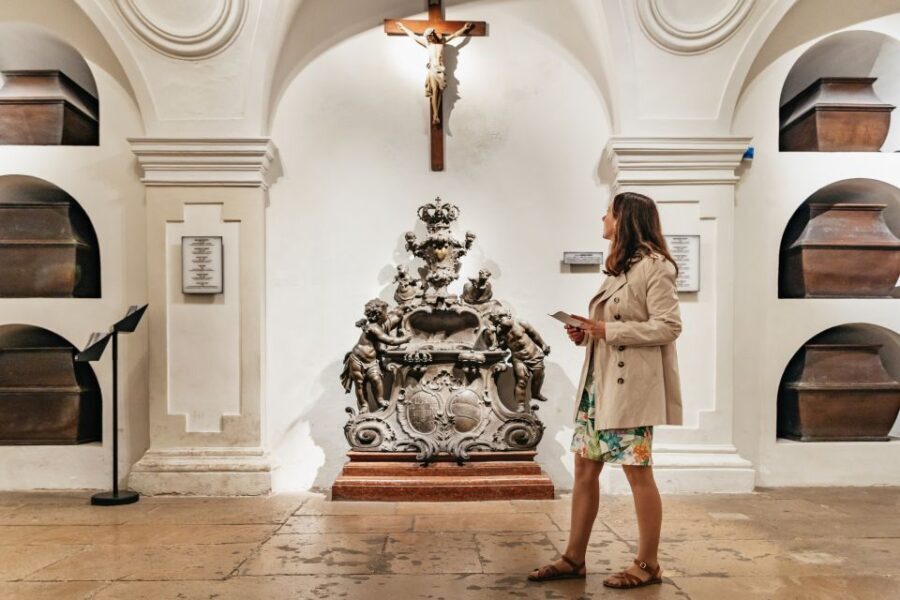
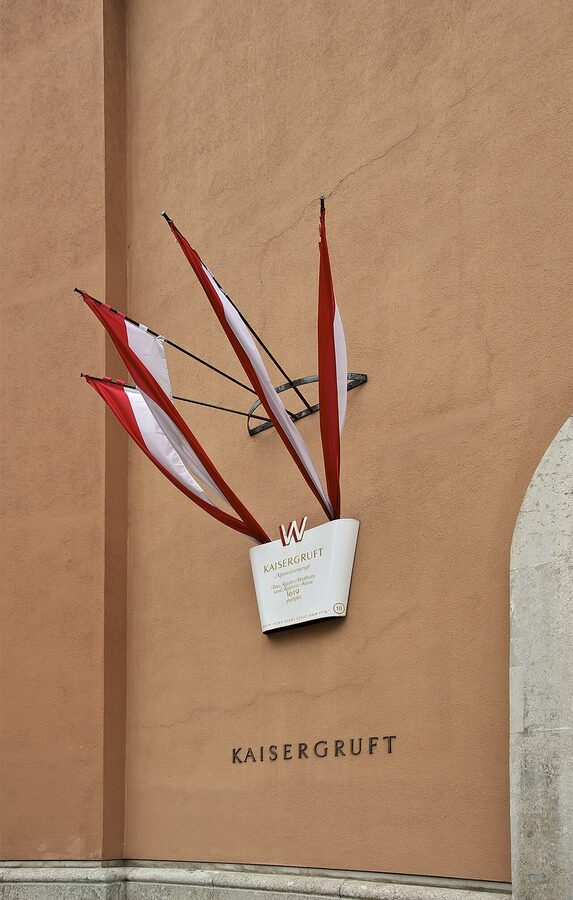
The Habsburg crypt ticket. €17 self-guided with audio guide (10+ languages). The Kapuzinergruft sits under the Capuchin monastery on Neuer Markt — 10 vaulted rooms running 180 metres under the inner city, with every Habsburg emperor from Matthias (d. 1619) to Franz Joseph (d. 1916) plus their empresses, princes, and 150+ relatives. Most famous sarcophagi: Maria Theresa + Francis I (the double pewter tomb), Joseph II (austere lead chest — he ordered the simplest possible burial), Franz Joseph + Sisi (side by side in the New Crypt). Our full review has the sarcophagus walk-through.
What’s Inside the Capuchins Crypt

The Kaisergruft (“Imperial Crypt”) runs under the Capuchin monastery on Neuer Markt. The 10 rooms are named chronologically — Founders’ Crypt, Leopoldine Crypt, Karolinsche Crypt, Maria Theresien-Gruft, Tuscany Crypt, Ferdinand Crypt, Franz Joseph Crypt, New Crypt — and you walk through them in order.
The Founders’ Crypt (1633). Empress Anna and her son Emperor Matthias. Plain lead coffins, no decoration. This was the original crypt; everything else was added later.
Leopoldine Crypt (1657). Emperor Leopold I and his immediate family. The first decorative sarcophagi — Leopold’s coffin has carved skulls and Habsburg double-eagles in pewter.
Karolinsche Crypt (1720). Emperor Charles VI (father of Maria Theresa). His sarcophagus is elaborate but restrained — lions at the corners, carved pewter skulls along the top.
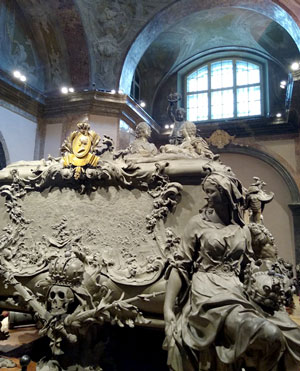
The Maria Theresien-Gruft (1750s). The crypt’s central room and its single most famous object: the double sarcophagus of Empress Maria Theresa and her husband Emperor Francis I. Six tons of pewter. Life-size figures of both rulers reclining on top, sculpted by Balthasar Ferdinand Moll. The artwork is extraordinary — the figures are depicted as they were in life (not death), mid-conversation with each other. The crypt literally centres on this one object.
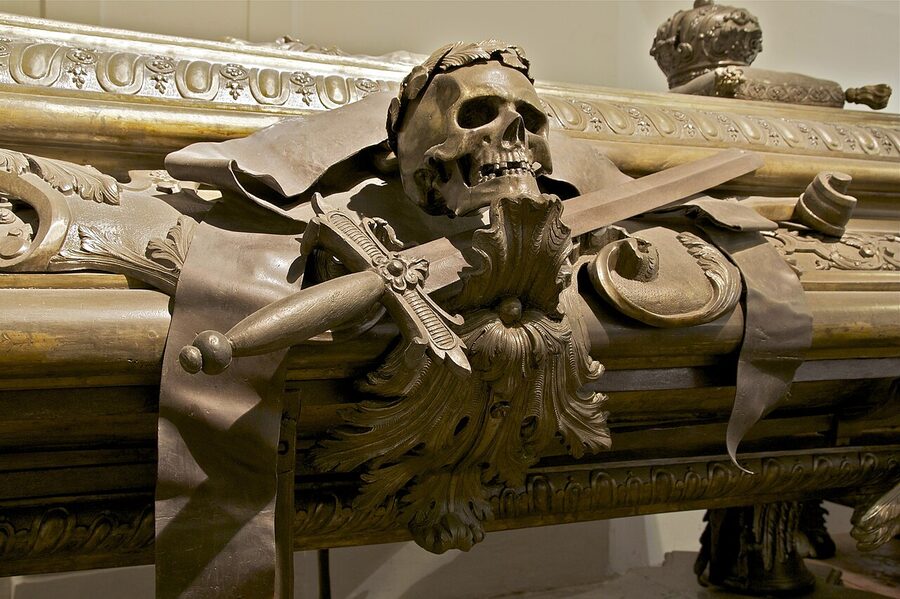

Joseph II’s coffin (1790). Notable for its plainness. Joseph II was the Enlightenment emperor — he reformed the Habsburg state, closed monasteries, introduced religious tolerance. He requested a simple pine coffin. The court overruled him and gave him a plain lead chest. He sits next to his mother Maria Theresa’s ornate double-sarcophagus, and the contrast is the whole point.
Franz Joseph Crypt (1916). The emperor who ruled 1848-1916 — the penultimate Habsburg. His tomb is in the New Crypt alongside Empress Elisabeth (Sisi) and their son Crown Prince Rudolf (who killed himself at Mayerling in 1889). Sisi’s coffin is covered in fresh flowers most days; the Austrian public still visits as pilgrims.
New Crypt (1961). Added to house the last Habsburgs buried here — including Otto von Habsburg (last Austro-Hungarian crown prince, died 2011) whose heart is at Pannonhalma Archabbey in Hungary and whose body is in the Kaisergruft, one of the last formal Habsburg triple burials.
Practical details: audio guide included. Photography allowed without flash. Modern lighting — not spooky, actually brightly lit. 45-60 minutes at a normal pace; 90 minutes if you listen to the full audio guide.
Sisi’s Heart — The Augustinerkirche
,_keizerin_van_Oostenrijk,_RP-F-F00674-BM.jpg)
The Augustinian Church (Augustinerkirche) is 3 minutes on foot from the Kaisergruft, inside the Hofburg complex. Most Kaisergruft visitors don’t realise you can see the second Habsburg burial site — the Herzgruft (Heart Crypt) — in the same afternoon.
What’s there: the Herzgruft is a small side-chapel containing 54 silver urns, each holding the heart of a deceased Habsburg. The custom of heart-burial dates from the 16th century and continued until 1878. Empress Sisi’s heart is one of the 54; her urn sits on a stone shelf with her name engraved.
Access: the Herzgruft is usually closed to visitors, opened only on specific dates (All Souls’ Day, 2 November; and occasional guided tours). Free entry during visiting periods. Call the church administration (+43 1 533 70 99) to check current access before visiting.
The main church (open daily): Augustinerkirche itself is the Habsburg wedding church — Maria Theresa married Francis I here (1736), Franz Joseph married Sisi here (1854), and most Habsburg royal weddings between 1634 and 1918 took place at the high altar. The marble monument by Antonio Canova (1805) in the right-hand chapel commemorates Archduchess Maria Christina; it’s considered one of Canova’s masterpieces.
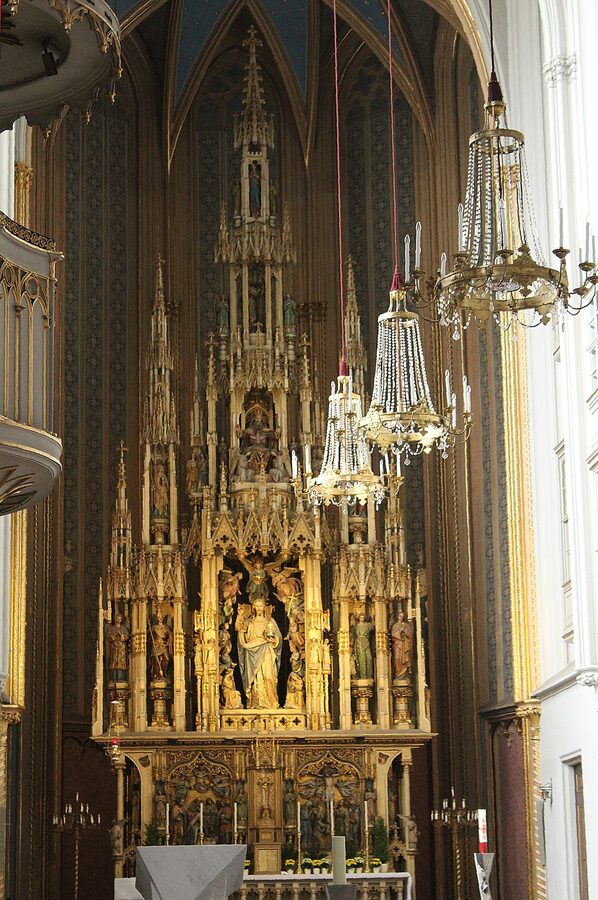

The intestines (St. Stephen’s Cathedral): less dramatic but worth noting. The Herzogsgruft (“Dukes’ Crypt”) beneath St. Stephen’s Cathedral contains 72 bronze urns of Habsburg intestines, buried there since 1363. Access is via the cathedral’s paid catacombs tour (€6.50, 30 minutes) which also covers the main catacombs with 11,000 plague victims and the bishops’ chapel.
So the three burial sites of Empress Elisabeth — body (Kaisergruft), heart (Augustinerkirche Herzgruft), intestines (St. Stephen’s Herzogsgruft) — are all visitable on a single day in central Vienna, the farthest two about 5 minutes apart on foot. This is the most genuinely macabre Vienna day-trip on the tourist menu, and also one of the most historically specific.
What the Underground Walking Tours Actually Show
The underground tours are a different experience from the crypt — less royal, more urban-history. The standard 2.5-hour Viennese Underworld tour visits 3-4 underground spaces that most visitors never see.
Roman Vindobona (Hoher Markt). Vienna started as the Roman military camp Vindobona, founded around AD 15. The ruins of the camp’s officers’ quarters sit 4 metres below the current Hoher Markt square — accessed via a small museum staircase. You see original Roman floor tiles, wall foundations, and a reconstructed section of the camp wall.
Medieval plague cellars. Several points on the tour descend into preserved medieval basements (12th-14th century), including one that served as a plague pit during the 1679 epidemic. The walls still show carved graffiti from plague-era residents. The guide usually points out a specific inscription (in medieval German) that reads approximately “pray for us, for we die tomorrow.”
18th-century coffeehouse cellars. Vienna’s famous coffeehouse tradition started in 1683 with beans left behind by the retreating Ottoman army. Several tour stops visit original coffee-roasting cellars — stone vaults where raw beans were stored before roasting.
WW2 air-raid shelters. The tour’s final descent is into a flak-tower basement — part of Vienna’s 1942-44 civil defence infrastructure. The city’s flak towers (still standing above-ground at Arenbergpark and Augarten) housed up to 30,000 Viennese during Allied bombing raids. The basement you visit has period equipment — bunks, gas masks, water canisters — preserved roughly as they were in 1945.
What the tour doesn’t cover: the subway system (U-Bahn), the famous Third Man sewer scenes (those require the separate Third Man Museum tour), and the Capuchin Crypt itself (which is a separate ticket).
Meeting point: usually Stephansplatz or Hoher Markt; check your specific booking. Wear comfortable shoes (cobblestones + stairs); bring a jacket (cellars stay at 10-12°C year-round).
When to Go
Crypt (Kaisergruft): daily 10am-6pm. Avoid midday when tour groups cluster (11am-2pm). Best time: 10am opening or 4pm afternoon.
Underground walking tours: typically run Tuesday-Sunday, multiple slots per day in summer, fewer in winter. Book 2-3 days ahead in peak season.
Augustinerkirche (main church): daily 9am-6pm except during services. The Herzgruft is only open on All Souls’ Day (2 November) and during pre-arranged guided tours.
Best season overall: October-March. All underground spaces are interior and weather-independent; you’re not missing anything by visiting outside peak tourist months. In fact, the atmosphere of the crypt is arguably better in winter when the street above is quiet.
Avoid: summer midday (when the 10-12°C underground temperature feels extreme against the 30°C outside), and around Halloween / Day of the Dead when the crypts get crowd-heavy with themed-tourism visitors.
Best day of week: Tuesday-Thursday. Weekends draw more domestic visitors to the Kaisergruft especially.
Getting to Each Site
Capuchins Crypt (Kaisergruft): Tegetthoffstraße 2, Neuer Markt. U-Bahn U1 or U3 to Stephansplatz, then 3 minutes on foot. Or U1/U4 to Karlsplatz, 5 minutes on foot.
Augustinerkirche: Augustinerstraße 3, inside the Hofburg complex. U1/U3 to Stephansplatz, then 5 minutes on foot via the Albertina; or U3 to Herrengasse, 3 minutes on foot.
Underground Walking Tour meeting point: typically Stephansplatz or Hoher Markt. Both reachable via U1 (Stephansplatz) or U3 (Herrengasse).
Walking between all three: the Kaisergruft → Augustinerkirche → St. Stephen’s Cathedral triangle is about 800 metres total. You can cover all three plus Hoher Markt on a single afternoon walk.
Combining with Your Vienna Day
Macabre-history afternoon: Kaisergruft (45-60 min) → Augustinerkirche + Canova monument (20 min) → Underground Walking Tour (2.5 hours) → drink at a Heuriger to process. Heavy day, unique experience.
Half-day Habsburg mortality: Kaisergruft morning → lunch → Sisi Museum at Hofburg afternoon. The Sisi Museum focuses on her life; the Kaisergruft focuses on her death. Together they make for a coherent Habsburg-Empress day.
Full Vienna-below-ground day: morning Kaisergruft, noon Hoher Markt Roman ruins (free), lunch, afternoon Underground Walking Tour, evening Vienna Philharmonic or classical concert. 10-12 hour day but thematically coherent.
With family: not recommended for kids under 10. The crypt imagery is intense for young children. Kids 12+ tend to engage well with the historical narrative.
As part of a Vienna pass: the Vienna PASS includes free entry to the Kaisergruft. If you’re getting the pass for other reasons, this is a free add-on.
A Short History of Habsburg Burial Customs
The “heart burial” tradition (Herzbegräbnis) is what makes Vienna’s underground tourism unusually specific. Before the Protestant Reformation, noble families across Europe practised body-splitting — it was linked to the medieval belief that the soul resided in the heart, and that separating the heart allowed for spiritual presence in a different location from the body.
The Habsburgs took this further than most. Between the 17th and 19th centuries, deceased emperors’ bodies were systematically divided between three Vienna sites:
– Body → Kaisergruft (Capuchins Crypt, Neuer Markt)
– Heart → Herzgruft (Augustinerkirche)
– Intestines → Herzogsgruft (St. Stephen’s Cathedral catacombs)
The custom formally ended with Franz Joseph (buried whole in 1916, though his heart was conceptually “included” in the Kaisergruft tomb without physical separation). Sisi’s was one of the last actual three-way burials — September 1898, after her assassination in Geneva.
Why this matters for a visit: if you go to the Kaisergruft and think “this is weird but interesting,” that’s the surface-level reaction. The deeper thing is that European royal mortality was organised differently for 400 years — with specific rituals, specific locations, specific theology — and Vienna is the one city where you can still visit all three endpoint sites of that system in a single afternoon.
Habsburg dynasty brief. Founded ~1273 when Rudolf I of Habsburg became king of Germany. Ruled the Holy Roman Empire, Austria, Hungary, Bohemia, Spain (for a branch), and parts of Italy over 640 years. Ended formally 1918 with the Austro-Hungarian defeat in WW1 and Emperor Charles I’s exile. Body count in the Kaisergruft: 12 emperors, 19 empresses, 118 archdukes and archduchesses, various cousins — 150 total sarcophagi.
Common Mistakes
Treating the Kaisergruft as creepy tourism. It’s a working religious space — still an active Capuchin monastery, still hosts memorial masses for Habsburg dates. Speak quietly, don’t pose with coffins for Instagram, dress appropriately (shoulders covered).
Skipping the audio guide. The 150 coffins look repetitive without context. The audio guide explains why Joseph II’s plain lead chest is historically significant, why Maria Theresa’s pewter sarcophagus has Francis I depicted sitting up (looking at her), and which coffins contain which tragedies. Worth the €3 upcharge.
Trying to see the Herzgruft without planning. It’s only open 2 November (All Souls’ Day) and during pre-booked guided tours. Most visitors end up staring at the closed door. Plan ahead by email if you specifically want to see the heart urns.
Going after a big lunch. The crypt is 10-12°C with stone walls and low lighting. Some visitors feel queasy, especially after a heavy meal. Go in the morning on an empty stomach.
Expecting all three Sisi sites to be equally open. Kaisergruft (body) is open daily. Augustinerkirche main church (wedding site) is open daily. But the Herzgruft (heart) is closed most days, and the Herzogsgruft (intestines) requires a specific cathedral catacombs tour. You can see 1-2 of 3 on most days; seeing all three needs calendar alignment.
Combining with a Sound-of-Music-style cheerful Vienna day. The underground tour + crypt are emotionally heavy. Don’t schedule a bubbly wine-tasting evening directly after; leave space to process. Many visitors find a solo coffee at a traditional Viennese coffeehouse the right ending to this kind of day.
Wearing inappropriate shoes. The underground walking tour descends and ascends multiple stairs, some uneven. Trainers or flat boots; no heels.
Practical Details
Kaisergruft:
– Address: Tegetthoffstraße 2, 1010 Vienna (Neuer Markt)
– Hours: daily 10am-6pm
– Admission: €17 adult, €10 child 6-18, €14 student
– Audio guide: included
– Photography: allowed without flash
Underground Walking Tour (2.5-hour):
– Meeting point: usually Stephansplatz (check booking)
– Price: €37 per person
– Duration: 2.5 hours
– Runs: Tuesday-Sunday, multiple slots in summer
1.5-Hour Underground Walking Tour:
– Same meeting point
– Price: €32 per person
– Duration: 90 minutes
Augustinerkirche:
– Address: Augustinerstraße 3
– Main church: daily 9am-6pm (free)
– Herzgruft: open only 2 November and during booked tours
– Canova monument: always accessible during church hours
St. Stephen’s Cathedral Catacombs:
– Address: Stephansplatz 3
– Guided tour only (in German and English at set times)
– €6.50, 30 minutes
What to wear: layer (underground is 10-12°C), flat comfortable shoes, nothing bright or flashy (you’re visiting religious/memorial sites).
Accessibility: the Kaisergruft is partially wheelchair accessible (street-level entrance + lift to main rooms, but some side chapels inaccessible). The underground walking tours involve stairs throughout and are not wheelchair-accessible.
The Short Version
Book the €17 Capuchins Crypt ticket for a morning visit. Take the audio guide. Plan 60-90 minutes inside — you’ll spend most of it at the Maria Theresa double sarcophagus and Sisi’s tomb. After lunch, walk 3 minutes to the Augustinerkirche to see where Sisi was married (and where her heart now lives behind a usually-closed door). If you have energy left, book the €37 2.5-hour Viennese Underworld Walking Tour for 3pm — Roman ruins, medieval plague cellars, WW2 bunkers.
All three sites together make Vienna’s most historically specific tourist day — a city that organised its royal mortality around three separate buildings for 400 years, and still has all three open (or almost open) to visitors. Nothing else in Europe is quite like it.
Affiliate disclosure: Some links in this article are affiliate links. If you book through them we may earn a small commission at no cost to you. All recommendations are based on my own visit.