
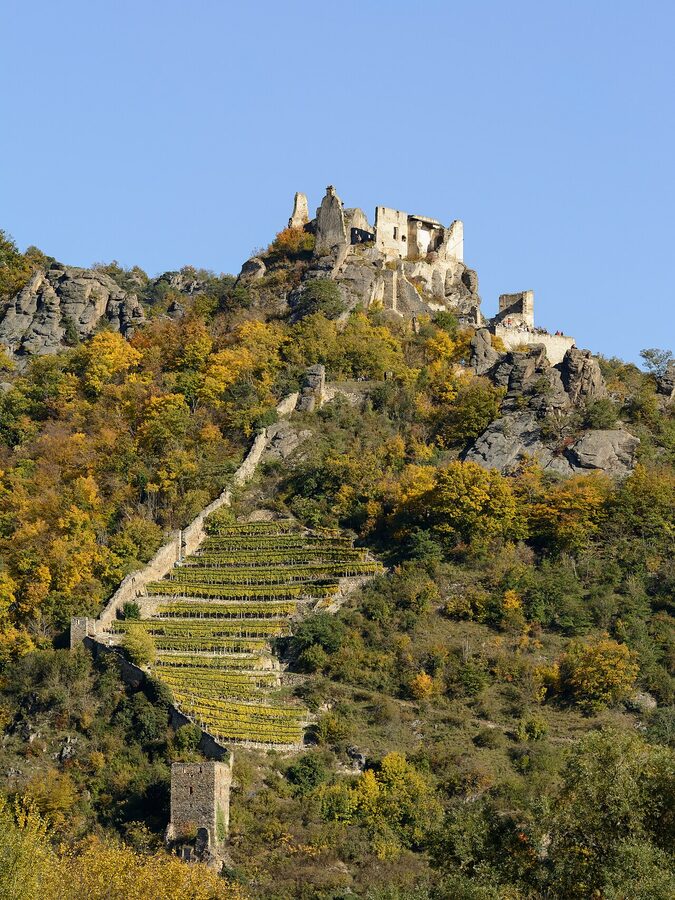
Richard the Lionheart spent Christmas 1192 in a cell 100 metres above the Danube, prisoner of Leopold V of Austria for insulting him at the siege of Acre the year before. The tower that held him still stands above the village of Dürnstein — cracked, roofless, a 15-minute climb up from the river. It’s the first thing most Wachau day-trips from Vienna point out as the boat floats past.

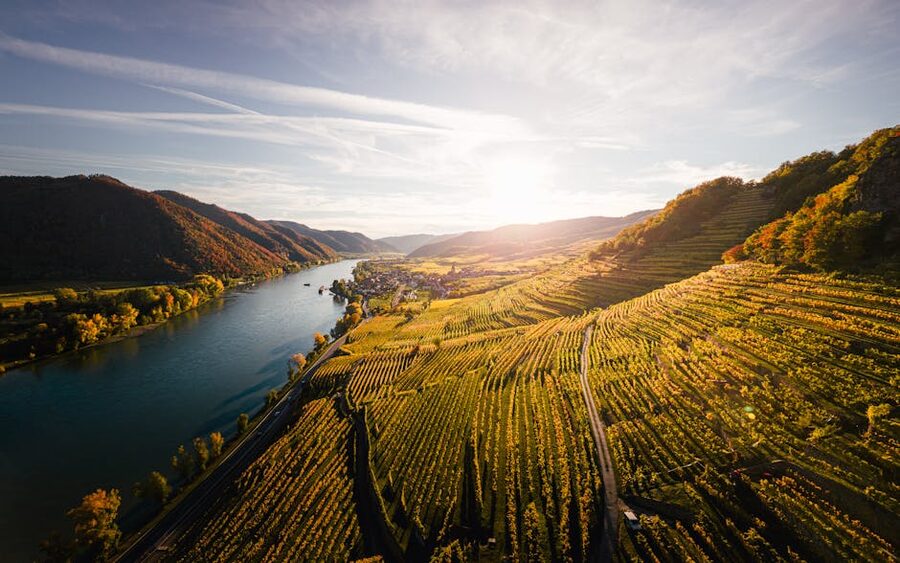
The Wachau is a 36-kilometre stretch of the Danube between Melk and Krems, UNESCO-protected since 2000, with terraced vineyards the Romans planted 2,000 years ago and a Benedictine abbey at each end. A day-trip from Vienna covers it in 9-10 hours: morning at Melk Abbey, scenic boat down the river, stop at Dürnstein, bus back. The standard tour costs about €150. It’s one of the genuinely worthwhile day-trips from Vienna — more interesting than Hallstatt, shorter than Salzburg, and almost never disappointing in terms of scenery.
In a Hurry? The Three Wachau Day-Trip Options
- Best overall: Wachau, Melk Abbey, and Danube Valleys Tour — $151, bus-and-boat, 9-10 hours. Covers Melk + Danube cruise + Dürnstein. The default.
- Viator alternative: Danube Valley Day Trip — $141.77, similar route via Viator’s operator. Use if you already have Viator bookings.
- Best for cyclists: Wachau Wine Tasting Bike Tour — $163.26, e-bike through the vineyards with tastings. Different format entirely.
- In a Hurry? The Three Wachau Day-Trip Options
- Which Tour to Book
- 1. Vienna: Wachau, Melk Abbey, and Danube Valleys Tour — from 1
- 2. Danube Valley Day Trip from Vienna (Viator) — from 1.77
- 3. Wachau Valley Wine Tasting Bike Tour from Vienna — from 3.26
- Melk Abbey — What You Actually See
- The Danube Cruise — Melk to Dürnstein
- Dürnstein and the Richard the Lionheart Story
- Wachau Wine — Why It’s Actually Significant
- Self-Organised vs Guided — The Maths
- When to Go
- Getting There Without a Tour
- Combining with Your Vienna Itinerary
- Common Mistakes
- Practical Details
- The Short Version
Which Tour to Book
1. Vienna: Wachau, Melk Abbey, and Danube Valleys Tour — from $151
The default full-day itinerary. Bus from Vienna to Melk (1h15), guided Abbey tour (90 minutes), lunch in Melk or packed lunch on the boat, scenic Danube cruise from Melk to Dürnstein (90 minutes on the water), 45-minute Dürnstein stop, bus back to Vienna. Lunch usually included in the €151 but varies by operator — check when booking. Groups 15-25 people. Guide speaks English + German. Our full review has the exact timing.
2. Danube Valley Day Trip from Vienna (Viator) — from $141.77
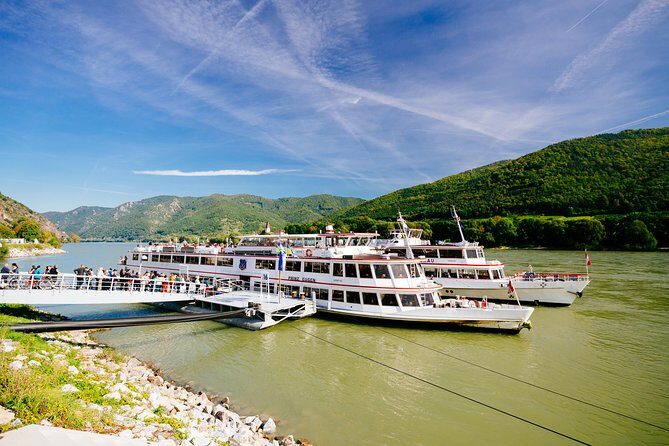
The Viator version of the Wachau day-trip. €10 cheaper than the GetYourGuide option for essentially the same product — same bus-boat-bus structure, same stops at Melk and Dürnstein, same 9-10 hour day. Book this if you’re already using Viator for other Vienna tours; otherwise the GYG option is the mainstream pick with more reviews. Includes the same guided Melk Abbey entry and the Danube cruise.
3. Wachau Valley Wine Tasting Bike Tour from Vienna — from $163.26
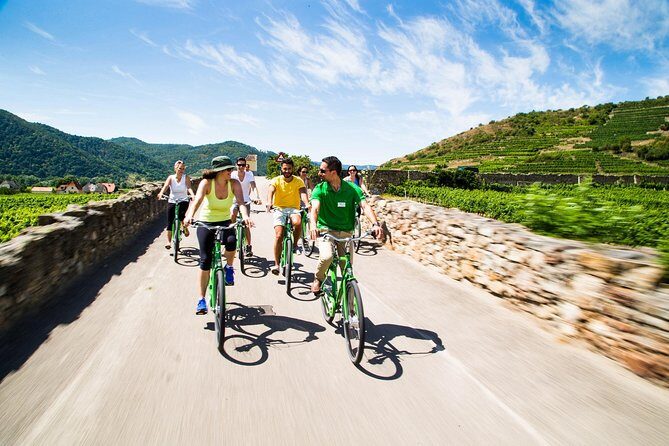
For visitors who’d rather pedal than sit on a bus. Train from Vienna to Melk (1h), collect e-bike at Melk, 30-35 km ride down the Wachau on the EuroVelo 6 cycle path, 2-3 wine tastings at small family estates (Weingut Pichler, Jamek, or similar), train back from Krems. Total 9 hours. Fitness level easy-to-moderate (e-bikes do the work). Best for active travellers — you see the vineyards from inside rather than from a boat deck. Weather-dependent; cancels in heavy rain.
Melk Abbey — What You Actually See

Melk Abbey is the day’s first stop and usually the structural peak. Plan 90 minutes inside on a standard guided tour; 2 hours if you have the flexibility.
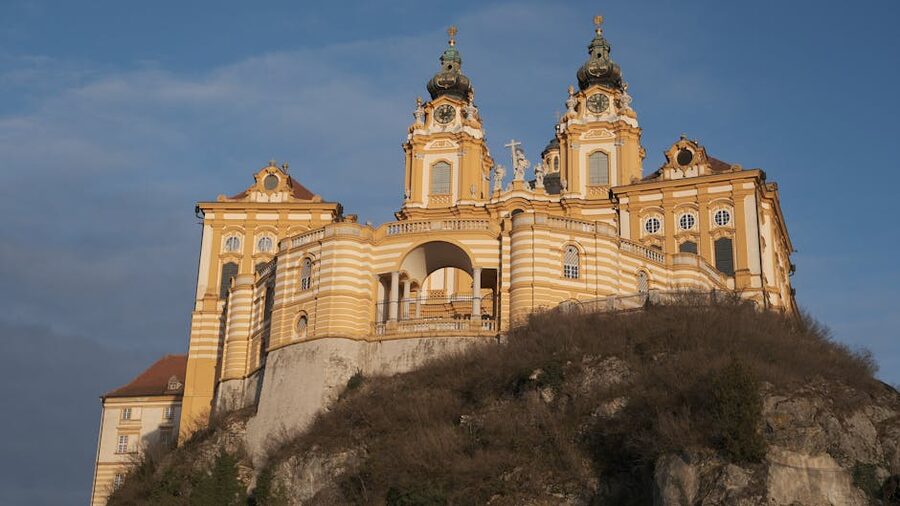
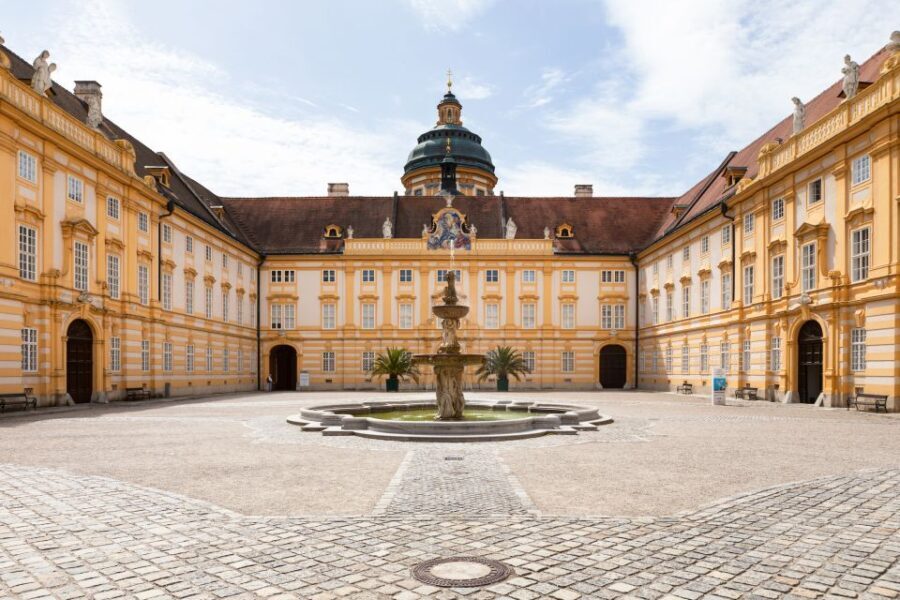
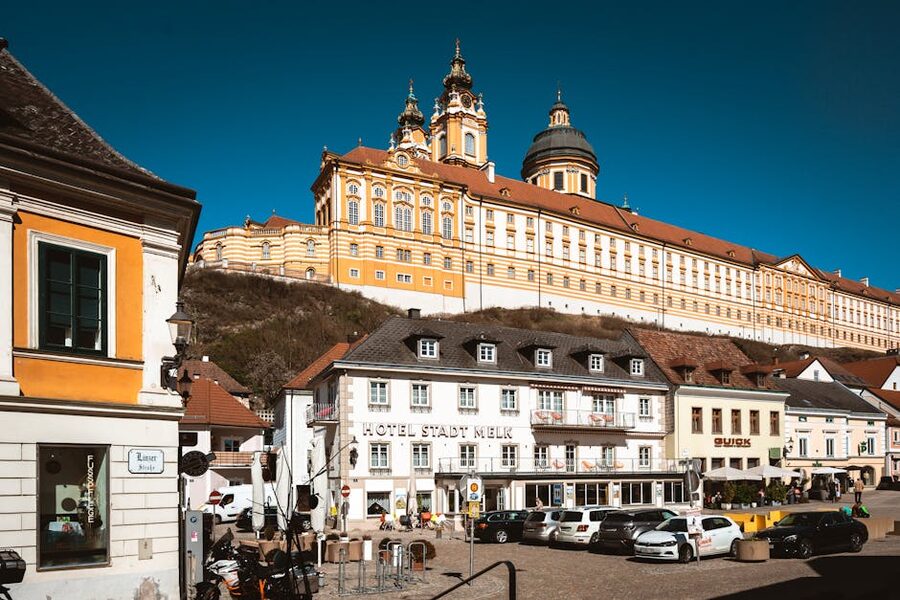
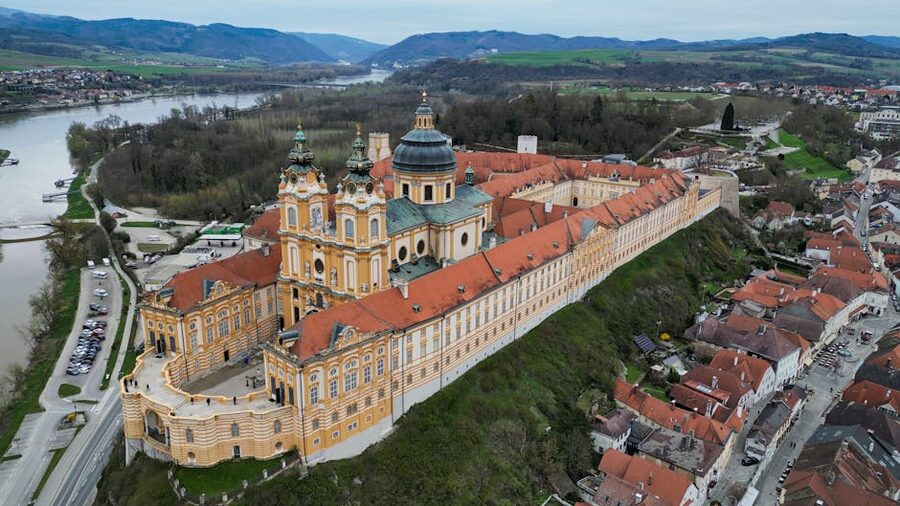
The approach. You enter from the north side via the Prälatenhof courtyard. The abbey complex is 17,500 m² — larger than most Austrian palaces — perched on a rock outcrop 60 metres above the Danube. The current Baroque reconstruction dates from 1702-1736, under architect Jakob Prandtauer, replacing a medieval complex that had stood on the same spot since 1089.
The Marble Hall (Marmorsaal). The first of the three interior showpieces. Designed as a reception hall for visiting emperors — its painted ceiling by Paul Troger (1731) depicts Hercules wrestling Cerberus, a not-very-subtle metaphor for the abbey’s political position between Vienna and the Vatican. Marble-coloured stucco (the “marble” is actually painted plaster) creates the impression of a massive stone room.
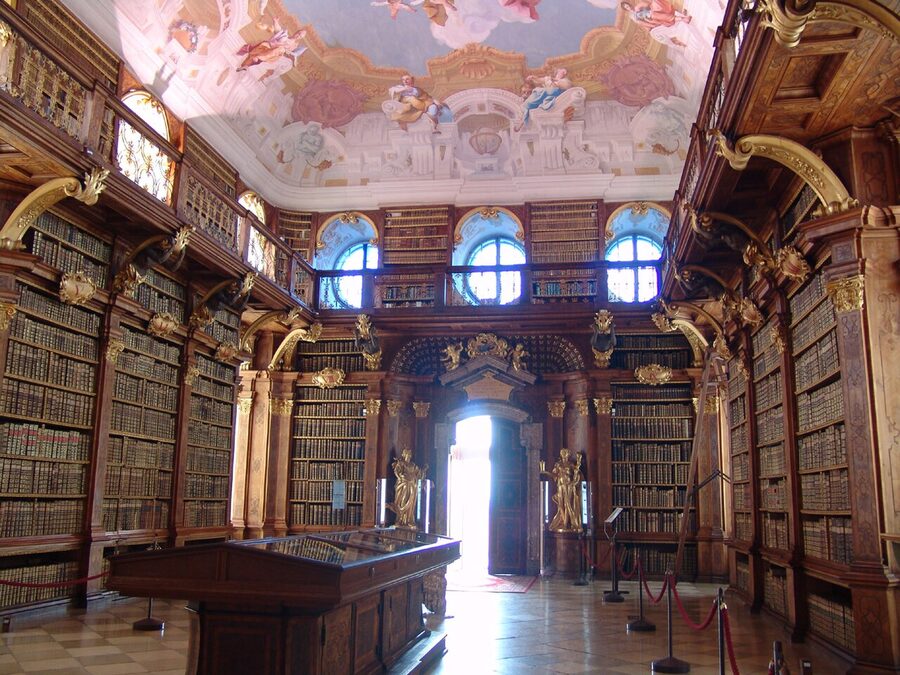
The Library. The abbey’s single most famous space. 100,000 volumes in 12 interconnected rooms, with the main hall running 42 metres along the abbey’s south wing. The ceiling frescoes — also by Paul Troger — represent Faith on the right side of the hall and Reason on the left, with the four faculties (theology, medicine, philosophy, law) arranged underneath. The books are real, mostly 16th-18th century, and the monks still add to the collection. Photography no-flash only.
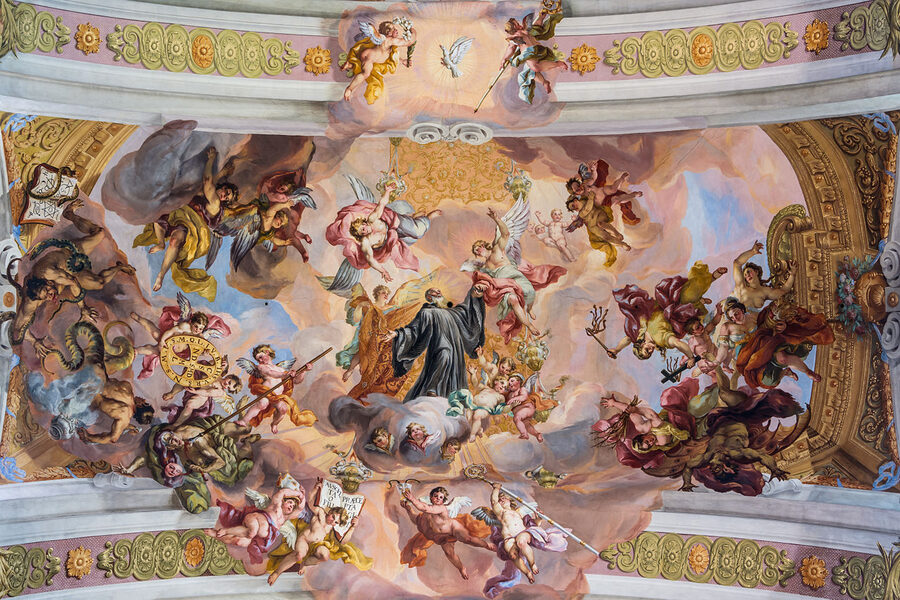
The Abbey Church (Stiftskirche). The most ornate of the three spaces — high Baroque Catholicism at full volume. Gold altar, twin pulpits, ceiling fresco of Saint Benedict ascending to heaven, wall frescoes of monastic life across the aisles. Acoustics are excellent; the monks still sing vespers here on most evenings, though visitors can’t usually attend during tour days.

The Imperial Corridor. 196 metres of long Baroque gallery connecting the Marble Hall and Library. Hung with portraits of every Holy Roman Emperor who slept at the abbey (Charles VI, Joseph II, Francis I). The floor is original 1730s polished marble.
The Abbey Gardens. Formal Baroque terraces behind the abbey, overlooking the Danube. Planted 1740s; restored 2000. Free to walk through; the garden café serves coffee and the abbey’s own Grüner Veltliner wine.
The shop. Surprisingly good. Sells the abbey’s wine (Marillenschnaps apricot brandy, Grüner Veltliner white, Riesling), honey from the abbey’s own bees, and genuinely readable reprints of medieval manuscripts.
What you won’t see: the monks’ living quarters, the seminary, the restored medieval tombs under the abbey church. These are working religious spaces closed to tourists year-round.
Standard admission: included in your day-trip ticket. Self-guided visitors pay €13.50 for abbey + gardens, €11 for abbey alone. Annual pass €28 — pays for itself in two visits if you’re local.
The Danube Cruise — Melk to Dürnstein
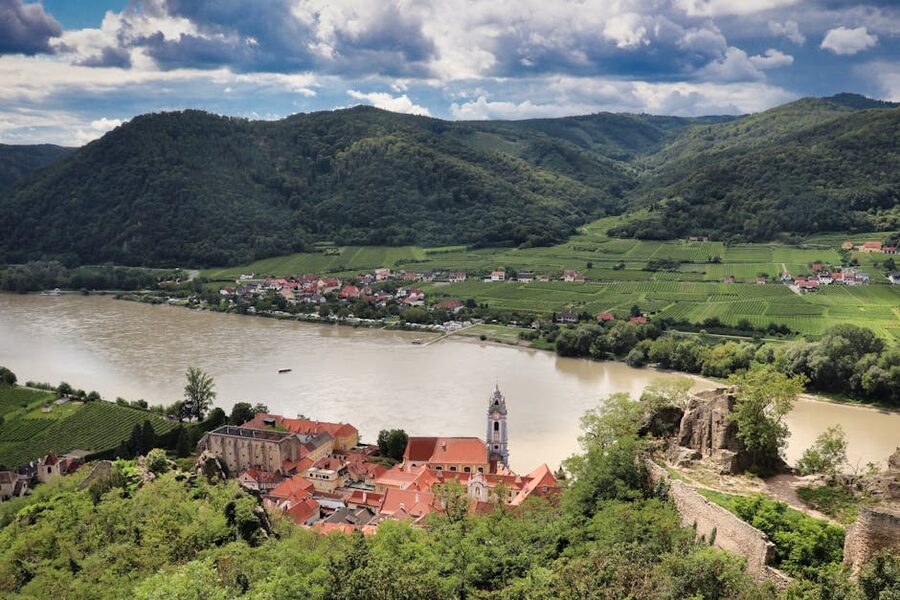
The 90-minute boat ride between Melk and Dürnstein is the middle part of the day and — for many visitors — the highlight.
You board at the Melk docks after the abbey visit. The boat is usually a 200-capacity river cruiser run by the DDSG Blue Danube company (the operator that still owns the actual “Blue Danube” brand, on the same river Strauss wrote the waltz about). Two-tier deck; lower deck has a café with Austrian wine by the glass (€4-7); upper deck has open-air seating and the full panorama.
What you pass, in order from Melk:
Schönbühel Abbey. 15 minutes downstream. A medieval castle-monastery hybrid built on a rock over the river. Currently being restored as a hotel.
Emmersdorf vineyards. The first terraced vines on the southern bank. Rows of Grüner Veltliner climbing the cliffs at a 45-degree angle — these terraces date from the 12th century, built by monks using local stone.
Spitz and the Tausendeimerberg (“1000-bucket mountain”). A vineyard-covered hill that, according to local lore, produces exactly 1,000 buckets of wine per year in the best vintages. Mostly a marketing story; the real number varies.
Weissenkirchen. The largest village along the route, with a fortified 15th-century church visible from the boat. Most tours don’t stop here but some pull in briefly.
Dürnstein. Your actual stop. The boat pulls into the Dürnstein docks; you step off for 45-60 minutes.
What to do on the boat: sit on the upper deck if the weather allows. Bring sunscreen in summer — the reflection off the water is intense. Order a glass of Wachau Grüner Veltliner from the lower deck; drinking Austrian wine while floating through Austrian vineyards is the whole point. Photos are best from 20 minutes after Melk (when the terraces fully open up) until 10 minutes before Dürnstein.
What not to do: pack your day full enough that you can’t enjoy this part. Many visitors treat the cruise as “just the transport between stops” and miss the point. Put the phone down, accept that 90 minutes at 15 km/h is what you’re here for, and watch the terraces go by.
Dürnstein and the Richard the Lionheart Story
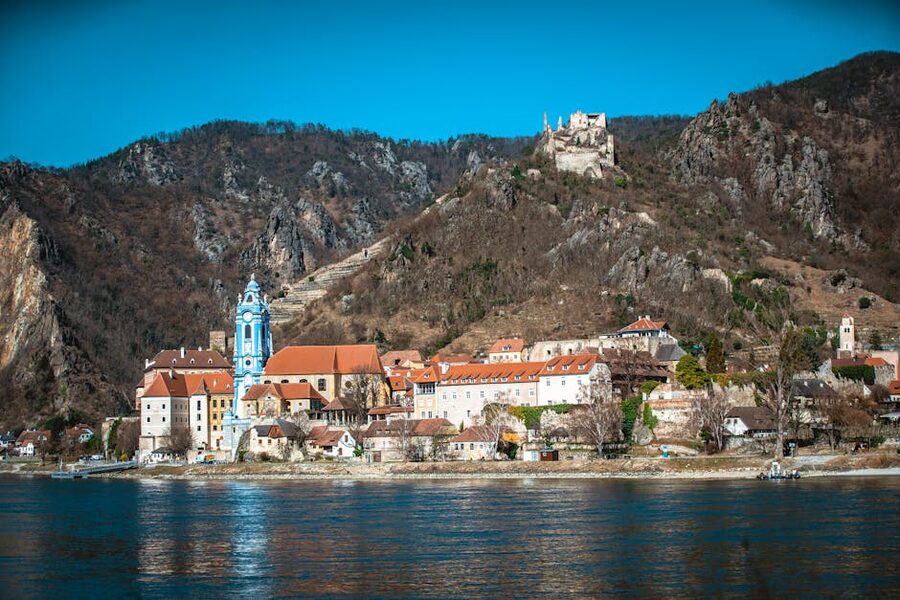
Dürnstein is the day’s second stop and a 45-60 minute village visit. It’s genuinely small — 850 permanent residents, one main cobblestoned street, and the abbey and castle as the two anchoring sights.
Stift Dürnstein (the blue-towered abbey). An Augustinian monastery from 1410, Baroque-reconstructed 1721-1733. The bright azure-blue tower is the signature landmark — you can see it from the boat as you approach. The interior has a notable collection of late-Baroque religious art. €6.50 entry (included in most day-trip tickets). 20-30 minutes inside.
The Dürnstein castle ruins. The Richard the Lionheart site. Ruins are on the cliff 100 metres above the village, accessed by a footpath from the Marktplatz (the main square). 15-20 minute climb on a reasonably steep path; good shoes recommended. The ruins themselves are modest — broken walls, a restored tower — but the view over the Wachau is the single best panorama of the valley. Free to visit.
The Richard backstory (for the history-curious):
In November 1191, Richard I of England and Leopold V, Duke of Austria, were both fighting at the siege of Acre during the Third Crusade. Leopold’s men captured the city walls; Richard ordered Leopold’s flag torn down and replaced with the English and French royal flags (the Crusade’s nominal leaders). Leopold took it as a personal insult; he withdrew his troops and returned to Austria.
A year later, Richard was sailing home from the Crusade when he was shipwrecked on the Adriatic. He tried to cross Europe by land in disguise (as a merchant, then as a Templar, then as a kitchen boy). In December 1192 he was recognised at an inn near Vienna — some accounts say a ring gave him away — and arrested by Leopold’s men.
He was held at Dürnstein Castle from December 1192 to March 1193, then moved to various castles in the Holy Roman Empire (Trifels, Speyer, Regensburg, Würzburg). Released 4 February 1194 after a ransom of 150,000 marks — roughly 3 times the annual income of the English crown.
The Blondel legend. According to a 13th-century French romance, Richard’s faithful minstrel Blondel wandered Europe for months trying to find his king. He sang the first verse of a troubadour song Richard had co-written outside each castle until one day, from a tower at Dürnstein, he heard Richard sing back the second verse. Historians agree this almost certainly didn’t happen — but it’s the story every tour guide tells, and the local Dürnstein tourism board has commissioned three statues of Blondel to make sure you don’t forget it.
Other Dürnstein details: the village wine-and-apricot economy is the main draw after the castle. Try the Marillenschnaps apricot brandy at any of the Heurigen (traditional wine taverns) on the main street. €3-4 for a small glass.
Wachau Wine — Why It’s Actually Significant
Grüner Veltliner is the Austrian national grape, and the Wachau makes Austria’s best version of it. Three classifications tell you the level:
Steinfeder (under 11.5% alcohol). Light, young, meant to drink within 2 years. The cheapest tier; €8-15 per bottle. Most of the boat-served wine is Steinfeder.
Federspiel (11.5-12.5% alcohol). The midrange. More complex, slightly more aged, usually paired with Austrian food at meals. €15-25.
Smaragd (“emerald,” named after a green lizard that sunbathes on the vineyard walls). The top tier — 12.5%+ alcohol, late-harvested grapes, aged 2-5 years. Austria’s best whites. €25-60 per bottle; cellar-worthy for 10-15 years.
The Wachau’s terraced vineyards are what makes this possible. The south-facing cliffs catch maximum afternoon sun; the stone terrace walls reflect heat back into the grapes; the granite soil drains fast and stresses the vines (which produces more concentrated fruit). Roman winegrowers figured this out 2,000 years ago.
The monks who took over from the Romans — Benedictines at Melk from 1089, Augustinians at Dürnstein from 1410 — professionalised the trade. Stift Melk still owns working vineyards and produces commercially; you can buy the abbey’s own Grüner Veltliner and Riesling at the abbey shop.
Where to taste on a day trip: the abbey shop in Melk, the garden café at Melk, lunch restaurants in Dürnstein (Gasthof Sänger Blondel has a solid by-the-glass list), the boat’s lower-deck café. Most day-trip tours include a single glass with lunch; upgrade to the bike tour if you want proper multi-estate tastings.
Self-Organised vs Guided — The Maths
Guided day-trip: €141-151. Includes transport, abbey entry, river cruise, Dürnstein stop, English-speaking guide, usually lunch. 9-10 hours total. The mainstream option.
Self-organised by train + ferry: €50-65 total.
– Train Vienna → Melk (ÖBB, 1h15, €25 round-trip)
– Melk Abbey entry (€13.50)
– Ferry Melk → Krems (DDSG, €26 one-way)
– Bus/taxi Krems → Dürnstein (€5)
– Train Krems → Vienna (€20 round-trip)
You save €80-100 but lose the guided commentary, the pre-arranged timings, and the “set it and forget it” feel. Works if you’re confident with Austrian public transport and German signage. Takes 10-12 hours. Best for repeat visitors, strong German speakers, or budget travellers.
Self-organised by rental car: €80-100 (car rental + fuel + parking).
Faster than train (60-75 min drive), more flexible for stopping at Weissenkirchen or Spitz, but you lose the river cruise (unless you return the car and take the ferry, which defeats the point). Best for groups of 3-4 who want full-day flexibility.
Bike tour: €163 guided, €40-60 self-organised.
The actively different day. E-bike rental in Melk (€25-35 per day), ride the 35-km cycle path downstream to Krems/Dürnstein, train back. Vineyard-tasting stops on your own schedule. Best for active travellers; takes 8-10 hours including tastings.
Private driver: €400-600 for 4-6 passengers.
The luxury option. Door-to-door service, chosen stops, flexible timing. Pay per car not per person, so worth considering for groups. Lunch costs extra.
When to Go
Best time of year: April-May for apricot blossom season, and September-October for wine harvest. Both give mild weather and manageable crowds. The Wachau in early September during harvest is genuinely special — the vineyards are active, the wine taverns all open, the day-trip buses are fewer.
Peak (June-August): busy. Expect full tours, the Melk Abbey library packed with groups, and the boat at capacity. Book 1-2 weeks ahead. Temperatures get warm on the boat deck (30°C+ in July).
Apricot season (early-mid April): the Wachau’s 100,000 apricot trees bloom for about 10 days. Whole valley turns pink-white. Photographer’s dream. Dates vary year to year; check current forecasts.
Harvest (September): vineyards are active, Sturm (fermenting new wine) is served at every Heuriger, most visits are Austrian day-trippers rather than international tourists. Best cultural timing.
Winter (November-March): reduced. Boats run a limited schedule or shut down November-April. Most day-trips become bus-only during winter, which misses the point.
Best day of week: Tuesday-Thursday. Weekends draw Vienna day-trippers.
Best starting time: 8am departure from Vienna. Gets you to Melk when the abbey opens (9am) and beats the afternoon tour buses.
Avoid: Austrian school holidays in early July and late August, when domestic tourists add substantially to international visitor numbers.
Getting There Without a Tour
If you’re going independent, here’s the standard route:
Step 1: Train from Vienna to Melk. ÖBB Railjet or IC trains depart Vienna Hauptbahnhof every 1-2 hours. Journey 1h15. €12.50 one-way, €25 round-trip. Book at oebb.at or buy on arrival.
Step 2: Walk from Melk Bahnhof to the abbey. 10 minutes through the village.
Step 3: Abbey entry. €13.50 self-guided. Opens 9am. Last entry 4:30pm.
Step 4: Ferry from Melk to Krems. DDSG Blue Danube operates 2-4 daily sailings mid-April to end of October. €26 one-way. 90 minutes. Departures usually 11:30am and 3:30pm; check ddsg-blue-danube.at for current times.
Step 5: Stop at Dürnstein. The ferry stops briefly en route. Get off, spend 1-2 hours, catch a later ferry or bus onward.
Step 6: Train from Krems back to Vienna. Regional train every 30-60 min. 1 hour. €10 one-way.
Total per-person cost: €62-80 depending on ferry class. Compare to €141-151 guided. Whether the savings are worth it depends on your comfort with logistics.
Single ferry pass: €42 covers the full Melk-Krems round-trip with unlimited stops. Consider if you want to see multiple villages rather than just Dürnstein.
Combining with Your Vienna Itinerary
The Wachau day-trip is 9-10 hours, which makes it a full day. Budget it as a complete day:
4-day Vienna trip: Day 1 Vienna city (Hofburg, Kunsthistorisches Museum, walking tour). Day 2 Schönbrunn Palace morning, Schönbrunn Zoo afternoon. Day 3 Wachau day-trip. Day 4 final day (Belvedere, food tour, classical concert).
3-day Vienna trip: compress days 1-2 above, keep the Wachau as day 3. Tightish.
With Hallstatt from Vienna also on the list: pick one or the other on a 3-day trip. On a 5-day trip, both work (ideally not back-to-back — give yourself a Vienna city-day between them).
As part of a Danube river cruise: many multi-day Danube cruise operators run Melk-Dürnstein-Vienna routes. If you’re on one, you’ll already see most of this; skip the day-trip.
Wine-focused: the bike-tour option pairs well with a Vienna Heuriger evening (traditional wine tavern in Grinzing or Neustift, 30 min from central Vienna). Two days of Austrian wine across different terroirs.
Common Mistakes
Booking the cheapest tour without checking what’s included. Some operators include lunch, some don’t. Some include Dürnstein abbey entry, some don’t. Read the inclusions line carefully.
Trying to do Wachau AND Hallstatt in the same trip. Possible but exhausting, and the two aren’t similar enough to compare fairly — Hallstatt is lake-and-village, Wachau is river-and-vineyards. Pick one or plan both as separate full days.
Skipping Dürnstein castle because it’s “just a ruin.” The view from the top is the single best Wachau panorama. The ruin itself takes 10 minutes. Don’t skip.
Expecting Melk Abbey to be a quiet monastery experience. It’s one of Austria’s top 10 tourist attractions — 400,000 visitors a year. Peak hours the library corridor can be 30 people deep. Go on the first tour slot (9am) for the quietest experience.
Not eating at a proper Heuriger. Most day-trips include a basic lunch; some visitors skip the Heuriger option and regret it. If you have 90 minutes free in Dürnstein, skip the boat café and eat at Gasthof Sänger Blondel or Heuriger Mayerhofer — €15-25 for a traditional Austrian platter with a glass of Grüner Veltliner.
Trying to photograph the abbey library properly. Non-flash only, and the space is low-light. Phone photos usually fail. Accept this and look with your eyes; the guided tour commentary is what makes the library come alive, not the photos.
Forgetting the Wachau is a working agricultural valley. It’s not a museum town. During harvest you’ll see tractors, workers, and farm traffic. That’s part of the charm, not a bug.
Practical Details
Duration: 9-10 hours from Vienna door-to-door.
Cost: €141-163 guided; €50-80 self-organised.
Best operator: GetYourGuide’s mainstream option (Wachau, Melk Abbey and Danube Valleys Tour) is the default. Viator’s version is functionally equivalent.
What to bring: sunscreen (strong on the boat), hat (the upper deck is exposed), layer (the boat wind gets cold), comfortable shoes (Dürnstein climb).
Food: most tours include lunch. If yours doesn’t, eat a proper meal in Melk (Gasthof Goldener Ochs €15-25 mains) or wait for Dürnstein (Heuriger Mayerhofer €12-22).
Language: English widely spoken. Audio guide at Melk Abbey is in 10+ languages. Dürnstein signage is mostly German but tourist-facing staff speak English.
Toilets: Melk Abbey has good public facilities. The boat has toilets on both decks. Dürnstein has public WCs near the boat dock (€0.50).
Photography: boat deck, abbey exteriors, gardens, Dürnstein castle — all allowed. Library and church require non-flash only.
The Short Version
Book the €151 Wachau day-trip from Vienna for an 8am departure. Morning at Melk Abbey (library, church, gardens), 90-minute Danube cruise through the terraced vineyards, 45-60 min in Dürnstein (walk the main street, climb to the castle ruin for the view, glass of Grüner Veltliner at a Heuriger), bus back to Vienna by 6pm.
If you’re a strong independent traveller, go self-organised for €60-80. If you want to pedal instead of float, book the €163 bike tour. If you’re doing both Wachau and Hallstatt, do them on separate days with at least one Vienna-city day in between.
The Wachau is where you learn that Austria’s second-most-important Habsburg-era tourist region isn’t Salzburg or Hallstatt — it’s this 36-km river valley that still does what it did for the Romans, the medieval monks, and Strauss’s waltz. Worth a full day.
Affiliate disclosure: Some links in this article are affiliate links. If you book through them we may earn a small commission at no cost to you. All recommendations are based on my own visit.