The striking idea here is that a forest walk can also be a passage through Ryukyuan creation stories. At ASMUI, ancient karst rock formations set the scene for tales of Amamikyu, the creator god said to have descended here and begun making the Ryukyu world.
I like two things in particular: you can explore at your own pace with an audio guide for 26 named sites, and much of the route is shaded beneath Yanbaru’s subtropical forest. One thing to weigh is that the walk may feel smaller and less dramatic than the promotional language suggests, and shade does not make Okinawa’s heat disappear.
- Key points before you go
- What makes ASMUI different from beachside Okinawa
- Beginning the walk beneath Yanbaru’s trees
- Reading the rocks and the creation story
- Goku Rock and the named spiritual stops
- The Churaumi Observation Deck and northern views
- Shade helps, but Okinawa still feels hot
- Is the ticket good value?
- Getting the most from a self-guided visit
- Who will enjoy ASMUI most
- Should you book ASMUI Spiritual Hikes?
- FAQ
- How long does the ASMUI walk take?
- What are the opening hours?
- Is the walk guided?
- Should I download the audio guide before arriving?
- What should I wear and bring?
- What is included in the ticket?
- What ages qualify for adult and child tickets?
- How long is the voucher valid?
- Can I change or cancel my booking?
- Where is ASMUI located?
- The Best Of Okinawa!
- More Hiking & Trekking Tours in Okinawa
- More Tours in Okinawa
- More Tour Reviews in Okinawa
Key points before you go
 1 / 4
 2 / 4
 3 / 4
 4 / 4
- A sacred site with a specific origin story: Asumui means four-linked rocky mountains in the Ryukyuan language, and local mythology connects the area with Amamikyu.
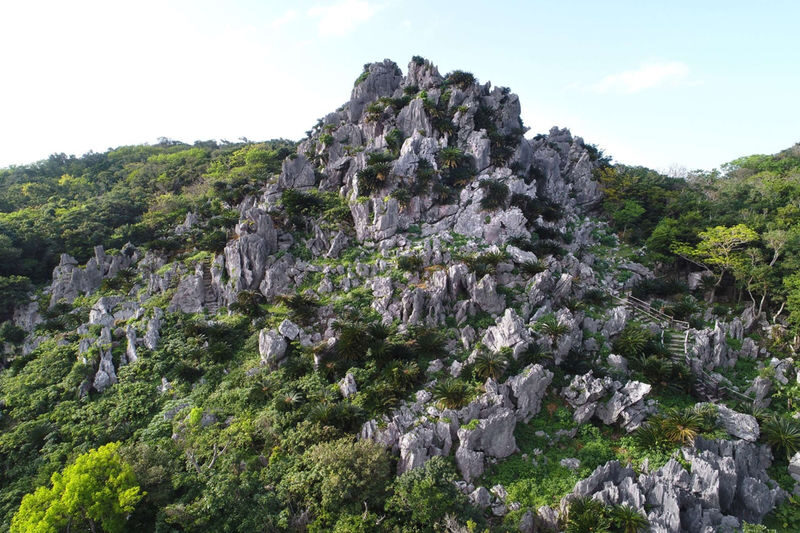
- Ancient northern tropical karst: The unusual rocks formed over roughly 250 million years.
- Twenty-six audio stops: Download the guide before arriving, since the signal inside the park is weak.
- Named rock formations and a sea view: The route includes Goku Rock, the Stone of Life’s Reincarnation, and the Churaumi Observation Deck.
- A manageable, warm-weather walk: Plan for around 1.5 hours, wear athletic shoes, and bring water and sunscreen in summer.
- A low entry price, with limits: Tickets start at $6.29, but the visit is self-guided and the price does not include transport.

👉 See our pick of the Our Picks For The 4 Best Drinking Tours In Okinawa
What makes ASMUI different from beachside Okinawa
Okinawa often brings to mind beaches, aquariums, and resort towns. ASMUI offers a different day out: a walk among limestone formations in Yanbaru National Park, in the northern part of Okinawa Island. It is a good choice if you want nature and local spiritual traditions rather than another stretch of sand or a shopping stop.
The site was formerly known as Daisekirinzan and has been reworked as ASMUI Spiritual Hikes. The new name draws on the Ryukyuan word for four linked rocky mountains. The place is also known as Amamikunumu, or Amamikyu no Mori, and has been designated a National Place of Scenic Beauty since 2015.
That designation matters because the appeal here is not just visual. The rocks and forest are tied to Okinawan cultural memory and religious tradition. You do not need to share those beliefs to appreciate the care taken to connect the natural setting with its stories. But the experience will make more sense if you arrive ready to listen, not only to look.
You can also read our reviews of more hiking tours in Okinawa

Beginning the walk beneath Yanbaru’s trees
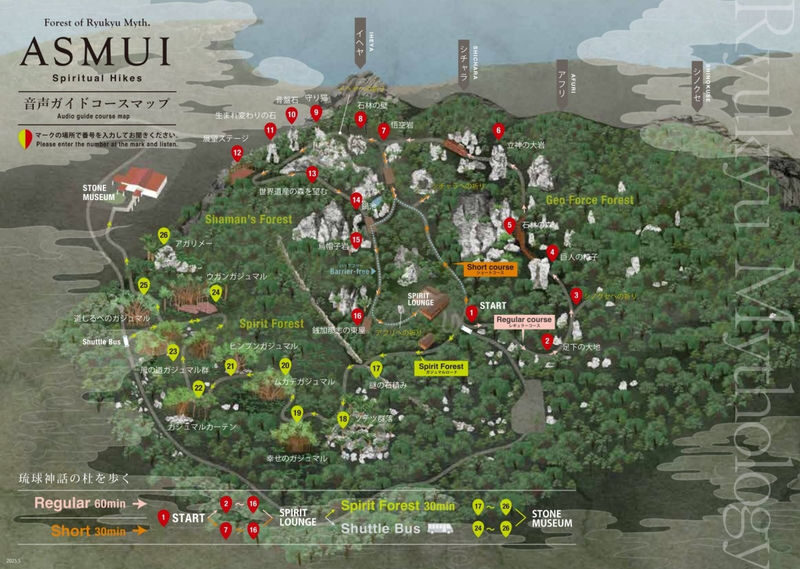
This is a self-guided visit, not a live guided tour. You use a digital audio guide on your phone to learn about 26 points along the route. The guide is available in English, Chinese, and Korean, giving you a way to follow the site’s stories without needing a group tour or a set departure time.
Download the app and audio content before entering. Mobile internet is weak inside the park, so waiting until you reach a stop to load the guide could interrupt the visit. Check that your phone has enough battery, too, since you will use it to follow the narration as you walk.
The visit takes about 1.5 hours, though your pace and how long you spend at each stop will shape the timing. That makes ASMUI a reasonable half-day addition to a wider trip, rather than a full-day activity on its own. The official opening hours are 9:30 a.m. to 5:30 p.m., with last entry at 4 p.m. Arriving well before last entry gives you time to walk without racing the clock.
Reading the rocks and the creation story
The central natural feature is a rare tropical karst formation. The rocks have been shaped over roughly 250 million years, and their irregular forms give the route its sense of age and character. Rather than expecting a single grand viewpoint, think of the walk as a series of smaller encounters with stone, forest, and story.
The audio guide ties the natural setting to Ryukyuan mythology. According to the tradition associated with this place, Amamikyu descended here and created the Ryukyu world. That story gives the rocks a role beyond scenery: they become part of a sacred beginning, and the walk becomes a way to encounter a distinctly Okinawan account of origins.
You can take this at your own speed. Pause when a formation catches your eye, listen to the relevant story, or move on if you prefer a brisk walk. The format is useful for independent visitors, though it asks you to manage your own attention. If you tend to lose track of audio while watching your footing, stop somewhere safe before starting each segment.
Goku Rock and the named spiritual stops
Among the 26 places are Goku Rock and the Stone of Life’s Reincarnation. Their names set the tone: this is not simply a geology trail with labels, but a route where natural forms are read through spiritual ideas and local myth. The audio gives you a reason to look closely and consider how people have understood the place.
The names may sound grand, but it is wise to keep expectations grounded. A rock formation can mean something powerful within a tradition without looking monumental to every visitor. The walk’s value comes from the combination of setting and interpretation, not from a promise that every stop will produce a dramatic view or revelation.
I would treat these spots as prompts for attention. Notice the shape of the rock, listen to the story, and decide what resonates with you. If you are primarily seeking spectacular scenery, the spiritual context may matter less to you, and the site may feel modest. If you enjoy the link between folklore and place, the stops give the walk more purpose.
The Churaumi Observation Deck and northern views
The Churaumi Observation Deck offers distant views of Okinawa’s northern sea. It is a change of emphasis from the closer forest and rock formations, and a useful point to pause and look outward. The view is part of the visit, but the available details do not promise a broad panorama or specify visibility conditions, so I would treat it as a scenic stop rather than the sole reason to come.
The name Churaumi may be familiar from Okinawa’s better-known attractions, but here the focus is on the sea seen from the Yanbaru setting. The appeal is the contrast: forest around you, karst underfoot, and the northern coast in the distance. On a hazy day, the view may be less distinct, so let the rock formations and stories carry the visit as well.



Shade helps, but Okinawa still feels hot
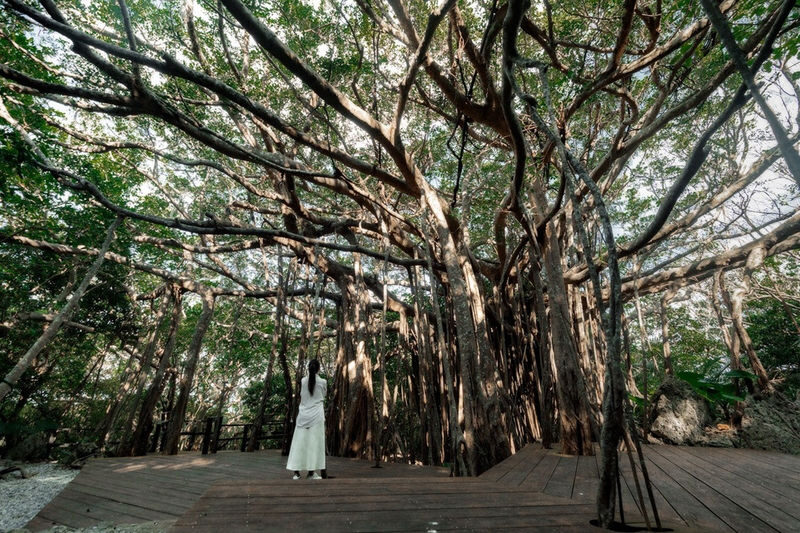
The walk is shaded for almost its entire length, a welcome feature in a subtropical climate. Even so, the shade does not remove the humidity or effort. A visitor completed the circuit in about 1.5 hours and still felt sweaty, a useful reminder to plan for heat rather than assume the trees will keep you cool.
Wear comfortable athletic shoes, as recommended. Bring drinking water and sunscreen in summer, even for a mostly shaded route. The advice is simple but practical: you will enjoy the stories and surroundings more if you are not preoccupied with sore feet or running low on water.
No information is provided about the trail’s accessibility, surface, or steepness, so do not assume that a forest walk is suitable for every mobility level. If you have specific needs, check directly with the attraction before booking. Likewise, families should consider that children will be walking and listening rather than taking part in a separate activity.
Is the ticket good value?
Admission starts at $6.29, a low entry price for a site with 26 audio stops and a walk through a rare natural formation. The value is strongest if you want a self-paced outing that combines nature with Okinawan mythology. You are paying for access to the site, not a live guide, transport, or a full-day program.
The audio guide is a key part of what makes the visit worthwhile. Without it, you would still have the rocks and forest, but much of the cultural interpretation would be harder to follow. Downloading it ahead of time is not a minor convenience; it helps make the ticket’s main feature usable once you are inside.
The price alone should not set your expectations. One visit took about 1.5 hours, and the setting was not as large or beautiful as that visitor had imagined. I would book for the combination of mythology, unusual stone forms, and a quiet forest walk, not because you expect a vast park or a succession of grand vistas.
Tickets are available for adults aged 15 and above and children aged 6 to 14. Children aged 15 or older pay the adult rate. The voucher is valid for 365 days from booking confirmation, and changes before redemption are free. You can cancel before redeeming for a full refund.
Getting the most from a self-guided visit
Before setting out, download the audio guide, charge your phone, and check the opening hours for your visit day. The park is listed as open every day from 9:30 a.m. to 5:30 p.m., with last entry at 4 p.m. Keep some time in reserve for stops that interest you; the route is self-guided, so there is no need to match another group’s pace.
The meeting point is given as 1241 Ginama, Kunigami, while the address information also gives 1241 Aza-Genka, Kunigami Village, within Yanbaru National Park. Since those forms differ, confirm the location details on your voucher or with the attraction before setting out. The attraction is in Kunigami, in northern Okinawa Prefecture.
This is not a transportation package. Plan how you will reach the site as part of your wider Okinawa itinerary. If you are staying in the south, the journey may take more planning than a nearby urban attraction, so consider pairing ASMUI with other northern Okinawa stops rather than treating it as a quick detour. No travel time or transport arrangements are included in the ticket details.
Who will enjoy ASMUI most
I would recommend ASMUI to you if you enjoy quiet walks, unusual rock formations, and cultural stories attached to a place. It is especially appealing if you have already seen Okinawa’s beach side and want a more reflective outing in Yanbaru. The audio stops make the visit accessible to independent visitors who are comfortable exploring by phone.
It is less likely to suit you if your main goal is a large-scale spectacle, a long guided hike, or a cool-weather escape. The walk is relatively short, the views are not guaranteed to feel expansive, and summer can still be sweaty despite the shade. Set expectations around a compact nature and mythology visit, and the experience is easier to appreciate for what it offers.
Should you book ASMUI Spiritual Hikes?
Book it if the idea of walking among ancient karst rocks while hearing Ryukyuan creation stories appeals to you. The low starting price, self-paced format, shaded route, and 26 audio stops make it an accessible way to spend about 1.5 hours in northern Okinawa.
Skip it if you need a major scenic spectacle to justify a trip or do not want to rely on your phone for interpretation. For the best value, download the guide in advance, bring water, and plan the visit as one part of a Yanbaru day rather than the whole event.
FAQ
How long does the ASMUI walk take?
The visit takes about 1.5 hours. Your pace and the time you spend listening at each of the 26 audio stops can affect the total.
What are the opening hours?
ASMUI is listed as open every day from 9:30 a.m. to 5:30 p.m. Last entry is at 4 p.m.
Is the walk guided?
No live guide is specified. You explore independently using a digital audio guide available in English, Chinese, and Korean.
Should I download the audio guide before arriving?
Yes. Internet signal inside the park is weak, so download the app and audio guide before entering.
What should I wear and bring?
Wear comfortable athletic shoes. In summer, bring sunscreen and drinking water.
What is included in the ticket?
The ticket includes admission to the attraction. Transport and a live guide are not listed as included.
What ages qualify for adult and child tickets?
Adult tickets are for ages 15 and above. Child tickets are for ages 6 to 14, while children aged 15 and older pay the adult rate.
How long is the voucher valid?
The voucher is valid for 365 days from the booking confirmation date and expires at 11:59 p.m. on its final day.
Can I change or cancel my booking?
Changes made before you redeem the voucher are free. You can receive a full refund if you cancel before redemption.
Where is ASMUI located?
It is in Kunigami, Okinawa Prefecture, within Yanbaru National Park. The address is given as 1241 Ginama and also as 1241 Aza-Genka, so confirm the location shown on your voucher before setting out.