
The mistake I see most often in central Madrid is the same one I almost made on my first trip. You buy a Royal Palace ticket online for noon, figure you’ll do Plaza Mayor and the Habsburg streets first, then stroll over for the palace tour. By the time you’ve taken your photos in the Plaza, the palace queue is two hundred metres long, the Almudena bells are ringing, and you’re standing in line behind a coach group from a cruise ship. You finally get inside at 1:40pm. Forty minutes later the city closes for lunch and you have nothing left.
An Essential Madrid combo tour sidesteps all of that. One guide, one ticket, three of the city’s biggest sights, and the queue handled for you.
Best skip-the-line: Madrid City Walking Tour & Royal Palace Skip-the-Line, $41 per person. Includes the palace ticket and the skip-the-line entry. The one to book if you only have one Madrid morning.


- What an “Essential Madrid” tour actually covers
- The two tours worth booking
- 1. Madrid Essential: Historic Center, Plaza Mayor & Royal Palace: .62 per group
- 2. Madrid City Walking Tour & Royal Palace Skip-the-Line: per person
- Which one to pick
- The mistake I keep watching people make
- Where the tours meet you
- What the route actually looks like, in order
- The Royal Palace: the part everyone underestimates
- Best time of day to go
- How the booking actually works
- How it stacks up against doing it independently
- What’s not on these tours
- A short history detour, because the buildings deserve it
- Practical bits
- Where to eat after
- Is it worth it
- Other Madrid guides worth a look
What an “Essential Madrid” tour actually covers
The label gets used loosely. Two operators can both list a “Madrid Essential” walking tour and run completely different routes. The two products worth booking, and the differences between them, are below, but here’s the shape of what the name should mean.
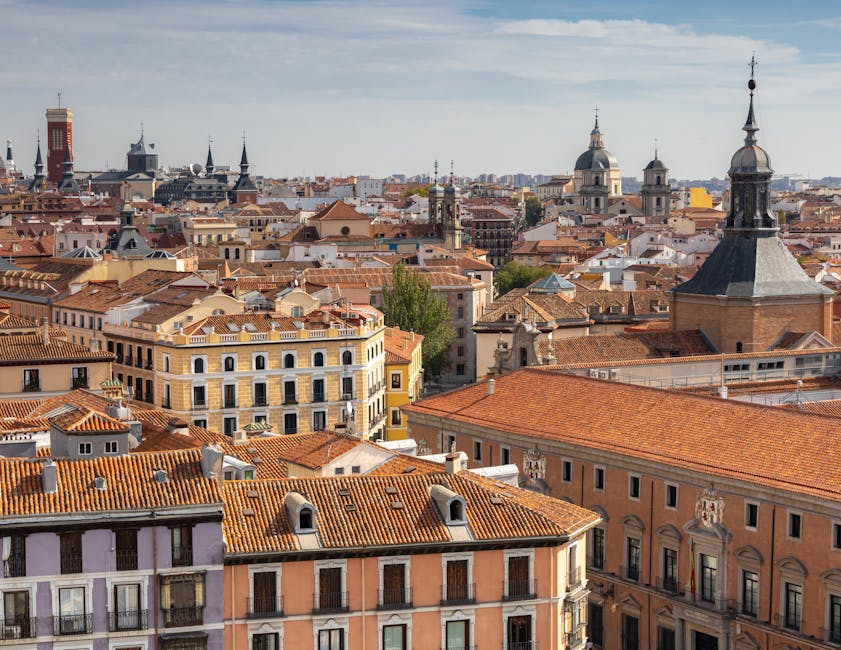
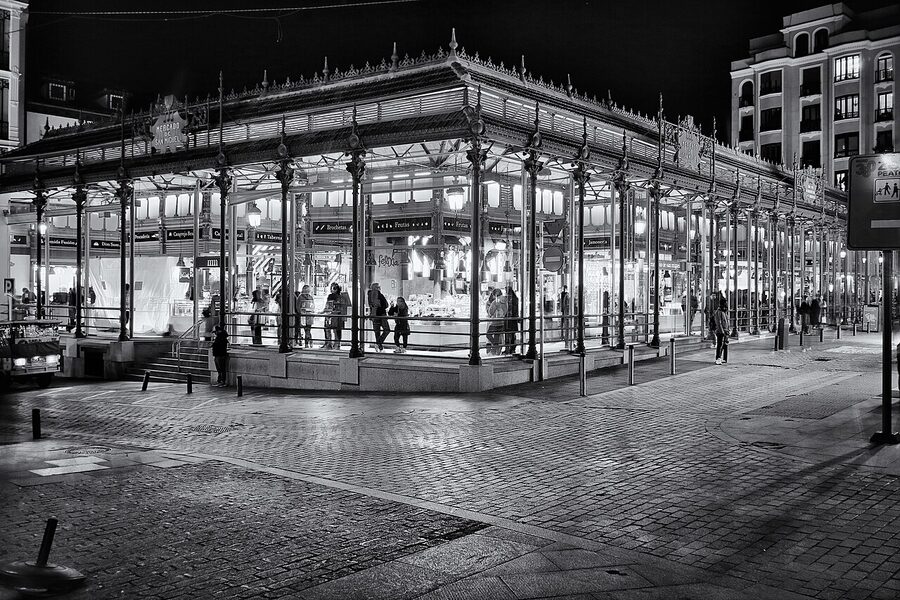
An Essential Madrid combo tour bundles the central Habsburg-era core (Plaza Mayor, Plaza de la Villa, the older Madrid de los Austrias streets), the Puerta del Sol crossroads, the Royal Palace exterior at minimum and ideally a Royal Palace interior visit with skip-the-line, and a glance at the Almudena Cathedral right next door. Most also pass Mercado de San Miguel without actually going in, guides know if a group of fifteen tries to push through it at lunchtime, you lose half of them in the cured-ham aisle.
Run time is 2 to 3.5 hours. Group size ranges from a free-walking-tour-style 25-person crowd to a small-group cap of 15. Languages on offer are mainly English and Spanish, with French and Italian on the bigger Viator runs.
The two tours worth booking
I went looking for combo products that genuinely deliver the brief above and not a watered-down version. Two stand out. They sit at opposite ends of the price spectrum, which is useful, you can pick by budget rather than fight to differentiate them.
1. Madrid Essential: Historic Center, Plaza Mayor & Royal Palace: $3.62 per group
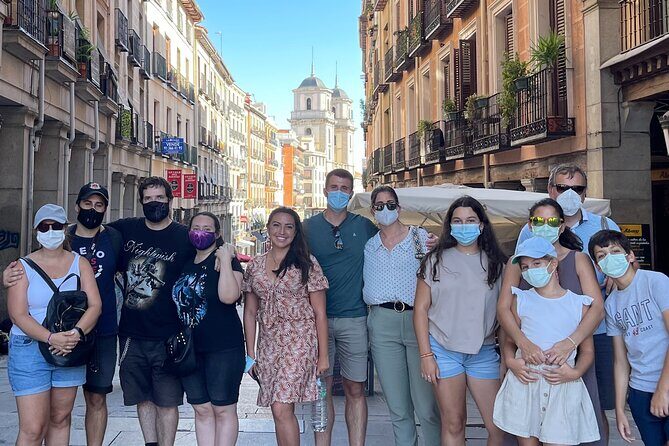
This is the budget pick that doesn’t feel cheap. Two and a half hours covering Puerta del Sol, the Habsburg streets, Plaza de la Villa, Plaza Mayor and finishing at the Royal Palace gates. Our full review of the Madrid Essential walking tour goes deeper on what guides like Javier and Mikael actually cover; the short version is the route is properly paced, the storytelling lands, and you finish in the right place to either go inside the palace or break for lunch. The catch: it stops at the palace gates, so you’ll need to add a separate ticket or skip the interior.
Check Availability
Read our full review
2. Madrid City Walking Tour & Royal Palace Skip-the-Line: $41 per person
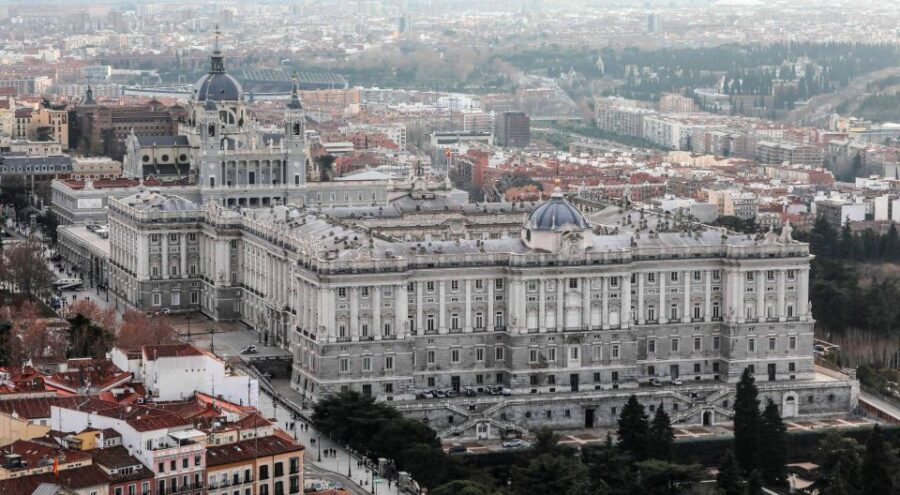
This is the one to book if you only have one half-day in central Madrid. Federico and Beatriz on the GetYourGuide pool are both good, see our full Madrid City Walking Tour and Royal Palace Skip-the-Line review for guide quality and pacing. The skip-the-line piece is the value-add: on a busy spring or summer day the standard palace queue can run 60-90 minutes, and that’s wasted on a tight Madrid itinerary.
Check Availability
Read our full review
Which one to pick
Cost isn’t the right axis. The real split is whether you want the palace interior or just the exterior with context.
Pick the Viator $3.62 group tour if you’ve already booked your Royal Palace ticket separately, or you don’t actually want the interior tour. The interior is a long, ornate-room slog if you’re not into European royal history, gilded ceilings, throne rooms, china collections. Some travellers honestly find the exterior and the Plaza de la Armería more striking than the inside.
Pick the GetYourGuide $41 skip-the-line tour if it’s your first Madrid trip and you want the palace done properly, or if you’re travelling on weekends, holidays, or in summer when palace tickets actually sell out. The combined price beats buying the components, and the skip-the-line is worth the difference on its own when the queue runs an hour.
The mistake I keep watching people make
It’s the same mistake every time. Someone books a Royal Palace ticket for 12:00 because that was the only slot left, plans to do Plaza Mayor “first thing”, and figures Madrid is small enough that the timing will work out.
What actually happens: Plaza Mayor takes longer than expected because it’s beautiful and you keep stopping. Then you realise the palace is a fifteen-minute walk, not five. Then the queue snakes out of the courtyard. By the time you’re inside, there’s an hour to go before everything in central Madrid closes for the afternoon Spanish lunch lull (most independent restaurants stop seating at 4pm, some kitchens close at 4:30). You finish the palace tour starving with nowhere to eat that isn’t a tourist trap.
A guided combo flips the order. Walking tour first while everyone is fresh, palace mid-late morning when you’ve got energy and the lines are ahead of the cruise-ship surge, lunch right after at one of the spots the guide quietly recommends on the way. The structure is doing the work.
Where the tours meet you
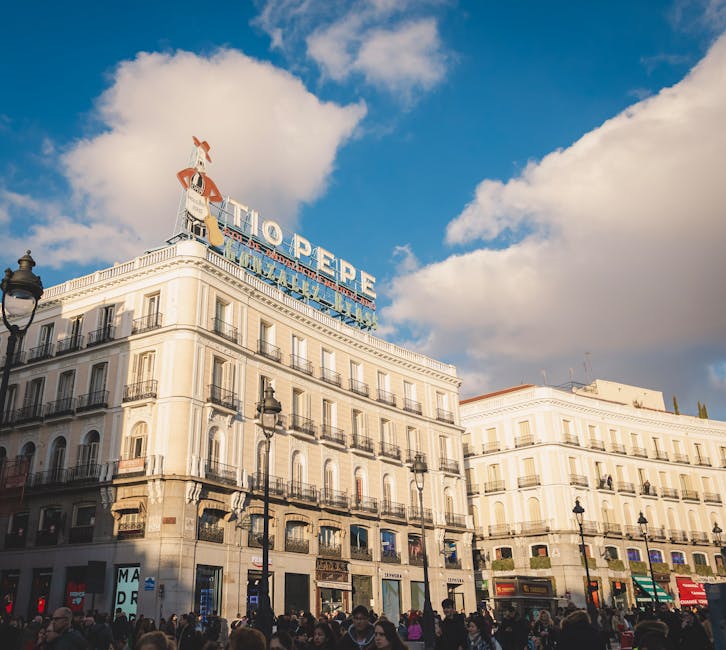
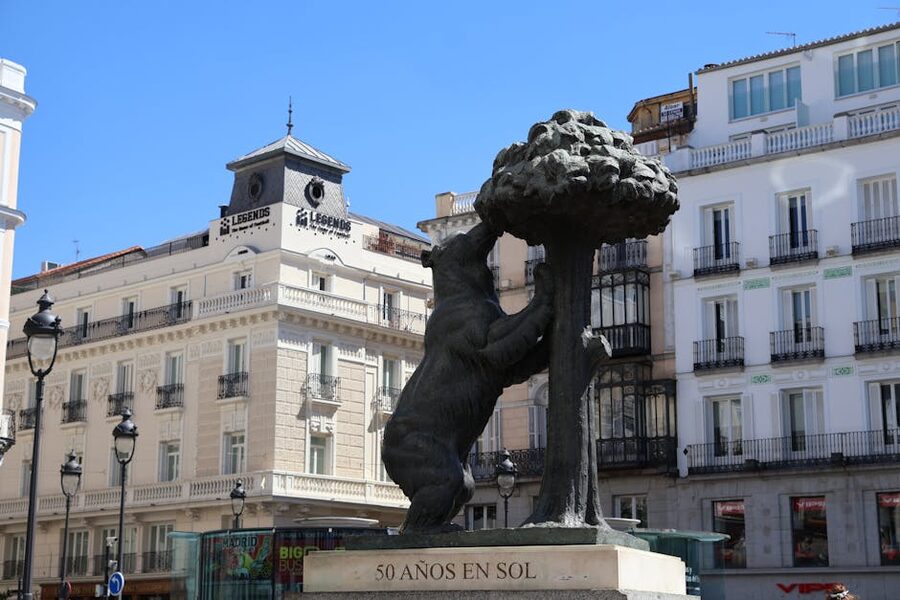
Both run from the Puerta del Sol area. The Viator group walk meets at the Bear and Strawberry Tree statue (the Oso y el Madroño) at the eastern end of the square, the bronze bear pawing the tree that’s on the city coat of arms. It’s the obvious pin on a map and a guide is always there with a coloured umbrella ten minutes before start.
The GetYourGuide skip-the-line tour usually meets a couple of streets away, often at the Plaza Isabel II by the Teatro Real, depending on the operator’s slot. Confirm the exact spot in the booking confirmation 24 hours out, some operators rotate meeting points by season because the Plaza Isabel works better in winter when the bear statue area gets too crowded with Christmas market stalls.
What the route actually looks like, in order
If you want to walk it before booking, or just understand what you’re paying for, this is the typical sequence both tours follow. They diverge slightly in the middle, but the bones are the same.
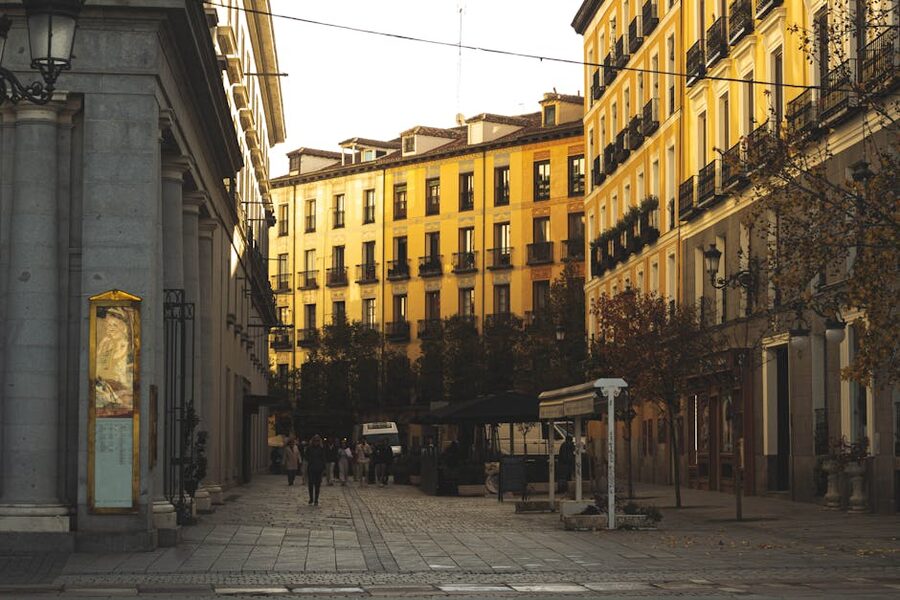
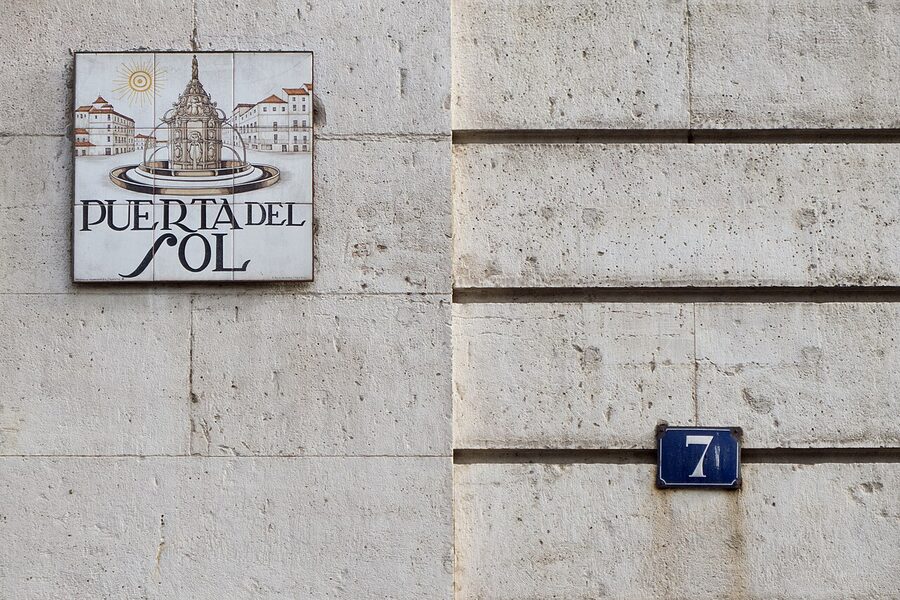
You start at Puerta del Sol, the literal kilometre zero of Spain, marked by a small brass plaque in front of the Casa de Correos. The clock on that building is the one Spain watches on New Year’s Eve. Most guides spend ten minutes here explaining the radial road system, then walk you west along Calle Mayor.
Calle Mayor was the city’s main spine before Gran Vía was carved through in the 1910s. You’ll pass the spot where the failed assassination attempt on Alfonso XIII happened on his wedding day in 1906, bomb hidden in a flower bouquet, killed twenty-five bystanders, the king and queen survived. The plaque is easy to miss; ask the guide to point it out.
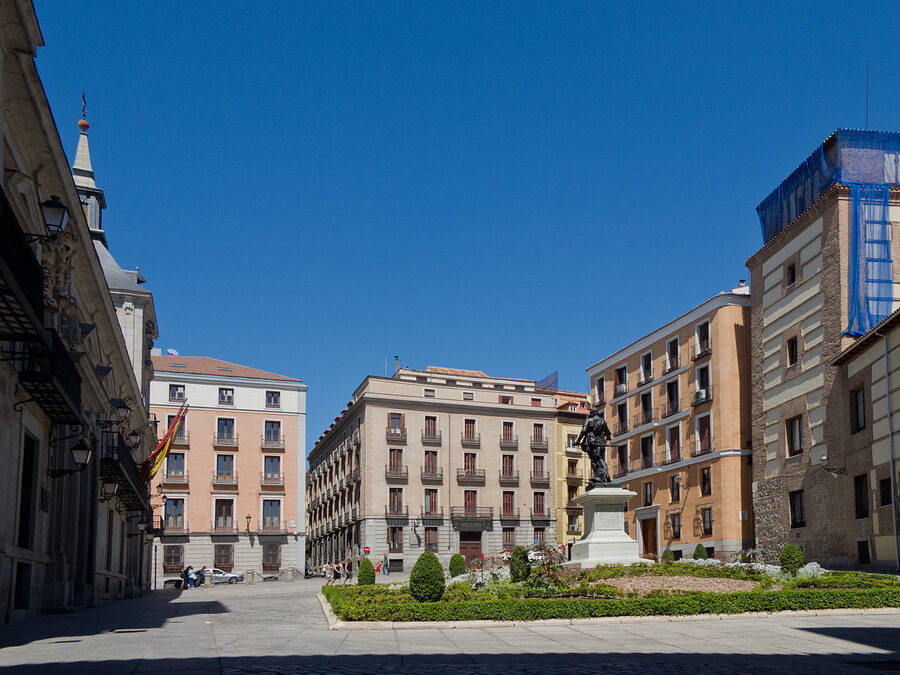

Plaza de la Villa is the next stop, small, tucked off Calle Mayor, easy to walk past on your own. This is where Madrid’s first town hall sat. The buildings around the square span the 15th to the 17th century. Two minutes here, then onwards.
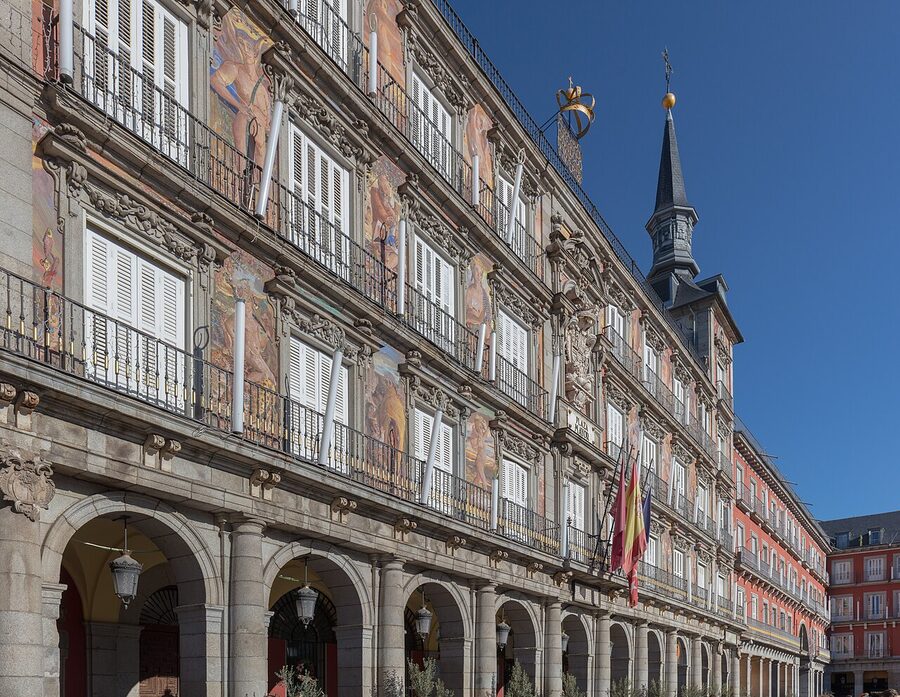
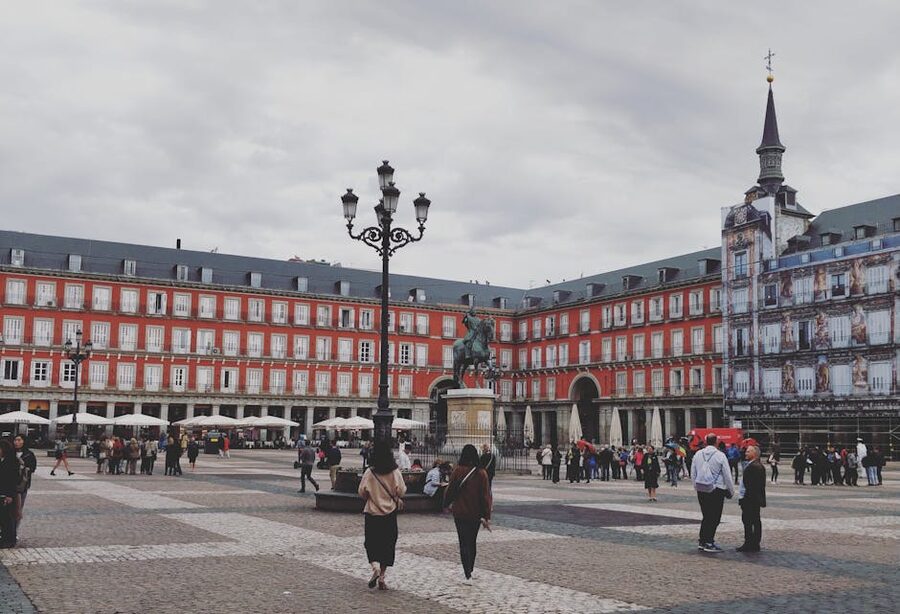
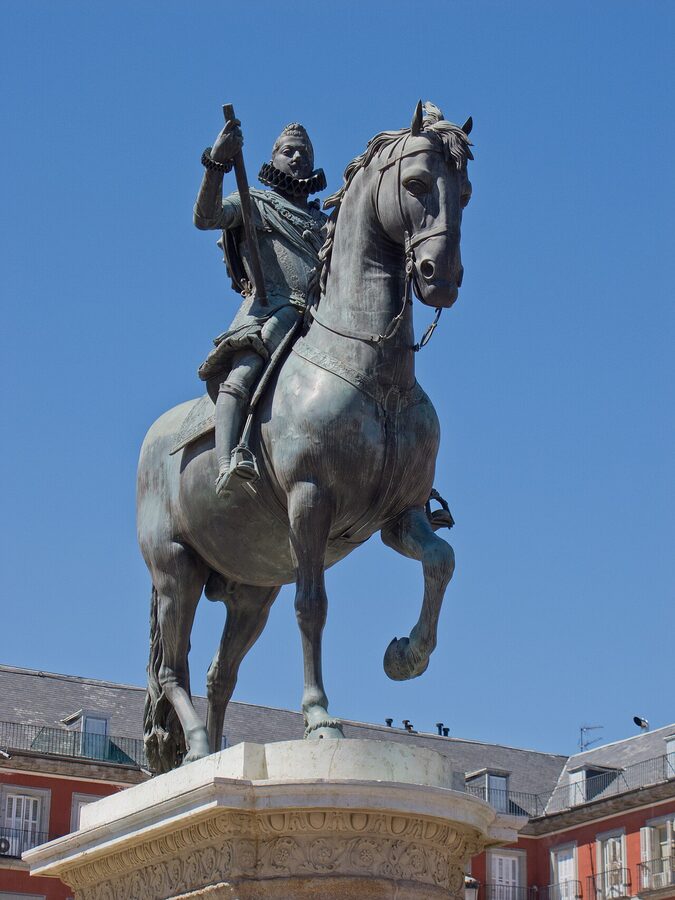
Plaza Mayor is the centrepiece. You enter through one of the nine arches, the most famous is the Arco de Cuchilleros on the southwest corner, dropping you down a steep step (this is where Goya’s painting of the executions happened, the same Plaza). Guides usually do their longest stop here, ten to fifteen minutes, walking you around the perimeter while pointing out the Casa de la Panadería frescoes, the Felipe III statue, and the bronze plaques marking the four arched exits.
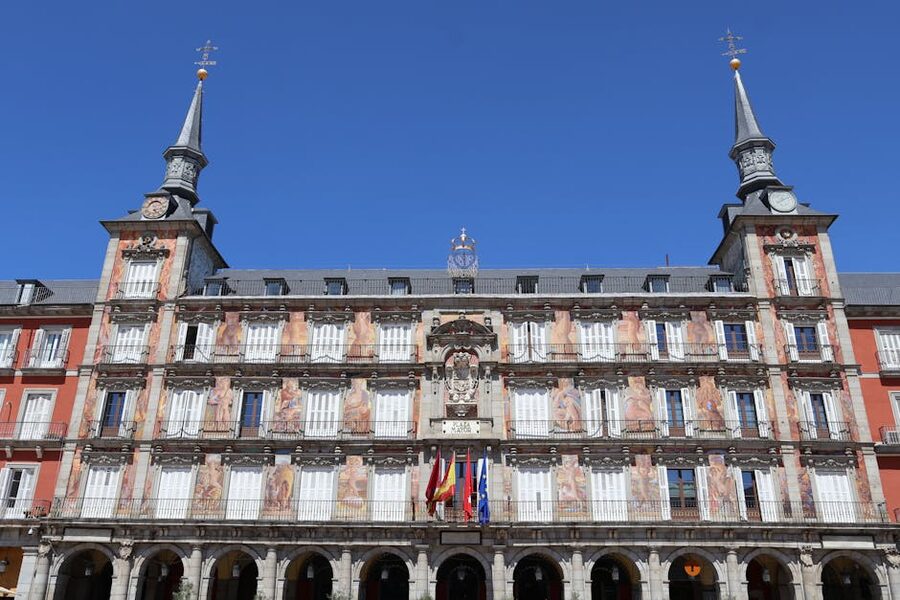
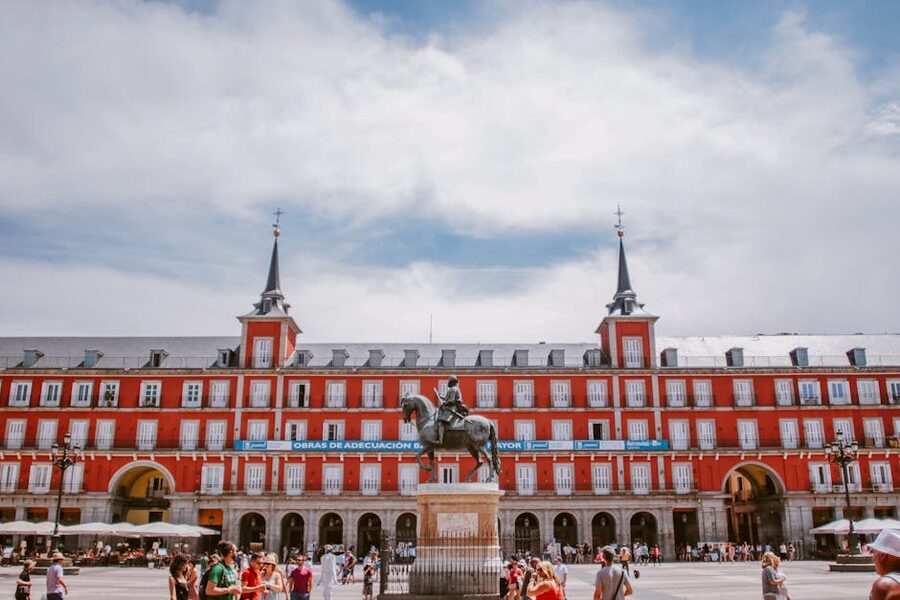
From Plaza Mayor most tours pop out the southwest corner, walk past Mercado de San Miguel (without going in, there’s no time, and the guide knows you’d lose people inside), then up Calle de la Cava de San Miguel to the Plaza de la Villa shortcut. The route loops down to Calle Bailén, where the cathedral and palace face each other across a wide pedestrian square.
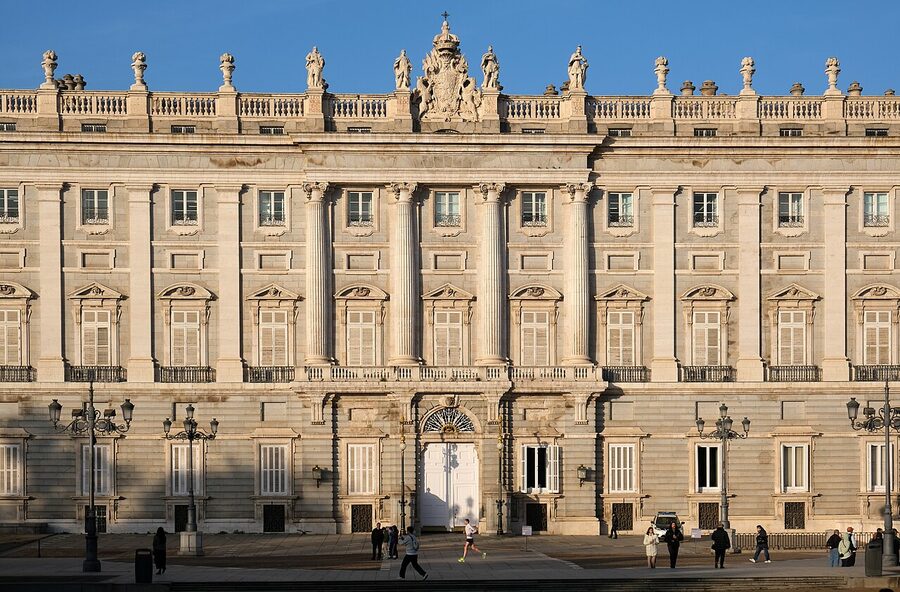
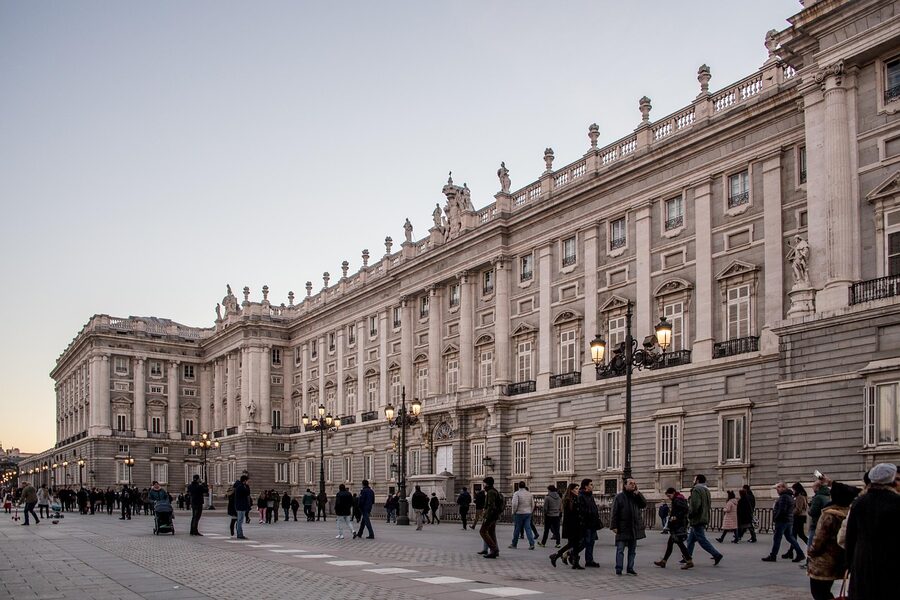
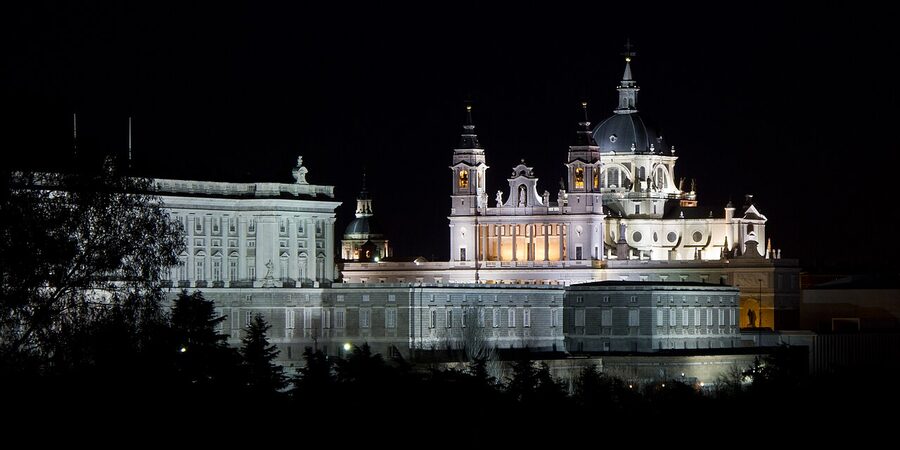
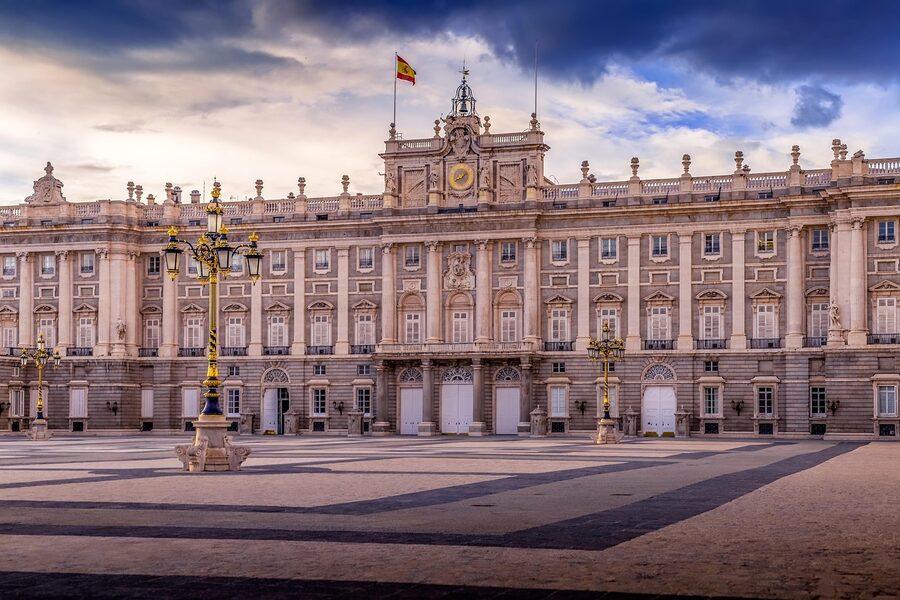
Plaza de la Armería sits between the Almudena Cathedral and the Royal Palace. This is where the cheap walking tour ends, you say goodbye to the guide here. The skip-the-line combo carries on through the palace doors. Inside, the standard route covers the Hall of Halberdiers, the Throne Room (the Tiepolo ceiling is the most photographed thing in the building), the State Dining Room with its 144-seat table, and either the Royal Armoury or the Royal Pharmacy depending on the day.

The Royal Palace: the part everyone underestimates
If you’ve never done a European royal palace before, this is one of the bigger ones. The Palacio Real has 3,418 rooms across roughly 135,000 square metres, which is more than double Buckingham Palace’s footprint. You’ll see maybe 25 of them on a standard tour. That’s the point, it’s a curated walk through about an hour’s worth of state apartments, not a museum.
The royal family hasn’t actually lived here since Alfonso XIII left for exile in 1931, but it’s still used for state functions. If you’re visiting on a day when an official ceremony is scheduled, the palace closes without much warning, your tour will still go (your money’s safe), the route just gets re-routed around the closed wing. Check the official site the night before if you’re booking a specific ticket independently; the combo tour operator handles this for you.
Best time of day to go
Mornings from 9:30 to 11:30 are the gold window. The palace opens at 10:00 (11:00 on Sundays), and the first guided slot of the day is the cleanest, fewer cruise groups, no school groups before 11, and the light through the throne-room ceiling is much better than midday. By 12:30 the palace queue triples and you start running into multi-language tour clusters in every room.
Avoid 14:00 to 17:00 entirely if you can. The Spanish lunch lull empties the streets but doesn’t actually empty the palace, tourists pivot to indoor sights when the cafés are full, so the interior gets denser exactly when the rest of the city quiets. Most central restaurants stop serving by 16:00 and don’t reopen until 20:00, which leaves you stranded.
Late afternoon (17:30 onwards) works in summer when the palace stays open until 19:00. The light is good, the cruise groups are gone, and you can walk to a tapas bar that opens at 19:30 immediately afterwards.
How the booking actually works
Both tours book the same way: pick a date, pick a time slot, pay online, get a confirmation email with the meeting-point pin and the guide’s umbrella colour. No printout needed, your phone is enough, but screenshot the confirmation in case the venue WiFi is slow.
The cheap Viator group walk is essentially free to book, the €3 fee covers the platform booking only, and you’re expected to tip the guide €5-10 per person at the end. Cancellation policies are loose because the tour costs nothing to operate per head; you can usually cancel up to 24 hours out. No-shows aren’t fined, but you’ve burned the slot for someone else.
The GetYourGuide skip-the-line is a real ticket, with a real palace ticket inside it. You can usually cancel up to 24 hours out for a full refund, but the palace ticket inside the booking is non-transferable, so don’t try to share it with a friend who couldn’t make it. ID is sometimes spot-checked at the palace door.
Group sizes worth flagging: the Viator $3.62 product can run up to 25 people in peak season, which is too many in Plaza Mayor on a Saturday, the guide loses the back of the group around the Felipe III statue. The GetYourGuide combo caps at 15 and is the better choice if you want to actually hear the storytelling.

How it stacks up against doing it independently
The case for going independent: the Royal Palace standalone ticket is €14, and the historic centre is genuinely walkable with a good guidebook or a phone audio guide. If you’re a confident traveller, you can do all three sights for €14 plus your shoe leather.
The case against: the audio-guide app does not skip the line, and the line is the actual problem. On a high-season Saturday in May or June, an unbooked palace queue can run 90 minutes, and on Heritage Days (Patrimonio) it stretches longer. €27 of palace queue saving is the real price gap between the GetYourGuide combo and DIY, not the €41 sticker price.
The other case for guided: a guide gets you the small details that the app misses. The location of the 1906 bomb. The story of the Casa de Cisneros architectural restoration. The Tiepolo ceiling being one of three he painted in Madrid before dying in the city in 1770. None of that is in the wall placards, and none of it shows up in a typical guidebook.

What’s not on these tours
Worth setting expectations. An “Essential Madrid” combo doesn’t cover Retiro Park, the Prado, the Reina Sofía, the Thyssen, the Gran Vía, the Salamanca shopping district, the Templo de Debod, or any of the Habsburg monasteries. It is genuinely just the central Habsburg core plus the palace.
If your Madrid trip is two full days, you do this on day one morning, the Prado on day one afternoon, and Retiro plus Reina Sofía on day two. Three days lets you add the Royal Palace gardens, Salamanca, and an evening flamenco show. Anything less than two days and you’re skipping at least one of the big four (Prado, Reina Sofía, Royal Palace, historic centre).
If you want a wider central-Madrid loop without the palace interior, an independent walking tour of central Madrid covers more ground, Retiro, Gran Vía, Salamanca’s edge, but doesn’t get you inside any sight. Different product, different reason to book it.
A short history detour, because the buildings deserve it
Madrid wasn’t always the capital. Felipe II made the call in 1561, picking it over Valladolid because the geography was more central and the politics easier. The city had been a small fortified Moorish town (Mayrit, the source of the modern name) for five centuries before that, with a population probably under five thousand. Within a hundred years of the capital decision it had grown to 150,000.
The Royal Palace sits where the original Alcázar fortress stood for eight hundred years. The Alcázar burned down on Christmas Eve 1734, fire crews spent the night saving paintings rather than the building, which is why the Prado now has so many Velázquez canvases that smell faintly of smoke if you get close enough. Felipe V used the rebuild as an excuse to commission a French-Italian Baroque palace that would outclass Versailles. The result is the largest functioning royal palace in Europe by floor area.
Plaza Mayor was completed in 1619 under Felipe III. It’s seen executions, royal weddings, bullfights, autos-da-fé, and at least four major fires. The current frescoes on the Casa de la Panadería are 1992, a Carlos Franco repaint, after the previous frescoes had faded so badly that they were almost invisible by the 1980s.
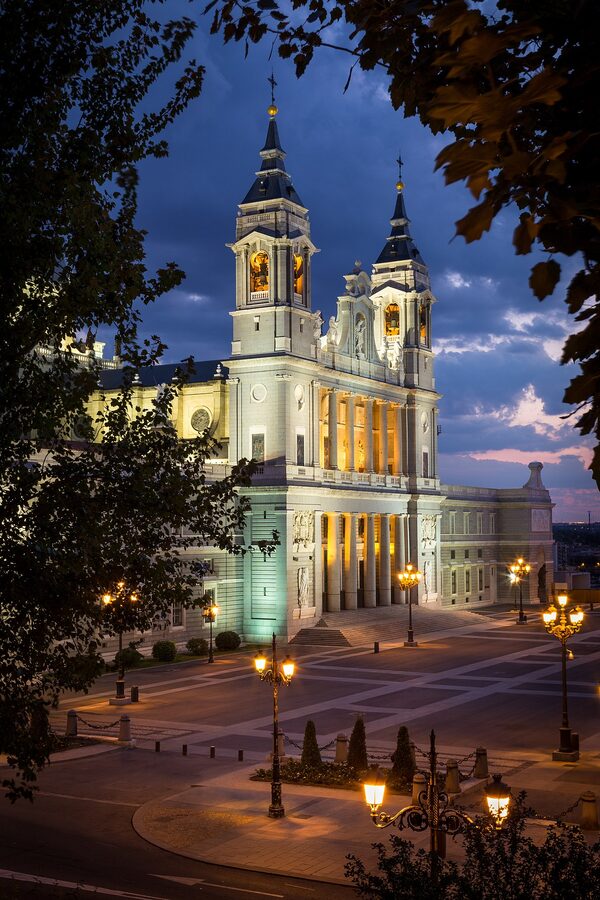
The Almudena Cathedral on the other side of the palace took 110 years to finish. Construction started in 1883 and the cathedral was only consecrated in 1993 by John Paul II. This is why Madrid was the only major European capital without a finished cathedral until the 20th century, every previous attempt got tangled up in political and Catholic-Spanish-state quarrels and stalled.

Practical bits
What to wear: closed shoes. The cobblestones in the Habsburg streets are uneven and the palace marble is slick in flat-soled trainers. Skirts and dresses are fine. There’s no formal dress code, but bare shoulders aren’t great in the cathedral if you’re going in for the bonus stop. Throw a scarf in your bag.
What to bring: water, especially May to September when central Madrid hits 38°C. There’s no fountain stop on the Viator route after Plaza Mayor and the palace doesn’t sell water on the standard route. A small day bag is fine; large backpacks have to go through palace security and slow you down.
Toilets: the cafés on Calle Mayor will let tour groups use theirs if you’ve ordered a coffee at the start. The palace has toilets after the main route ends, before the gift shop. There’s nothing in between Plaza Mayor and the palace, which is about a 25-minute walk plus stops.
Photography: allowed everywhere except inside the Royal Palace, where it’s prohibited beyond the entrance hall. You can photograph the Plaza de la Armería, the staircase, and the gardens. The throne room signage is enforced, staff will ask you to delete the photo.
Tipping: the cheap Viator group walk is tip-based, so €5-10 per person at the end is the expected range. The GetYourGuide combo is fully paid, so tipping is optional, €5 per person is generous if the guide was good.
Mobility: the Habsburg streets are not great for wheelchairs or strollers. The palace has lifts, but the connection between the walking tour and the palace entrance involves cobbles and one set of steps. If mobility is an issue, the panoramic bus tour covers more ground with less walking.
_03.jpg)
Where to eat after
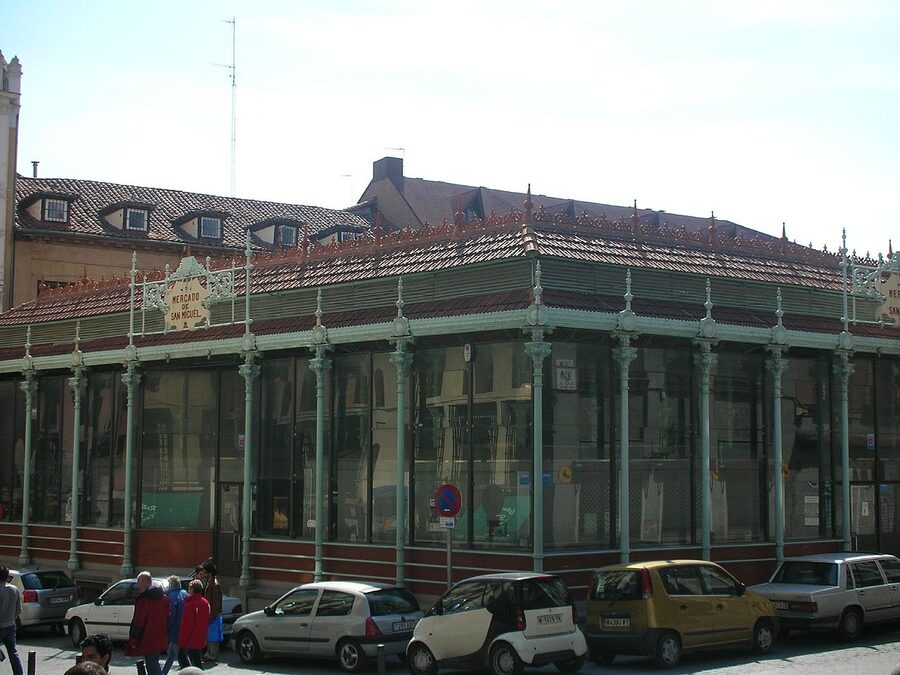
This is the question every guide gets at the end. Mercado de San Miguel is the obvious answer and the wrong one, overpriced, crowded, aimed at tourists. Walk five minutes past it and you’ve got better food at half the price.
For tapas, head to Calle de la Cava Baja, parallel to Plaza Mayor’s south side. Casa Lucas, Taberna Tempranillo, Casa Lucio (the proper old-school one) all sit on this street. Cava Baja runs about 300 metres and ten of those addresses are reliable. Lunch service runs to about 4pm, dinner from 8:30pm. Gap in between is the lull.
For a proper sit-down lunch at 14:00 specifically, Botín on Calle de los Cuchilleros (in the Guinness Book as the world’s oldest continuously operating restaurant, 1725) takes 90 minutes and is right behind Plaza Mayor. Their suckling pig is what they’re famous for. Book ahead, walk-ins on a weekend lose.
For a quick post-tour bite at 16:00 when most kitchens have closed, the Mercado San Miguel does work, it’s one of the few places that stays open through the lull, and the queues are shorter at 16:30 than at 13:30. Just don’t expect a meal so much as a tapas snack.
Is it worth it
The €3.62 Viator walking tour is worth it for everyone who can find Plaza Mayor on a map and isn’t going inside the palace. You’d be hard-pressed to do better for the money, even a coffee on Plaza Mayor costs more than the booking fee, and you get a Spanish-history-trained guide for two and a half hours.
The €41 GetYourGuide combo is worth it on first trips, weekend bookings, and any time the palace queue is a real risk. The skip-the-line element alone is worth €25 in saved waiting on a busy day, and the storytelling lifts the palace interior from “ornate rooms” to a connected narrative that makes sense.
Skip both if you’ve got a Madrid Pass already (it includes palace entry separately) or if you’ve done European royal palaces before and don’t want another. Versailles, Schönbrunn, Buckingham state rooms, they’re all variations on a theme. If you’re tired of the theme, do the historic centre on your own and put the Madrid time into the Prado or the Reina Sofía instead.
Other Madrid guides worth a look
If you’re also planning a Reina Sofía visit (Picasso’s Guernica is there, 7.76 metres long, fills a full wall), our Reina Sofía tickets guide covers the free-entry windows and which entrance to use. For the standard ticket queue, the Royal Palace tickets standalone piece is the right read if you only want palace entry without a guided combo. If you’d rather walk the city in your own time, the walking tour of Madrid guide covers the standalone walking-only options. And the panoramic bus tour is the right call for mobility-limited days or if you want to cover Retiro and the Salamanca district that this combo doesn’t reach.
For day trips out of Madrid, the Segovia, Ávila and Toledo combo is the punishing-pace three-cities-in-a-day option, and the Madrid tuk-tuk tour covers the small-alley access the bus can’t manage. The Toledo single-city day trip is the deeper alternative if Segovia isn’t on your list. And if Barcelona is also on the trip, our Barcelona one-day combo tour guide covers the equivalent product on the other side of the country.
Affiliate disclosure: this article contains links to GetYourGuide and Viator. If you book through them, we earn a small commission at no extra cost to you. It funds the next round of research trips. We only recommend tours we’ve actually evaluated.