
An older American woman on my last walking tour stopped on Szeroka Street, looked up at the Old Synagogue, and said her grandmother had left this exact street in 1936. She had photos, addresses, the lot. She had been to Auschwitz the day before and described it as duty. Kazimierz, she said, was where she came to find what her family had loved before they had to leave it. The guide just nodded and let her stand there for a minute. It is that kind of tour.
A Jewish Quarter tour in Krakow walks two neighbourhoods that lived through the same century in opposite ways. Kazimierz, north of the river, was the historic Jewish district from the 14th century until the war. Podgórze, across the Vistula, was where the Nazis crammed roughly 17,000 people into a sealed ghetto in March 1941. Most tours cover both, in that order, in two-and-a-half to three hours.
This guide is the practical version. How long, how much, where to start, which operator does what. And why a guided walk is the right way to see this part of the city even if you usually skip tours.



Best overall: Krakow Jewish Quarter and Former Ghetto Tour. Two-and-a-half hours, both sides of the river, English-speaking guide. Around $19.
Kazimierz only: Kazimierz Jewish Quarter Walking Tour. Tighter, around 90 minutes to two hours, focused on the synagogues and Szeroka Street. Around $27.
With Schindler’s Factory inside: Schindler’s Factory and Ghetto Guided Tour. Three hours, includes the museum entry plus the Podgórze ghetto walk. Around $57.
- What a Jewish Quarter tour actually covers
- Pick a tour: three I’d actually book
- 1. Krakow Jewish Quarter and Former Ghetto Tour:
- 2. Kazimierz Jewish Quarter Walking Tour:
- 3. Schindler’s Factory and Ghetto Guided Tour:
- How to actually book one
- Free walking tour or paid: what’s the difference
- The synagogues you’ll see
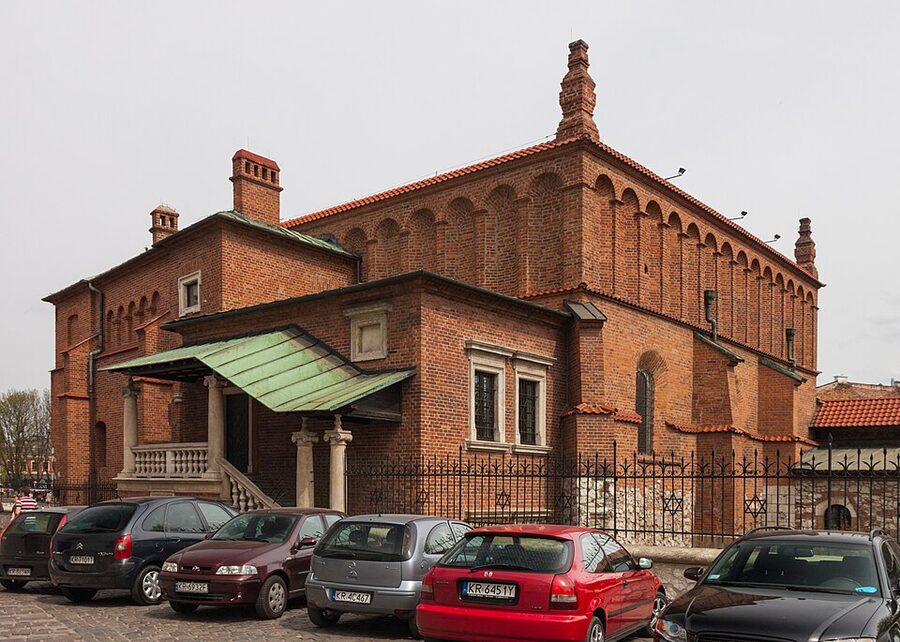
- The Old Synagogue (Stara Synagoga)
- Remuh Synagogue and the old cemetery
- Tempel Synagogue
- Isaac Synagogue (Synagoga Izaaka)
- The High Synagogue (Synagoga Wysoka)
- The Krakow Ghetto in Podgórze
- Plac Bohaterów Getta and the empty chairs
- The Eagle Pharmacy (Apteka pod Orłem)
- Schindler’s factory area
- A short history before you go
- Practical things to know
- How long
- What it costs
- What to wear
- Best time of year
- Best time of day
- Photography
- Children and pacing
- Combining the tour with the rest of Krakow
- Where to eat after
- Fitting the tour into a wider Krakow plan
What a Jewish Quarter tour actually covers
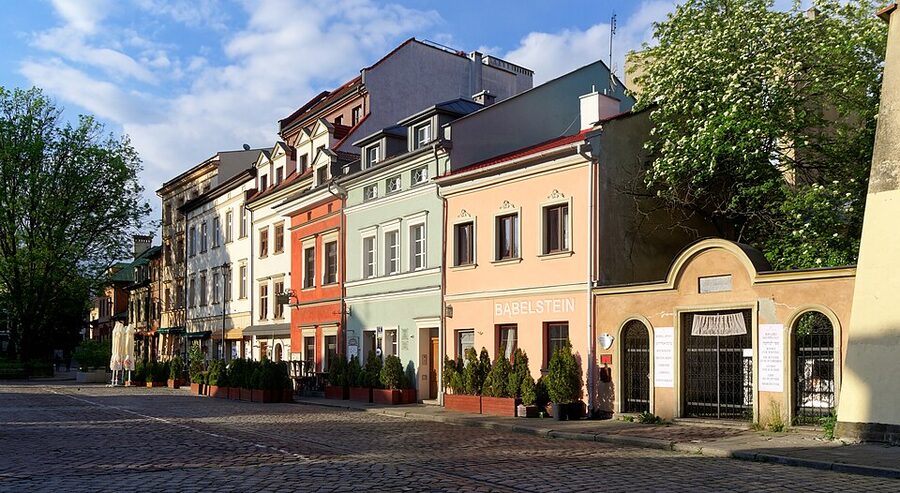
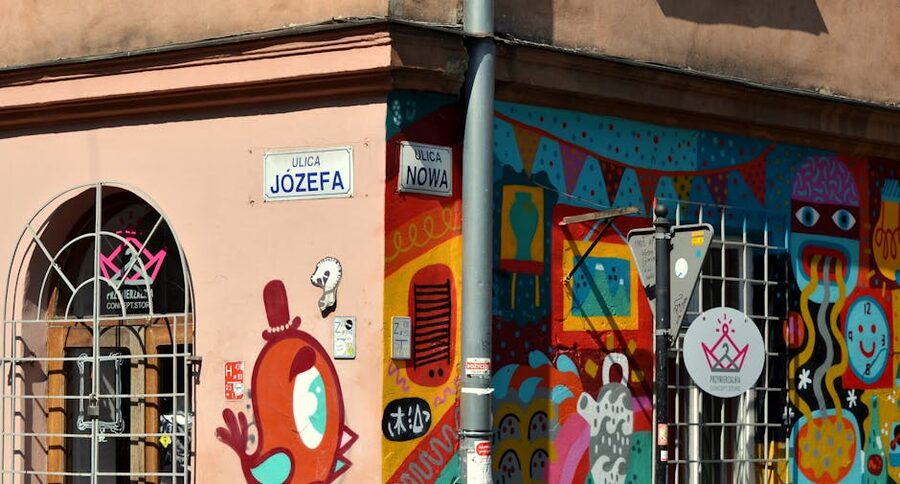
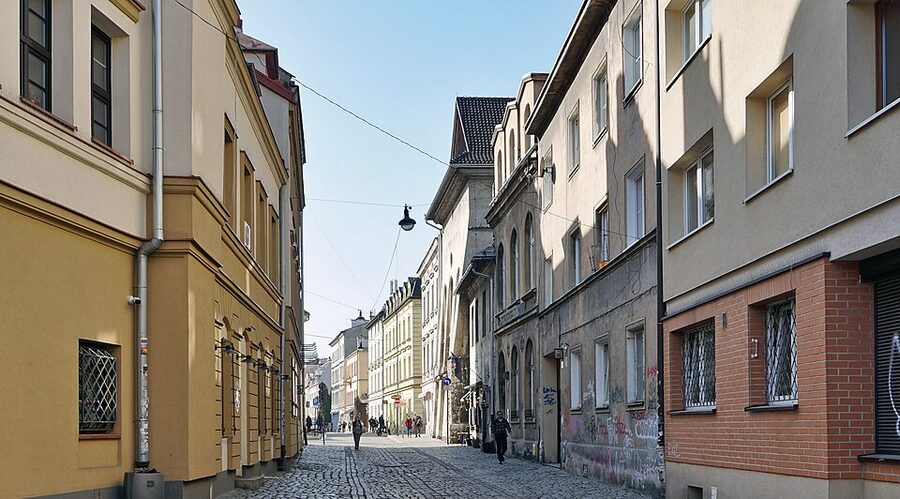
The standard route runs in two halves. Half one is Kazimierz, in the north. You walk Szeroka Street, see the Old Synagogue and Remuh on the same square, look at the old cemetery wall through its iron gate, then move on to the Tempel and the High Synagogue along Miodowa and Józefa. Most guides also point out the corner where Schindler’s List was filmed, because everyone asks anyway.
Half two crosses the Vistula on a footbridge. You enter Podgórze, which feels nothing like Kazimierz. Wider streets, less ornate. This is the former ghetto. The walk usually takes in Plac Bohaterów Getta with the chair memorial, the Eagle Pharmacy that ran inside the ghetto walls, and the surviving stretch of the wall on Limanowskiego or Lwowska Street. Some tours end here. Others continue another fifteen minutes to the gates of Schindler’s factory.
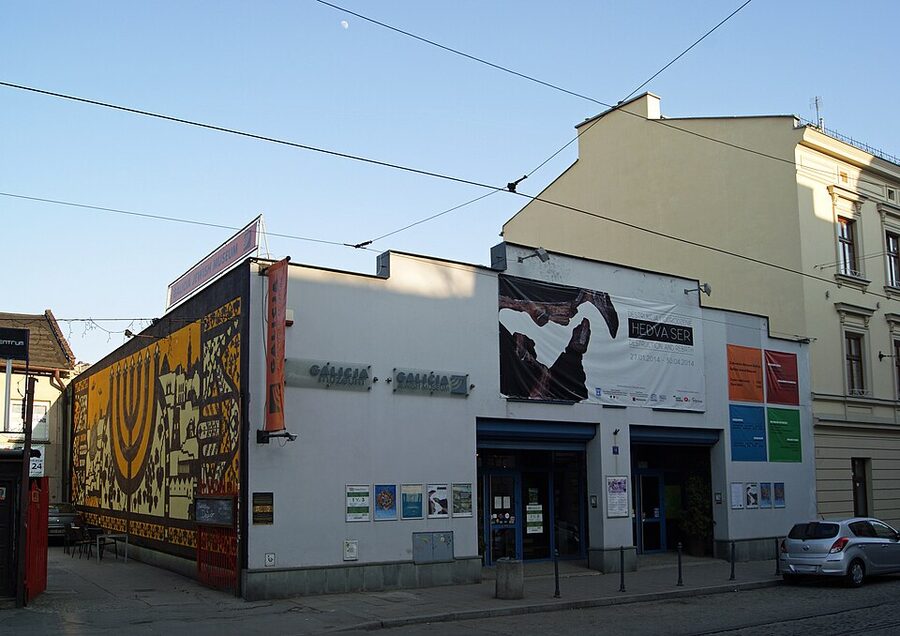
The thing to know is that almost nothing on this walk is open for entry. You’re seeing buildings from the outside. Synagogues that are still active places of worship are sometimes accessible (Tempel and Remuh both run as functioning shuls), but you’re paying for narration on the street, not museum tours behind the doors. If you want to go inside the Old Synagogue or the Galicia Jewish Museum, you do that separately.
Pick a tour: three I’d actually book
1. Krakow Jewish Quarter and Former Ghetto Tour: $19
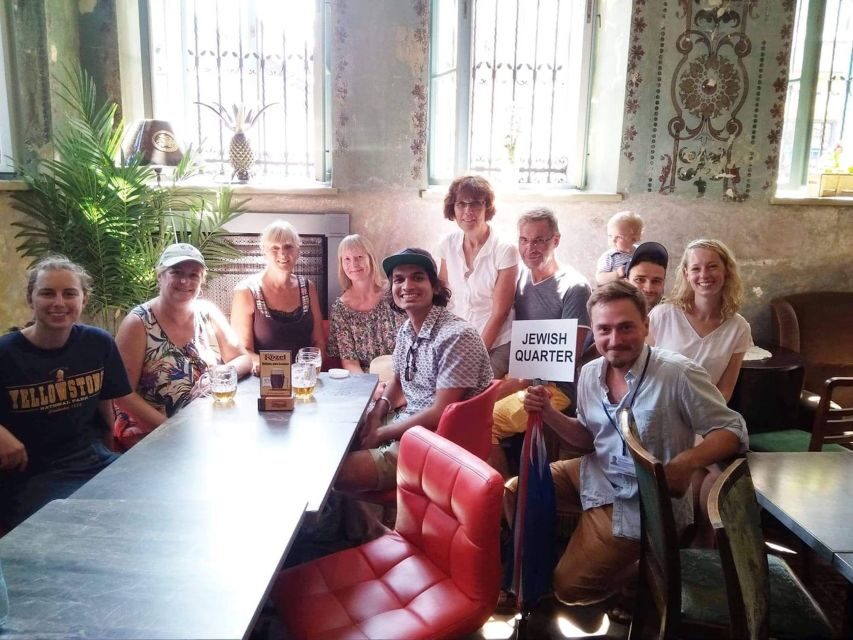
This is the one I send most people to. It runs daily, takes about 150 minutes, and crosses both districts so you understand the geography before/after rather than just one side. Our full review of the Jewish Quarter and Former Ghetto Tour gets into the guide quality. Bart and Fil come up by name in the feedback we collect, which usually only happens when guides are doing real work.
2. Kazimierz Jewish Quarter Walking Tour: $27

If you only want the Kazimierz half, this is the cleanest version. Around 90 minutes to two hours, focused entirely on the historic Jewish district north of the river. The our review of the Kazimierz walking tour goes into the synagogue stops in detail. Skip this one if you want the ghetto context, because Podgórze isn’t on the route.
3. Schindler’s Factory and Ghetto Guided Tour: $57
This one combines the museum visit with the outdoor ghetto walk, so you get both the inside-the-exhibits depth and the on-the-street context. It runs in English, French, Spanish, Italian and German, and our full review of the Schindler’s Factory combo tour covers what’s worth your time inside. If you’ve never been to Schindler’s, book this. If you’ve already got a separate Schindler’s Factory ticket sorted, the cheaper Jewish Quarter tour above is better value.
How to actually book one
Three approaches, depending on what kind of traveller you are.
Pre-book online before you arrive. This is what most people should do. You pick the operator, lock in your time slot, and the meeting point is on your phone. GetYourGuide and Viator both list every Jewish Quarter operator in Krakow. Cancellation is usually free until 24 hours before. The free walking tours that run on tips also let you reserve through their own websites (Free Walking Tour, SANDEMANs / New Europe), and you should reserve, even when it’s free, because groups fill up in summer.
Book on the day at the tour office. If you’re already in town and want flexibility, walk into one of the tour offices on Floriańska Street or just off the main square. They sell tours running that afternoon and the next morning. You’ll pay slightly more than online, but only by a couple of dollars, and you can switch between Jewish Quarter, Wawel, and Auschwitz options after looking at a map. This is also how you find out what the weather’s doing before committing.
Show up at a free walking tour meeting point. The free tours don’t strictly need a reservation in shoulder season. SANDEMANs starts at the Town Hall Tower in the main square; Free Walking Tour starts in front of the Wawel Castle entrance. You walk up, the guide spots the umbrella, you join the group. Tip at the end. Twenty zloty is fair, forty if it was excellent, and bring small notes because the guide isn’t running a card terminal at the end.

Free walking tour or paid: what’s the difference
This question comes up a lot, so the honest answer.
The free walking tours in Krakow are good. Genuinely. The big operators (SANDEMANs, Free Walking Tour, Walkative) train their guides well, and the tip system gives the guide a real reason to be engaging. The downside is the group size. A peak summer free tour can be 35 people, and at the back of that group you can’t hear the guide explain what happened on Plac Bohaterów Getta. You can also lose people in narrow streets, and the timing isn’t reliable because you’re moving with the slowest walker.
The paid tours from $19 to $30 are usually capped at 15 to 20 people, and the higher-end ones (the kind around $50 with Schindler’s entry included) cap at 12. You can hear everything. The guide isn’t competing with traffic noise from the back of a 35-person crowd. Pace is more reliable.
For Kazimierz, where you stop a lot at small synagogues on tight streets, smaller groups are worth the money. For the Old Town walking tour where you spend more time in big open squares, free works fine. We cover the trade-off for the wider city in our guide to Krakow Old Town walking tours.
The synagogues you’ll see
Kazimierz has seven historic synagogues. A two-hour walking tour gets to four or five from the outside and stops longer at the most significant two or three. Here’s what you’re looking at.
The Old Synagogue (Stara Synagoga)
The oldest surviving synagogue in Poland. Built in late Gothic in the 15th century, rebuilt in Renaissance form after a 1557 fire, gutted by the Nazis who used it as a warehouse during the war. It now houses the Jewish history exhibition of the Krakow City Museum. Tours pause out front and explain the architecture rather than going in.
Remuh Synagogue and the old cemetery
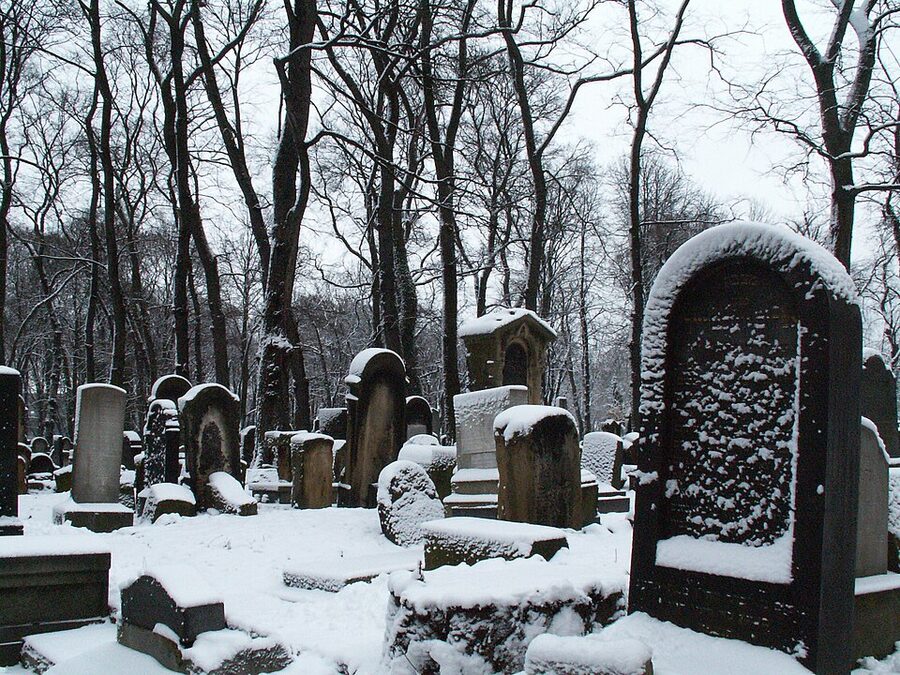
Halfway up Szeroka Street. Smaller than the Old Synagogue and more affecting. Remuh is named for Rabbi Moses Isserles (Rema), one of the most important Jewish legal scholars of the 16th century, who is buried in the cemetery beside it. The cemetery is the second-oldest Jewish cemetery in Poland and contains tombstones from 1535 onwards. Several were broken up by the Nazis to be used as paving stones, then reassembled into the Wailing Wall you can see at the back. Most guides spend more time here than at any other site on the tour.
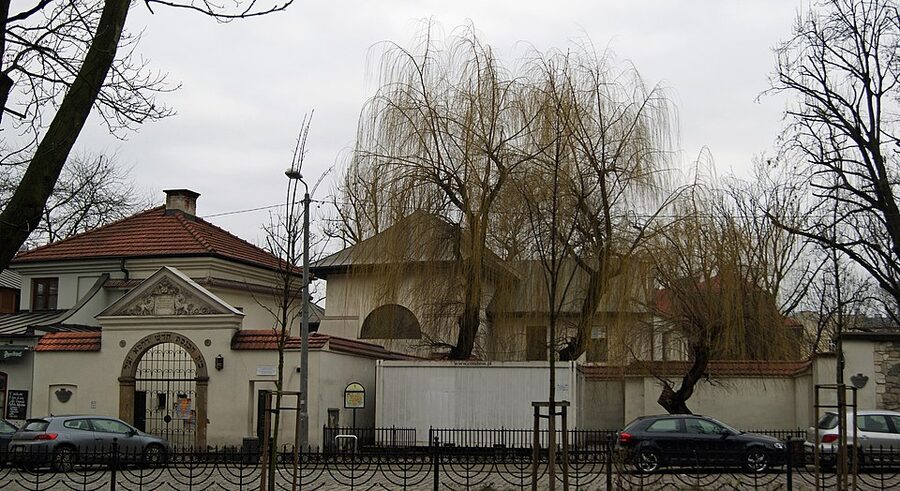

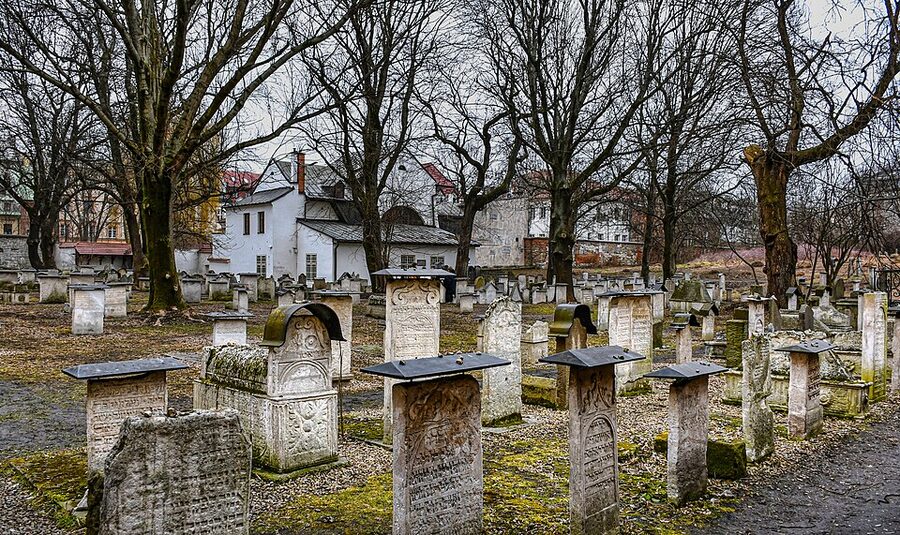
_Cemetery_and_Remah_Synagogue,_40_Szeroka_Street,_Kazimierz,_Krak%C3%B3w,_Poland.jpg)
Tempel Synagogue
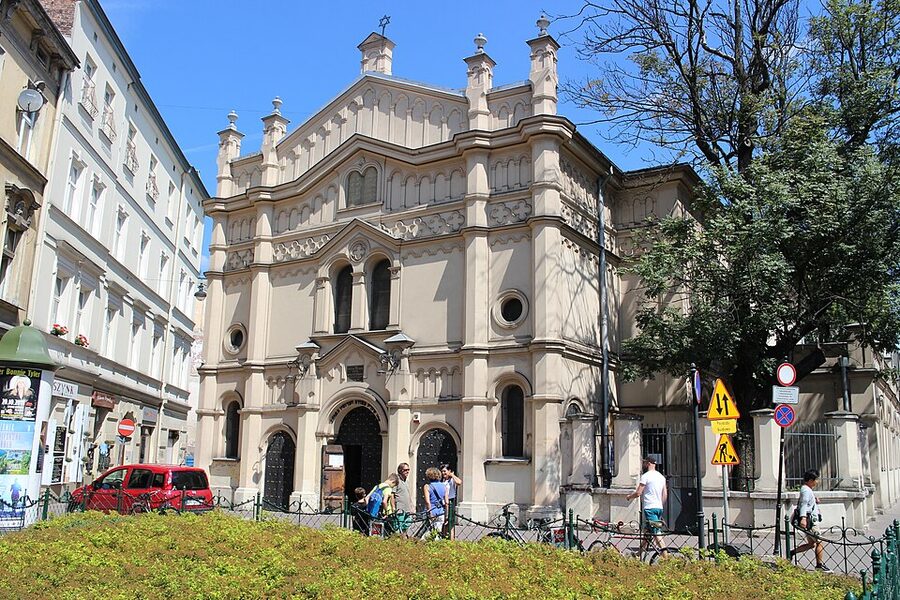
On Miodowa Street. Late 19th century, Reform / Progressive in tradition, the most ornate of the surviving synagogues. The interior is a wedding-cake of polychrome painting and gilding, with stained glass that survived the war because the Nazis used the building as a stable rather than destroying it. Tempel still functions as the Reform community’s synagogue and you can sometimes go in between Friday services.

Isaac Synagogue (Synagoga Izaaka)
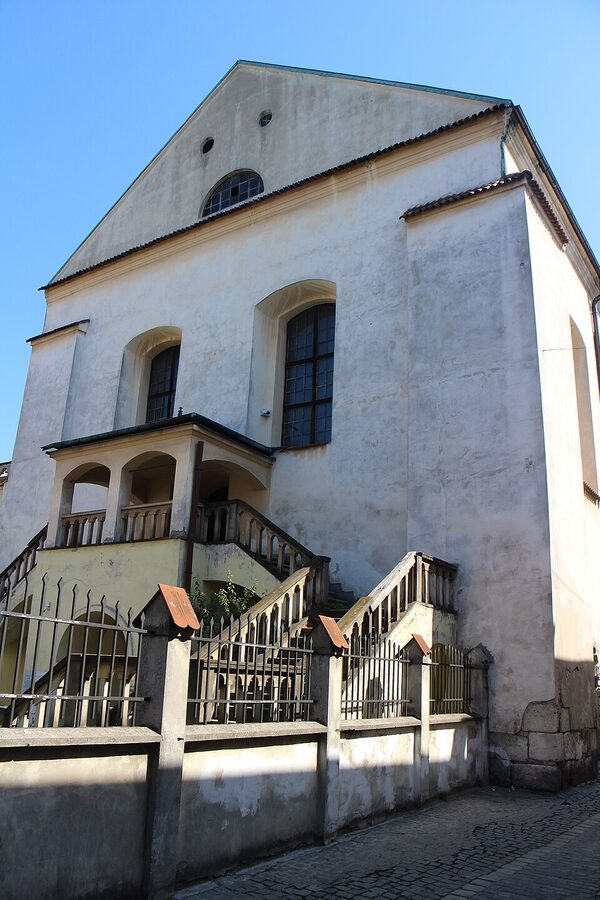
Baroque, 1644, named after Isaac ben Jakubowicz who funded its construction. The interior has surviving Hebrew inscriptions on the walls, partially restored. Smaller than Tempel, less ornate, more atmospheric.

The High Synagogue (Synagoga Wysoka)
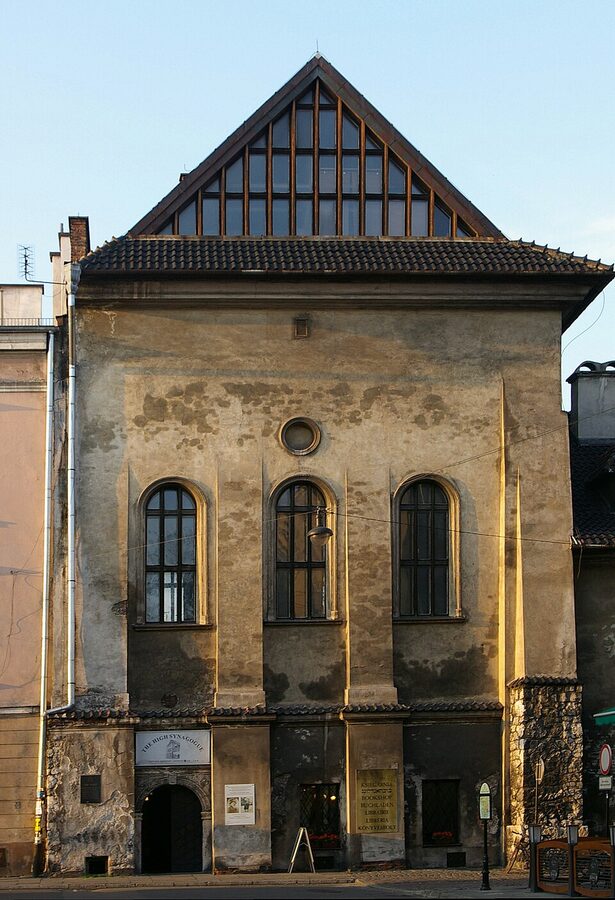
On Józefa Street. Renaissance, 16th century. The “high” name comes from the prayer hall being on the second floor, above shops on the ground floor, which was a common arrangement in old Polish towns. The synagogue isn’t active anymore, the ground floor is now a bookshop.

The Krakow Ghetto in Podgórze
This is the harder half of the tour. You cross the Vistula on the footbridge by Plac Bohaterów Getta and the air changes. The streets are wider, the buildings flatter, the silence different.
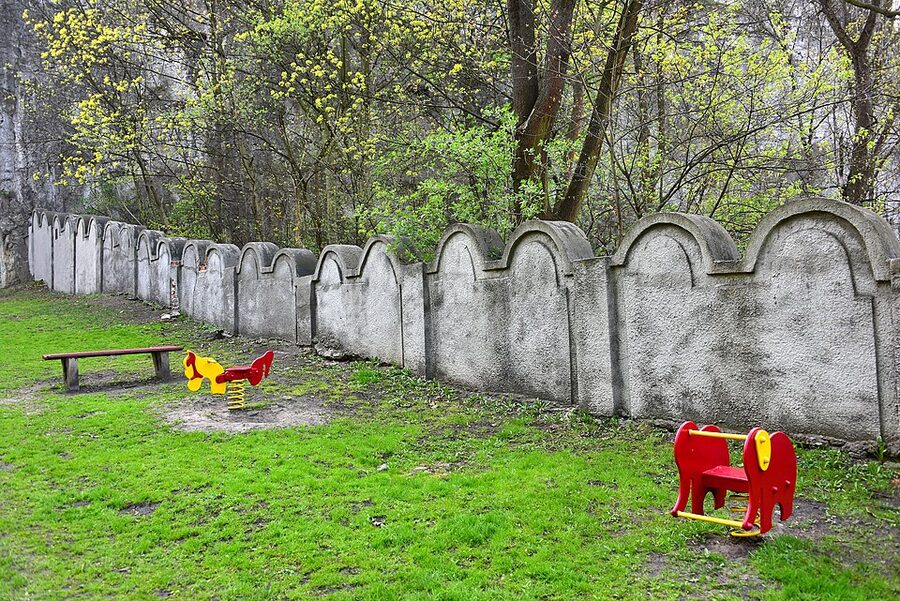
The Krakow Ghetto operated for two years, from March 1941 to March 1943. About 17,000 Jews were sealed inside an area of roughly fifteen blocks, a fraction of Kazimierz’s pre-war Jewish population. The ghetto wall was built deliberately to look like a row of Jewish gravestones, with the curved tops you can still see on the surviving Limanowskiego fragment. It was psychological as well as physical.

The deportations to Bełżec extermination camp ran in two waves in June and October 1942. The final liquidation was March 13 and 14, 1943: those still considered fit for work were marched to the Płaszów concentration camp, the rest were shot in the streets or sent to Auschwitz. About 2,000 people were killed inside the ghetto during the liquidation alone. If you’ve already done a trip to Auschwitz from Krakow, what you’re seeing in Podgórze is where most of the Krakow victims came from.
Plac Bohaterów Getta and the empty chairs
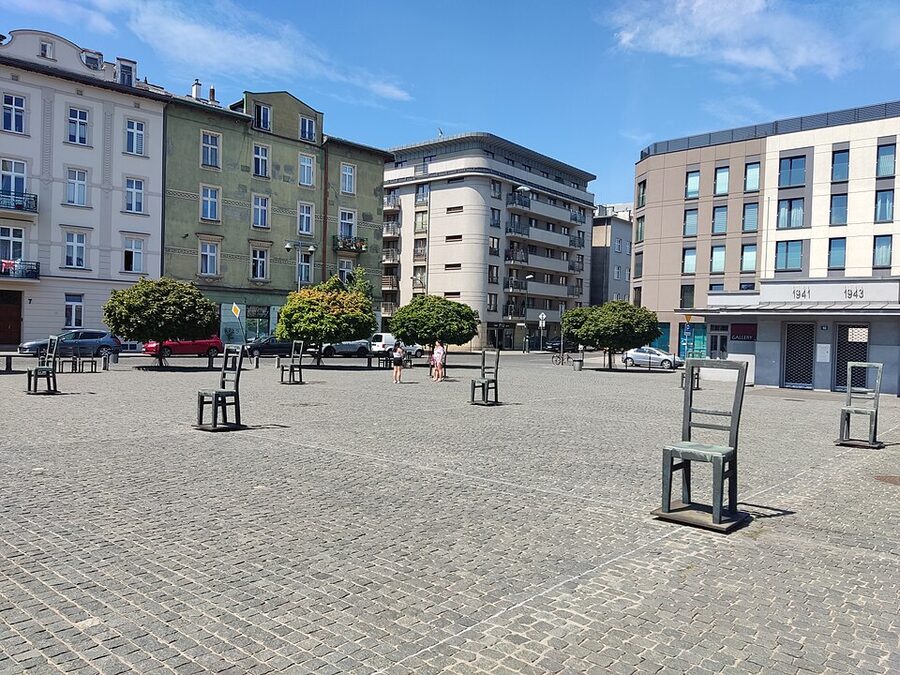
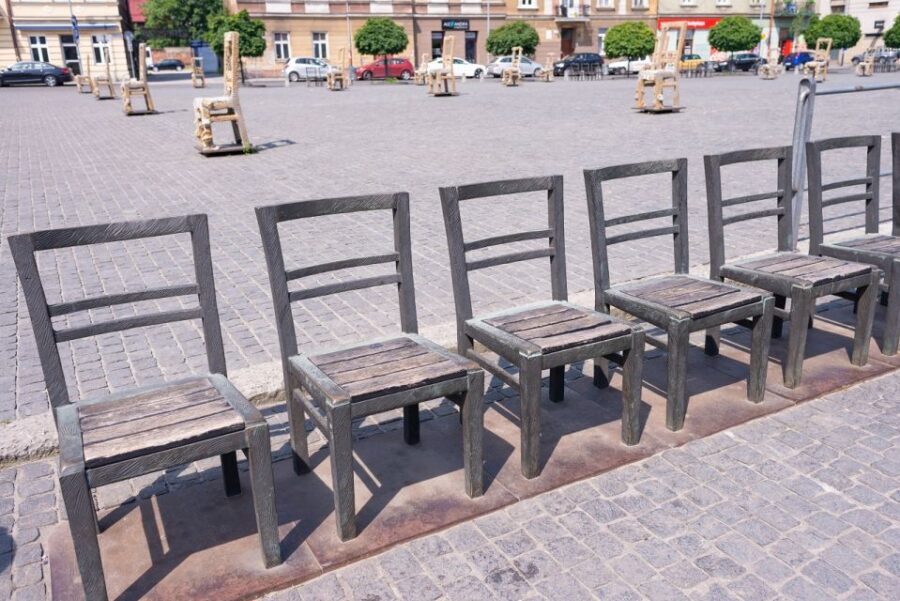
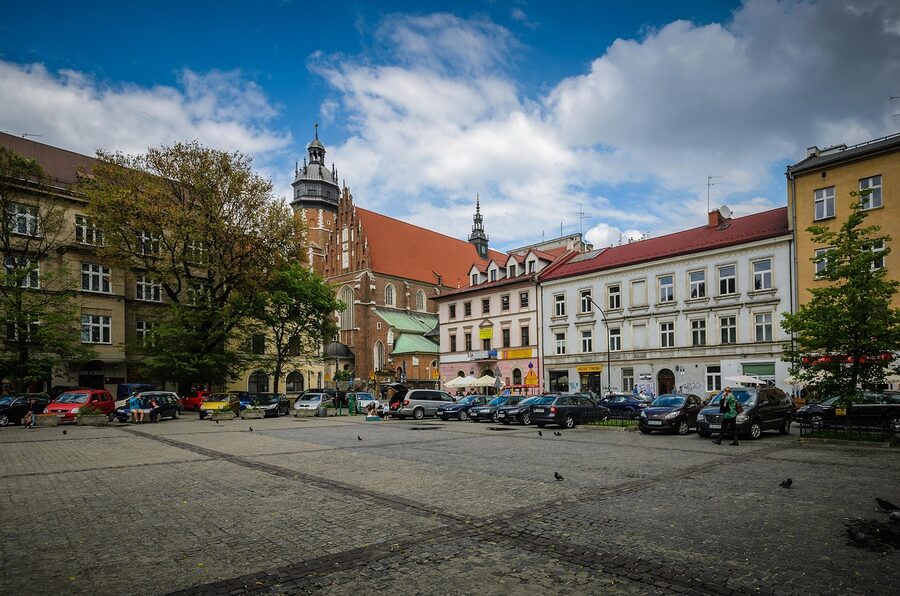
This is the heart of the Podgórze tour. The square was the assembly point for the deportations. Witnesses describe residents throwing their furniture out of upper-storey windows in the panic of the final round-up, because they had no time to bring belongings and no idea where they were going.
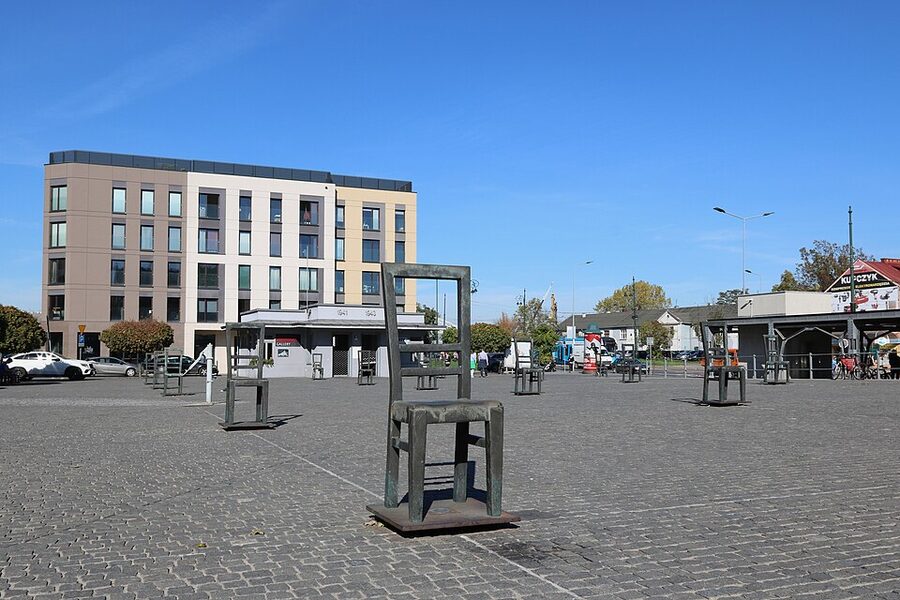
The 2005 memorial by Lewicki and Latak is 33 large iron chairs and 37 smaller ones, scattered across the square in rows. The chairs are exactly the right scale and exactly the wrong place. You can sit on them, which feels strange, until your guide explains that’s the point. People used to sit here. Now there are only chairs. Most groups stand quietly here for a few minutes. Don’t talk over the guide.

The Eagle Pharmacy (Apteka pod Orłem)
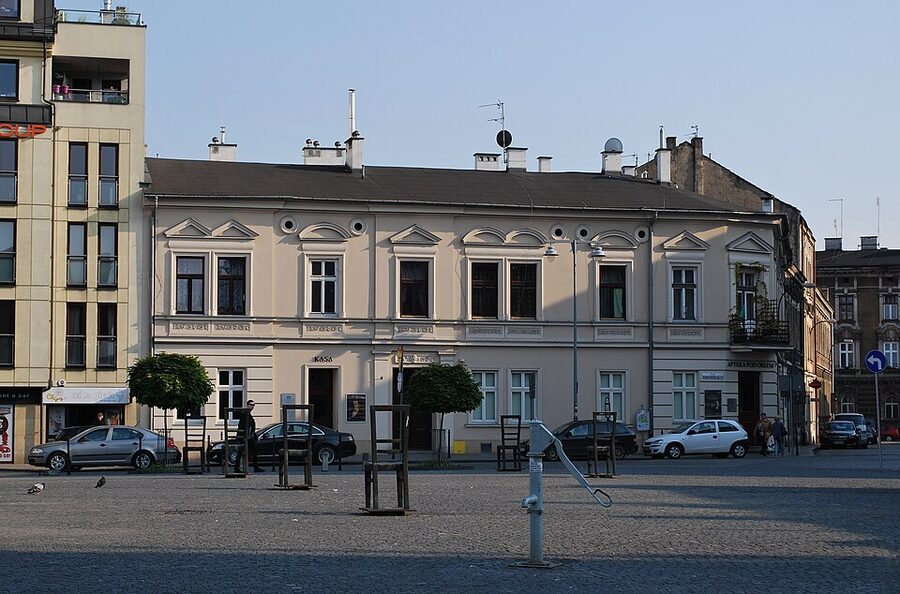
On the western edge of Plac Bohaterów Getta. Tadeusz Pankiewicz was the only non-Jewish shopkeeper allowed to remain inside the ghetto walls, and his pharmacy became a meeting point, an information drop, and a refuge for residents. He hid people, smuggled letters out, gave away medicine, and survived the war. The pharmacy is now a small museum, around 14 zloty for entry, and most guided tours either go inside or, if time is tight, point at it and explain the story from the square. Worth coming back for if your tour skips it.
,_18_Bohaterow_Getta_(Ghetto_Heroes)_square,_Podg%C3%B3rze,_Krakow,_Poland.jpg)
Schindler’s factory area
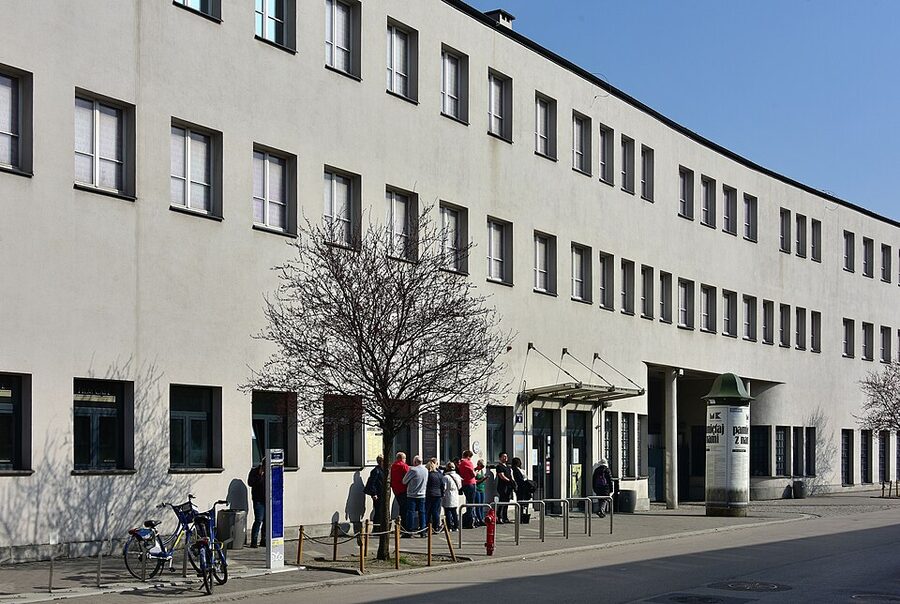
About fifteen minutes’ walk further into Zabłocie. Most Jewish Quarter tours that don’t include factory entry will stop outside the gates and explain the building’s role: this was Oskar Schindler’s enamelware works, the Deutsche Emaillewaren-Fabrik, where roughly 1,200 Jewish workers were saved by being kept on the factory’s labour list during the ghetto liquidation and afterwards. The building is now part of the Krakow City Museum and runs the famous Krakow Under Nazi Occupation 1939 to 1945 exhibition. Going inside takes around 90 minutes minimum and you need a separate ticket. We’ve done a full Schindler’s Factory tickets guide that explains the booking, queues and the layout of the exhibition.

A short history before you go
Tours move fast, and the guide can’t stop every five minutes to explain context. So a quick version.
King Casimir III the Great founded Kazimierz as a separate town in 1335, on a Vistula island just south of Krakow’s main walls. From the late 15th century onwards, it became home to the Jewish population that had previously lived inside Krakow proper. By the 16th century, Kazimierz had its own city walls separating the Jewish quarter from the Christian part of the same town, and a flourishing community of merchants, scholars and craftspeople.
The 1772 partition put Kazimierz under Austrian rule. The walls were torn down, the Jewish community was given more legal rights than they had in most of Europe at the time, and the population grew. By 1939, Krakow’s Jewish population was roughly 60,000 to 70,000. Around a quarter of the city.

The German invasion came in September 1939. Krakow became the capital of the General Government, the Nazi-occupied rump of Poland. In March 1941, the city’s Jewish population was forced into the Podgórze ghetto. Over the next two years, almost all of them were murdered: most at Bełżec extermination camp in 1942, the rest at Auschwitz, at Płaszów, or in the streets during the March 1943 liquidation. Roughly 6,000 to 7,000 Krakow Jews survived the war, the majority of them outside Poland by 1945. The community that returned numbered in the low hundreds.
Kazimierz emptied, and stayed mostly empty under communism. By the 1980s the buildings were neglected, the synagogues padlocked or used as warehouses. Steven Spielberg shot Schindler’s List on these streets in 1993 because they still looked like 1943, and the film changed the district’s trajectory. Restoration money started arriving. Cafes opened. By 2010, Kazimierz was the most fashionable district in Krakow, mostly run by Polish entrepreneurs in their twenties. The Jewish heritage sites were restored, partly with German and American foundation money. The Jewish Community Centre opened in 2008.
That’s the bit guides don’t always have time for. The neighbourhood you’re walking through has had a community of hundreds, then 60,000, then nothing, then a few hundred again, in the space of one century.

Practical things to know
How long
Two-and-a-half hours is the most common length. Some Kazimierz-only tours run 90 minutes to two hours. The combo tours that include Schindler’s Factory entry run three hours. If you can spare it, take the longer Kazimierz plus Podgórze version. The crossing of the river is part of the experience.
What it costs
Free walking tours are tip-only. Twenty zloty (around $5) is fair for a regular tour, more if the guide was excellent. Paid Kazimierz-only tours run roughly $20 to $30. Combined Kazimierz plus Podgórze tours sit around $19 to $27 with a guide-only format, or $50 to $70 if Schindler’s Factory entry is included. Private tours start around $100 for two people and rise sharply for larger groups.
What to wear
Walking shoes you’d be comfortable in for three hours on cobblestones. Layers, because the wind off the Vistula in spring and autumn is sharper than the air temperature suggests. If you go inside Remuh or Tempel, men cover their heads (the synagogues provide kippot at the entrance) and shoulders should be covered for everyone. Modesty rules are pretty light at the active synagogues, but they’re enforced for shorts and tank tops in summer.
Best time of year
April to October. May and June are the sweet spot. July and August get genuinely hot in Krakow now, which is brutal on a three-hour walking tour. Late September and early October are quieter, the light is better for photos, and the queues at Schindler’s are at half their summer length. November to March is cold and grey but tours still run. Wear a hat.
Best time of day
Morning tours are quieter. The 9 or 10am slots get you on the streets before tour groups from cruise buses arrive, and the synagogues are easier to enter outside service times. Afternoon tours from 2 or 3pm are also good. Avoid 11am to 1pm in summer when groups stack up at Plac Bohaterów Getta. Evening tours are rare for Jewish Quarter content because most operators feel the subject deserves daylight.
Photography
Outside, anywhere. Inside synagogues, ask first. Remuh is generally fine without flash, Tempel sometimes asks for no photos during prayer hours, the Old Synagogue’s exhibition charges a small fee for photo permission. Plac Bohaterów Getta is open public space, photograph what you want, but don’t pose for selfies on the chairs. People do, and it looks bad. The chairs are a memorial.
Children and pacing
The Holocaust content is heavy. We’d suggest 12 and up. Younger kids will struggle with both the duration and the subject. If you’re travelling with a teenager who’s read Anne Frank or done a school unit on the Holocaust, this tour can be one of the moments of a Krakow trip that they remember twenty years later. If you have small kids, do the Kazimierz-only tour and skip Podgórze, or save the ghetto walk for a return trip.
Combining the tour with the rest of Krakow
Most people fit the Jewish Quarter walk into a three or four-day Krakow trip. Here’s the rough sequencing that works.
Day one: orient yourself. A general Old Town walking tour in the morning, free time at the Cloth Hall and Wawel, dinner in Kazimierz so you’ve seen the streets in the evening too. The contrast between Old Town and Kazimierz is stark in the dark: Old Town is medieval and floodlit, Kazimierz is bohemian and lower-key.
Day two: Auschwitz. The hardest day of the trip and you want it before the Jewish Quarter tour, not after. Auschwitz gives you the scale of what happened. Coming back to Kazimierz the following day adds the local face. There’s a useful Auschwitz and Wieliczka combo day trip that knocks out two of Krakow’s heavy-hitter day trips in one go, but most people prefer doing them separately.
Day three: Jewish Quarter and Schindler’s Factory. The combined tour does both in three hours. If you want to slow it down, walking tour in the morning, museum in the afternoon, long lunch on Plac Nowy in between.
Day four: lighter day. A Krakow bike tour covers more ground than walking, including the Jewish Quarter and the river path, and works as a recap. Or a Vistula river cruise if you want something genuinely relaxed. Wieliczka Salt Mine is also a half-day option, and a deliberate change of subject.
Where to eat after
The tour ends in Podgórze or back on Szeroka Street, depending on the operator. Either way you’re a five-minute walk from a good lunch.
On Szeroka, the obvious pick is one of the Jewish-style restaurants like Klezmer-Hois or Ariel for traditional fare with klezmer music in the evenings. The food is solid rather than incredible, and the atmosphere does feel a bit theatre-set, so the better local choice is to walk five minutes north to Plac Nowy and eat zapiekanki at the round market hall. A zapiekanka is a long open-faced bread with mushrooms, cheese and various toppings, runs around 15 zloty, and is the unofficial Kazimierz street food.
For something more substantial, Hamsa on Szeroka does Israeli food at a level the synagogue-flanked restaurants can’t reach. Pierogi at Pod Wawelem or any of the milk bars (bar mleczny) on Grodzka Street works for cheap and traditional Polish.
If you finish in Podgórze, walk five minutes to ZaKładka on Józefińska, which sits between French bistro and Polish modern, or back across the bridge for the Plac Nowy options.
Fitting the tour into a wider Krakow plan
Krakow rewards three full days minimum. Most travellers spend two days on the heavy memorial visits: Auschwitz on one, the Jewish Quarter and Schindler’s Factory on another. The rest fills with the Old Town, Wawel Castle, day trips and the food. If you’re still working through the booking, a Wawel Castle tickets walkthrough covers the royal complex and our Zakopane day trip guide covers the mountains. Whichever Jewish Quarter tour you book, do it on a different day from Auschwitz. They’re both heavy. Spreading them out is kinder to yourself.
Booking the tours above goes through GetYourGuide. We may earn a commission if you book through one of these links, at no extra cost to you. It helps fund this site and is one of the reasons we’re able to keep recommending things we’d actually book ourselves.