
Here is the math nobody warns you about when you arrive in Seville on a Saturday in April. Cathedral entry plus the Giralda is one ticket. Royal Alcázar entry is a second. Both sold separately, both with their own queues, and the Alcázar’s online slots are usually gone three days out. Buy them piecemeal, queue at both, and you’ll spend more on tickets than a guided combo costs and still miss the bell-tower climb because half the people who buy a Cathedral ticket don’t realise the Giralda is included.
That’s the case for booking a combo tour. One operator handles the timed entries for both monuments, you skip both lines, you actually go up the Giralda, and someone who knows the difference between Almohad brick and Mudéjar plasterwork is standing next to you while you look at it.
Best guide quality: Cathedral, Giralda, and Royal Alcázar Guided Tour, $69. Slightly longer, smaller groups, the guide rosters tend to be Seville-licensed historians rather than freelancers.
If you’re booking last-minute: Priority Access Cathedral, Giralda & Alcázar Tour, $64. The one with the most consistent same-day availability when the others sell out.
- Why the combo solves real problems, not just a queue
- What the combo tour actually covers
- The three combo tours worth booking
- 1. Seville Cathedral, Giralda & Alcázar Entry With Guided Tour:
- 2. Cathedral, Giralda, and Royal Alcázar Guided Tour:
- 3. Priority Access Cathedral, Giralda & Alcázar Tour:
- The math against buying tickets separately
- How to read the booking page
- What to expect inside the Cathedral
- The Giralda climb
- Inside the Royal Alcázar
- Best time to do this
- What the guide actually adds
- A short history of why these two are paired
- Practical tips for the day
- If the combo isn’t right for you
- Other ways to see Seville
Why the combo solves real problems, not just a queue
Seville’s two big-ticket monuments share a plaza but operate on entirely different ticket systems. The Cathedral and Giralda are bundled into one entry. The Alcázar has its own. Buying them separately is fine if you’re a planner who books three weeks out. If you turned up in Seville on a Tuesday and want to see both on Wednesday, the Alcázar online slots are probably already gone.
That’s the practical problem the combo tours solve. The operator pre-allocates blocks of timed entries to both sites, so when you book the tour, you’re effectively buying two slots that are no longer publicly available. The other thing the combo solves is the Giralda blunder. The bell-tower ramp goes up from inside the Cathedral, and the entry is unmarked unless you know to look for it. I’ve watched whole tour groups finish the Cathedral and walk out without realising the Giralda was part of their ticket.
What the combo tour actually covers
Three monuments, one guide, roughly 2.5 to 3 hours. The standard route runs Cathedral first, then up the Giralda, then a five-minute walk across Plaza del Triunfo to the Alcázar. Some operators reverse it. The order matters less than people think; what matters is that you’re in front of the Cathedral entrance with a guide before the 10am wave of independent walk-ups.
Here’s what each piece adds up to:
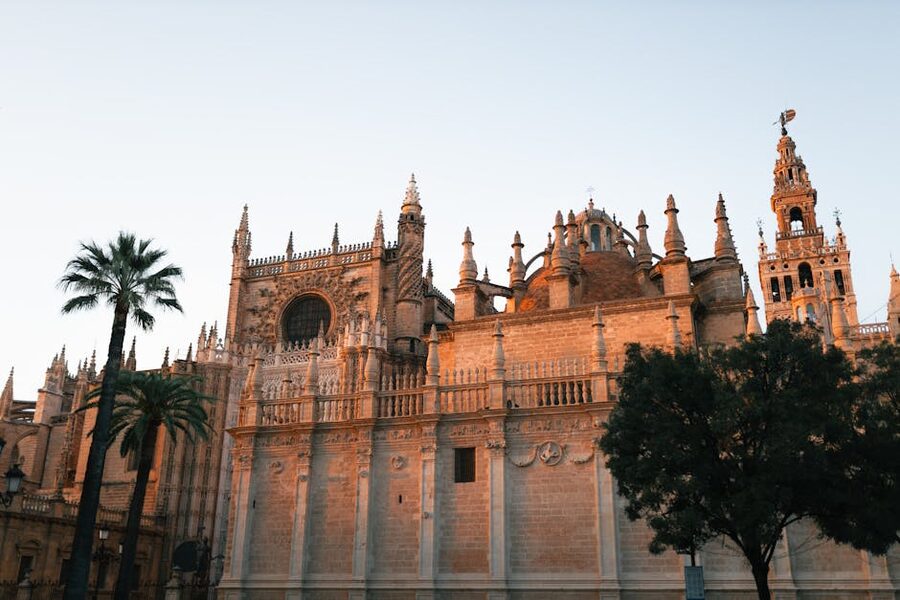
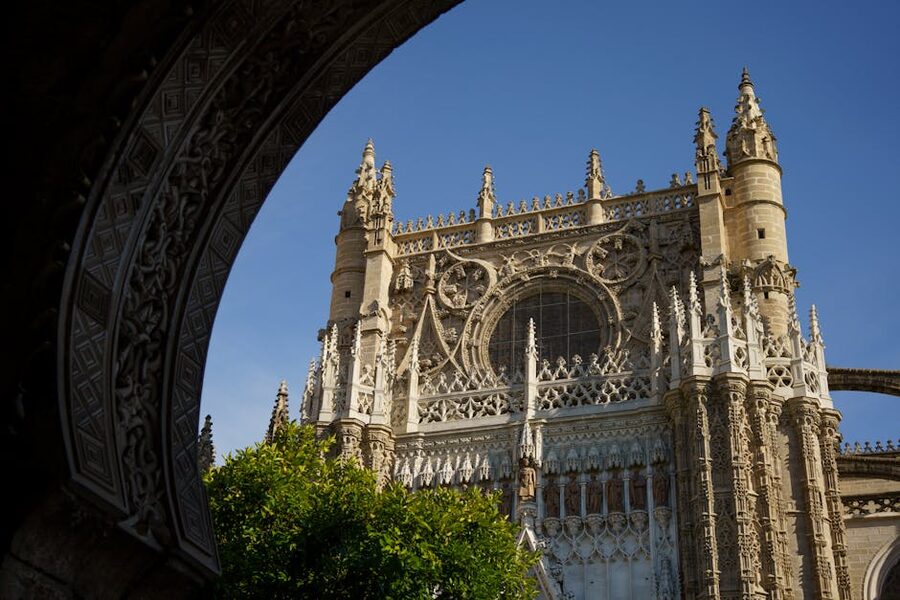
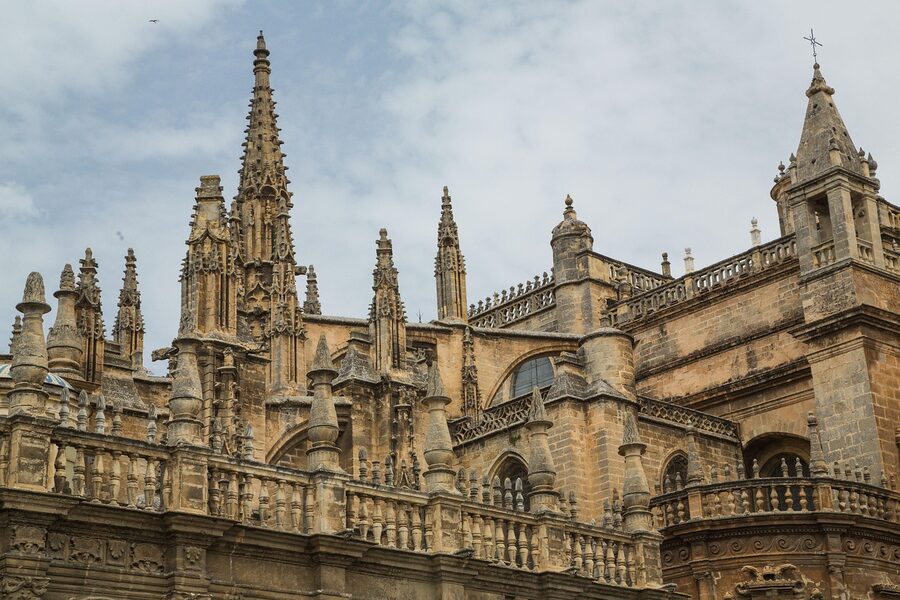
- Seville Cathedral: the largest Gothic cathedral in the world by volume, built on top of the Almohad-era mosque between 1402 and 1506. The interior is dim and cool even in August. Highlights are the Capilla Mayor (a gilded altarpiece bigger than most parish churches), the tomb of Columbus, and the Patio de los Naranjos courtyard where the original mosque ablution fountain still works.
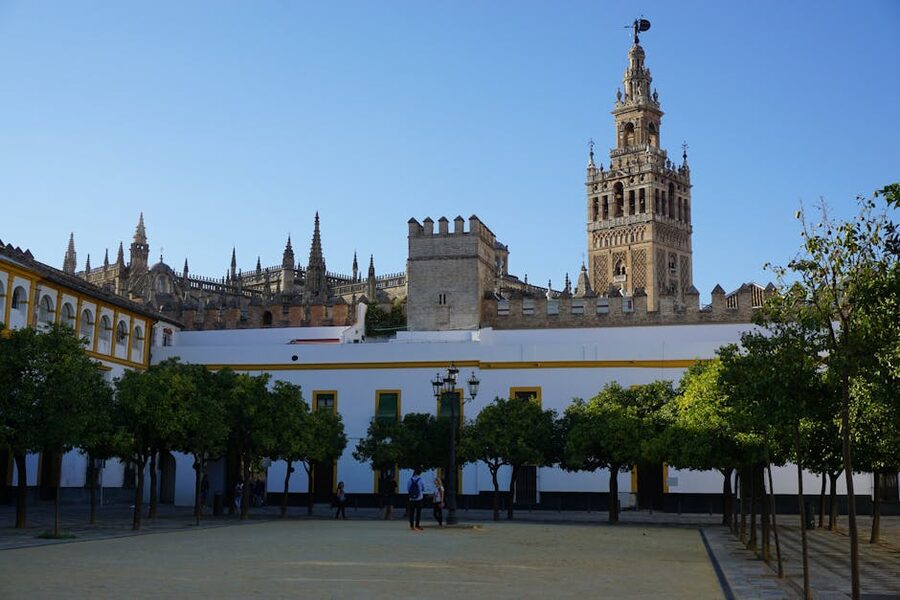
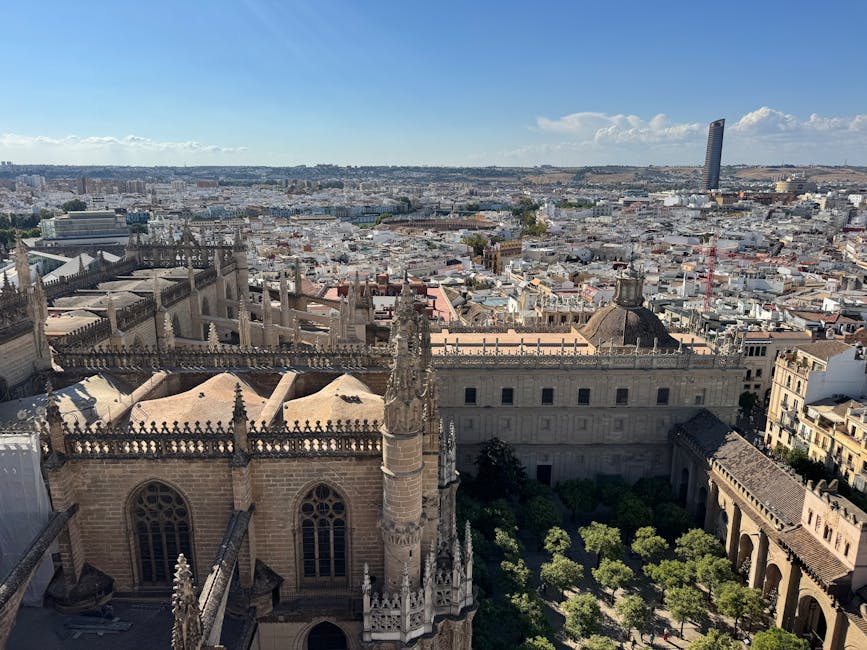
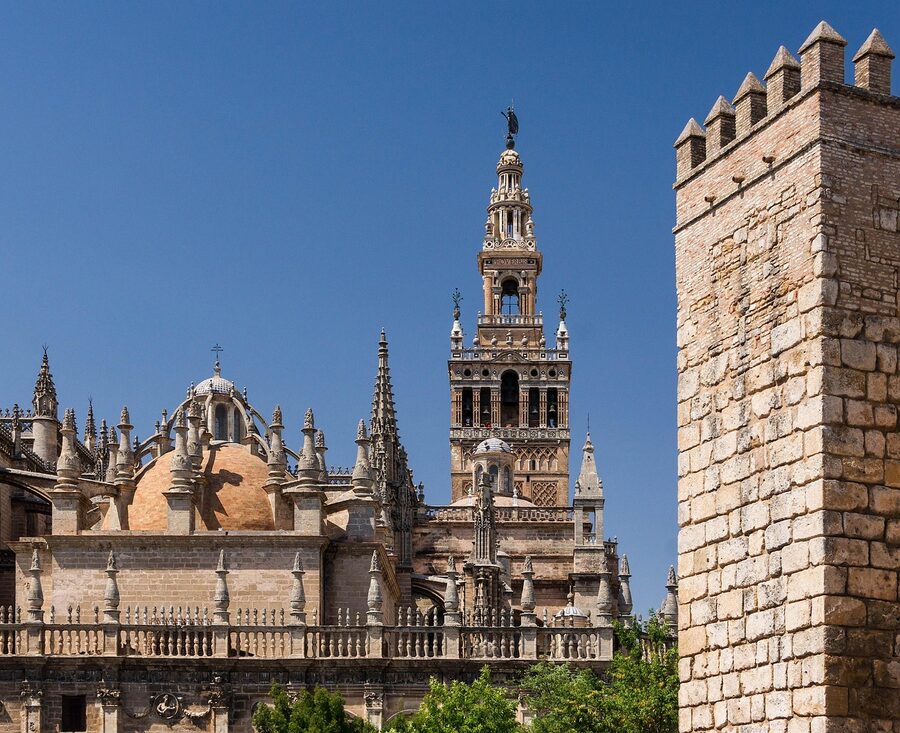
- The Giralda: 35 ramps and 17 steps to the top, no spiral staircase. The Almohad designers built it as a ramp because the muezzin rode a horse to the top to give the call to prayer. It’s an easier climb than people expect and the views over the Cathedral roofs and the Alcázar gardens are the best in central Seville.
- Royal Alcázar: the oldest royal palace still in active use anywhere in Europe. The royal family stays in the upper floors when they visit. You won’t see those. What you’ll see is Pedro I’s 14th-century Mudéjar palace (the part that doubled as Dorne in Game of Thrones), the Patio de las Doncellas with its sunken garden, and the gardens, which run for about ten acres of paths, fishponds, and Moorish water channels.
The three combo tours worth booking
Multiple operators offer roughly the same product. After cross-checking the options, three are worth your shortlist. They all cover the same monuments. Where they differ is in price, group size, and how the time is allocated between the three sites.
1. Seville Cathedral, Giralda & Alcázar Entry With Guided Tour: $65
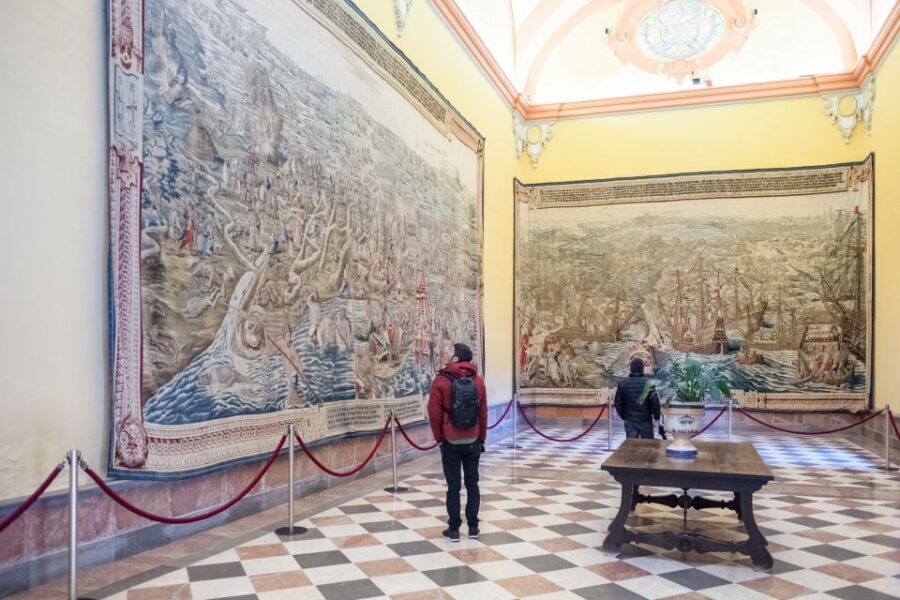
This is the workhorse pick. It’s the cheapest of the three, it sticks to 2.5 hours, and the operator runs enough departures that you can almost always book within a week of travel. Our full review covers the group-size cap and what the guide actually focuses on inside each site. Pick this one if you want the no-frills version that gets you in and out without padding.
Check Availability
Read our full review
2. Cathedral, Giralda, and Royal Alcázar Guided Tour: $69
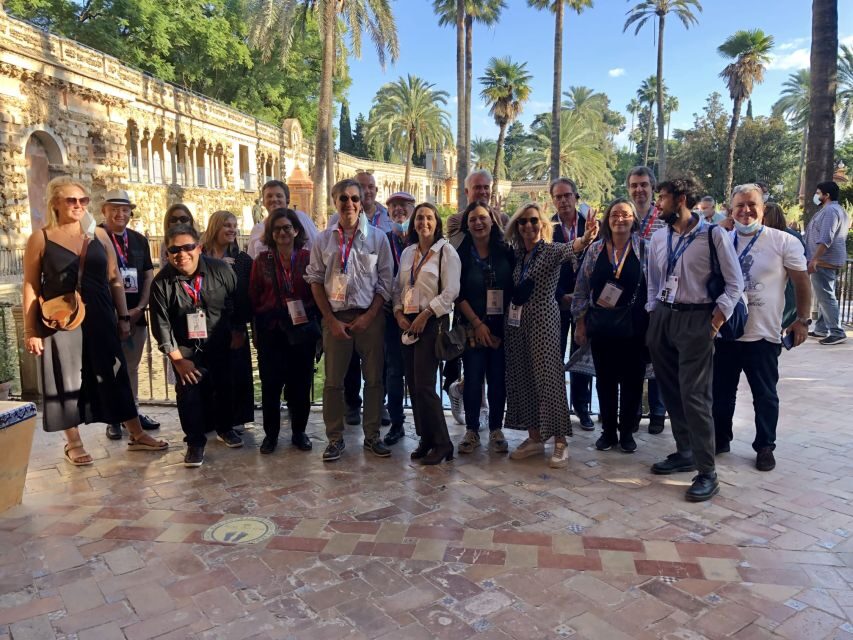
If the depth of the guide commentary matters to you, pay the extra four dollars. The guide rosters skew toward people with art-history backgrounds, and the group sizes are typically capped lower than the cheaper option. Our full review goes into who actually shows up and how the time is split. This is the one I’d pick for a first visit.
Check Availability
Read our full review
3. Priority Access Cathedral, Giralda & Alcázar Tour: $64
Same monuments, same 2.5 to 3 hours, with one practical difference: when the other two sell out, this one usually still has slots. Our full review covers the meet-up logistics and what the priority-access lane actually looks like at the Alcázar gate. Book it if you’re inside a week of travel and the cheaper options are gone.
Check Availability
Read our full review
There’s also a 3-hour Alcázar and Cathedral entry tour at $78 that runs slightly longer with more time inside the Alcázar gardens. It’s a fine pick if your priority is the gardens specifically; for most travellers the cheaper 2.5-hour options cover the same ground.
The math against buying tickets separately
Strip out the guide and run the numbers. Standard Cathedral plus Giralda entry is about €13. Royal Alcázar standard entry is €14.50. Add fast-track or skip-the-line upgrades on each (you’ll want them in summer) and you’re looking at roughly €40 to €50. The combo tours start at $64, which by today’s exchange is about €58. So for around eight to ten euros more than DIY skip-the-line tickets, you also get a guide and the actual scheduled entry slots, which during peak season are the harder thing to find than the money.
The gap shrinks further if you’re travelling outside July and August. In May, October, and November, walk-up Alcázar tickets are sometimes available at the gate by mid-afternoon, but the window is unpredictable. In December and January it’s almost always doable. From late June through early September, don’t try.
How to read the booking page
A few things to check before you confirm:
- Meeting point: every combo tour I’ve used in Seville meets outside the Cathedral, usually at Plaza del Triunfo or Avenida de la Constitución. The booking confirmation will name the exact spot. Get there 15 minutes early; the guide will leave on time.
- Language: GetYourGuide listings default to English unless you change it. Spanish, French, Italian, and German departures exist but are less frequent. If you want a non-English guide, check the language picker on the booking page before you commit to a date.
- Group size: this is the variable nobody publishes upfront. Smaller is better; ask in the operator chat if it matters to you. Anything over 25 starts to feel like a herd inside the Cathedral.
- Audio headsets: most combo tours hand you a wireless receiver at the meeting point so you can hear the guide while wandering a few metres away. If your booking confirmation doesn’t mention them, message the operator.
What to expect inside the Cathedral
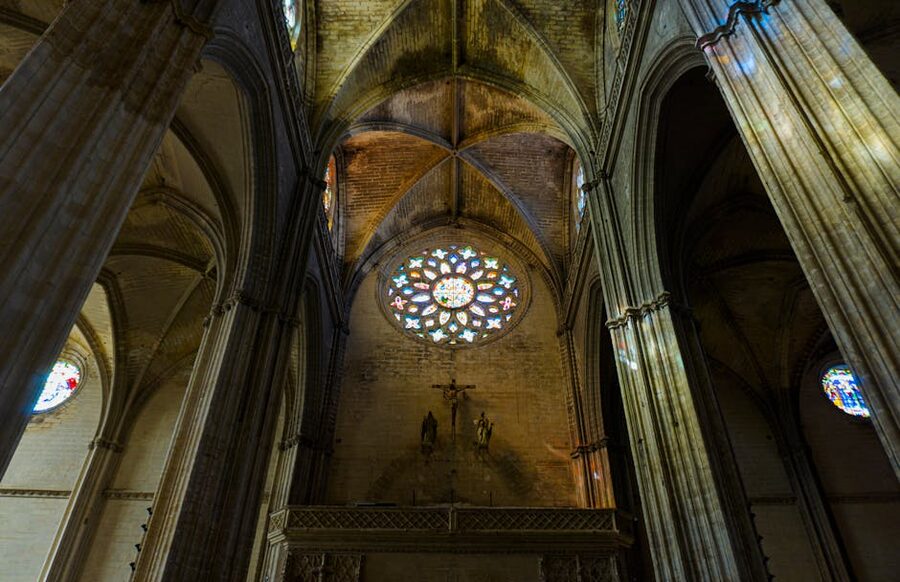
The Cathedral is huge in a way that’s hard to convey. It’s the third-largest church in Europe by floor area and the largest Gothic cathedral by volume, built directly on the footprint of the Almohad mosque it replaced. Inside, the temperature drops about ten degrees from the street, which in July feels like air conditioning. The guide will walk you through the obvious stops:
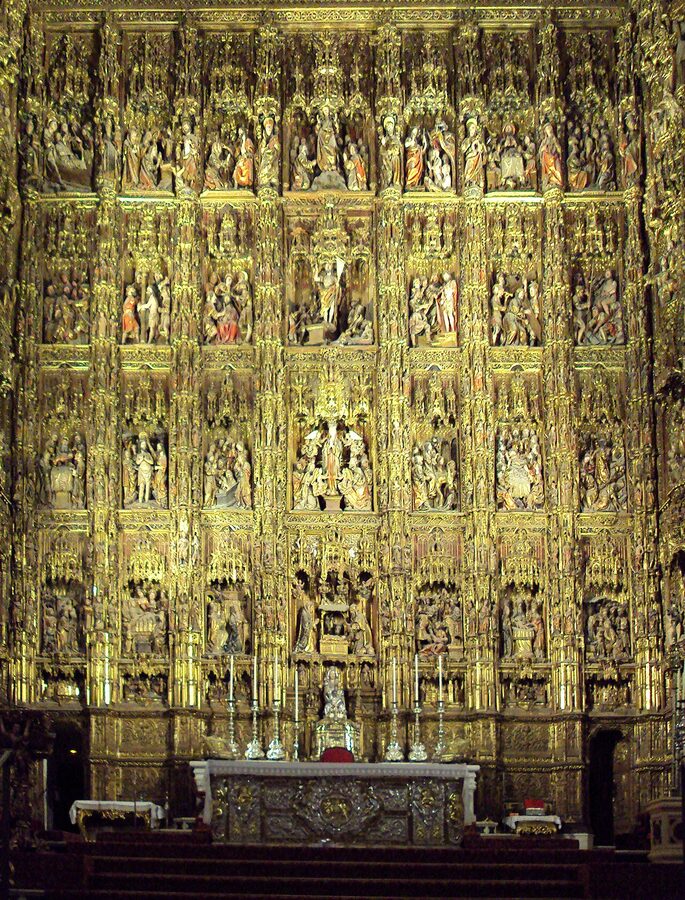

The Capilla Mayor is the headline. Forty-five panels of gilded wood carving covering 28 metres in height, with about a thousand individual figures. The work started in 1482 and ran for over 80 years. You stand behind a wrought-iron grille, which sounds disappointing until you realise the scale only registers properly from a few metres back.
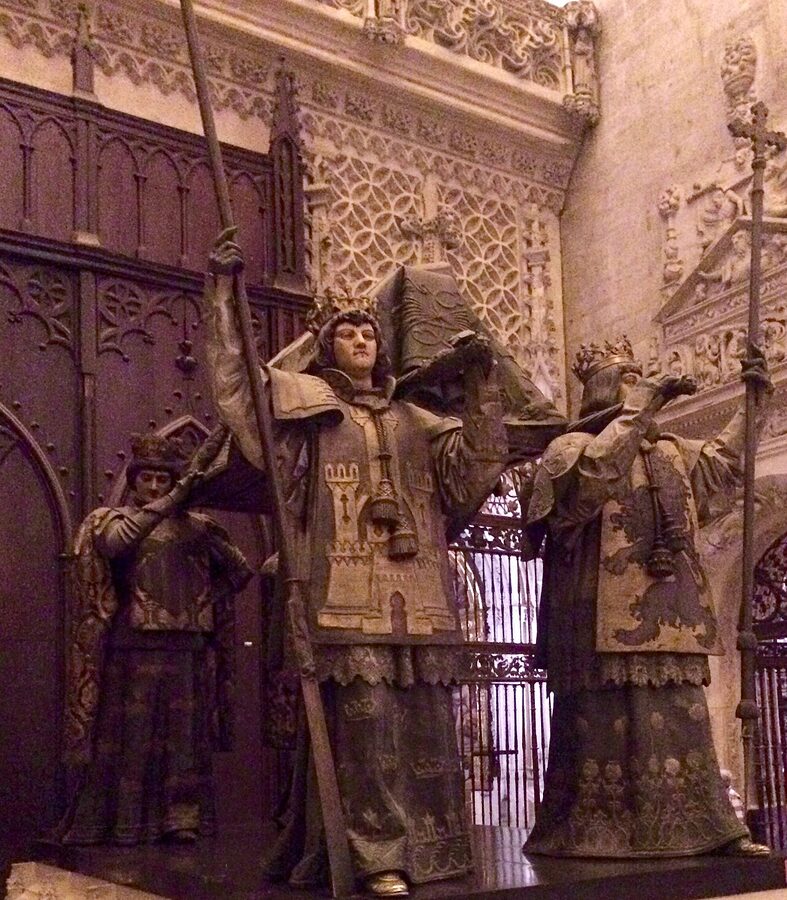
The tomb of Columbus is at the far end of the south transept, four bronze pallbearers carrying the coffin aloft. Whether the bones inside are actually his is a question; DNA testing in 2006 confirmed at least some of them are, but Columbus was reburied so many times across two continents that nobody fully accounts for him. The guide will tell you the story; it’s a good one.

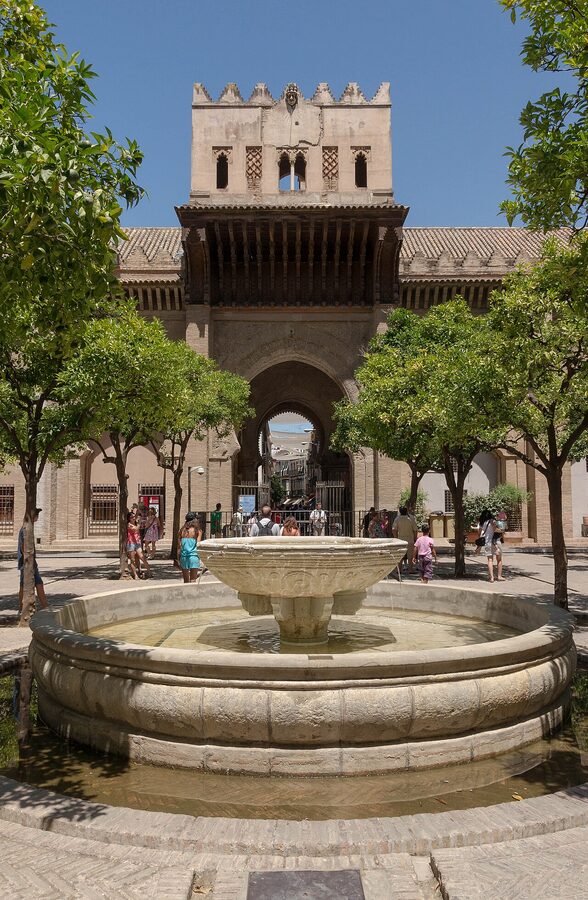
And the Patio de los Naranjos, on the way out. This was the courtyard of the original mosque. The orange trees are arranged on the same grid as the original prayer hall columns. The fountain in the centre still works for ablutions; you’ll see locals dipping their hands as they walk through.
The Giralda climb
This is the one most independent ticket-holders skip by accident. The entrance is inside the Cathedral, near the north transept, and the signage is terrible. With a guided tour you’ll be walked straight to it.
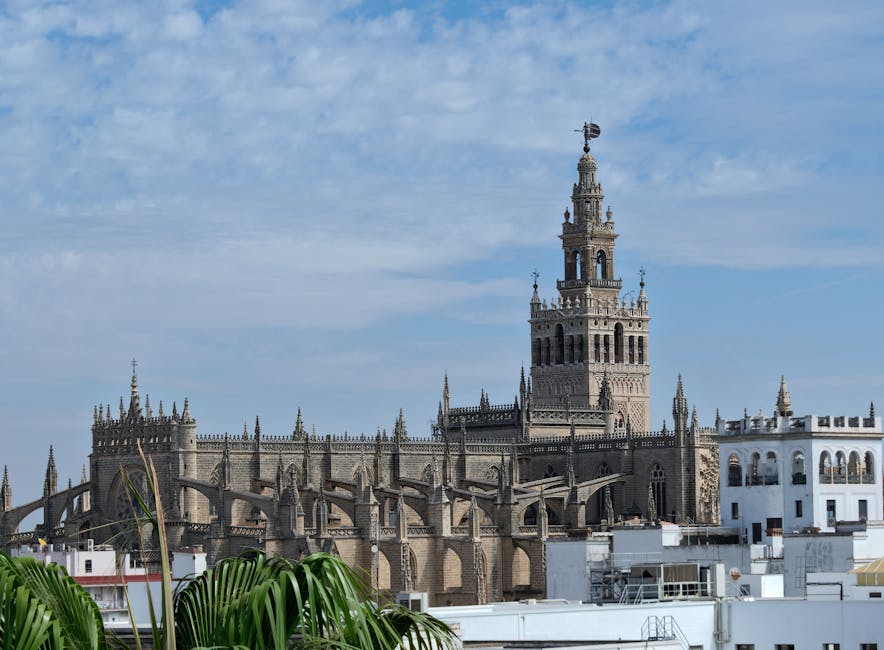
The climb itself is 35 ramps and 17 steps to the bell stage. No spiral staircase, no scrambling, no claustrophobia. The Almohad architects built it as a ramp specifically so the muezzin could ride a horse to the top to make the call to prayer five times a day. It still works for that purpose; what it works even better for is making the climb accessible to anyone who can manage a moderate hill.
About halfway up, narrow windows give you sideways views over the Cathedral roof. The bell stage at the top is open on all four sides. On a clear day you can see east toward the Sierra Morena and south past the Guadalquivir. In summer, do this part early. By 2pm the bells get crowded and the heat radiates off the brick.
Inside the Royal Alcázar
The walk between Cathedral and Alcázar takes about five minutes across Plaza del Triunfo. You’ll go through security at the Puerta del León gate (the Lion Gate, marked with a heraldic lion above the arch) and into the first courtyard, the Patio del León. From there the route depends on the operator, but every tour eventually lands at the Mudéjar palace of Pedro I, which is the heart of the visit.
.jpg)
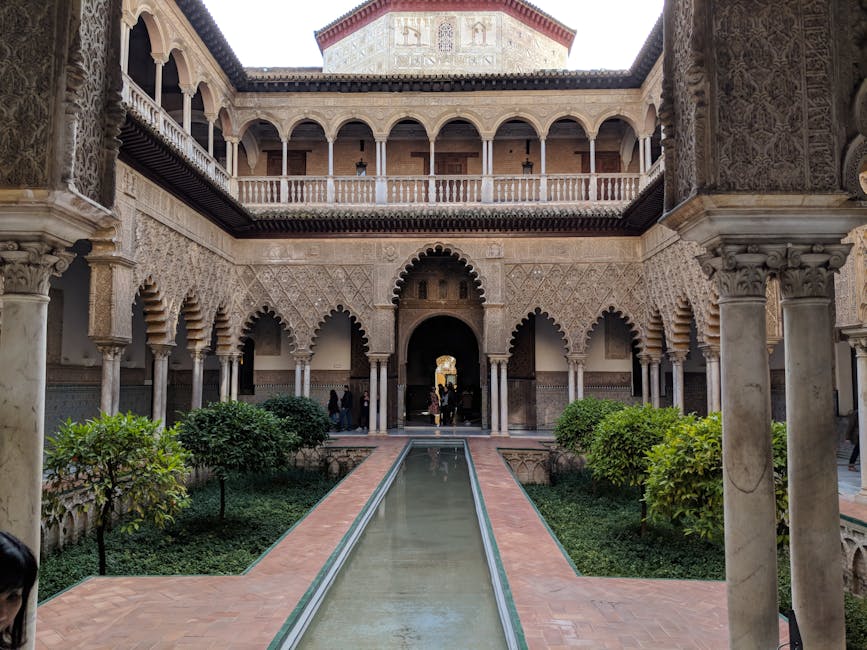
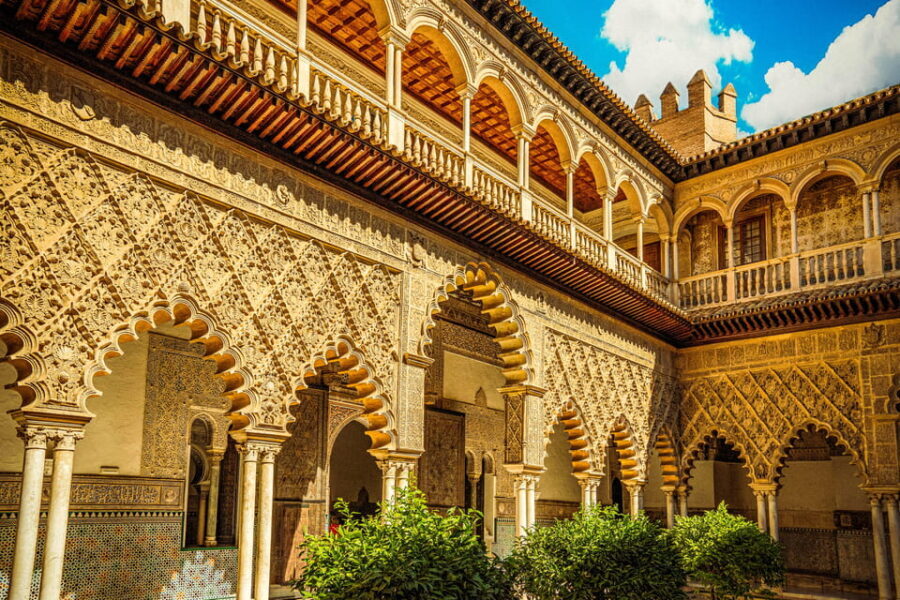
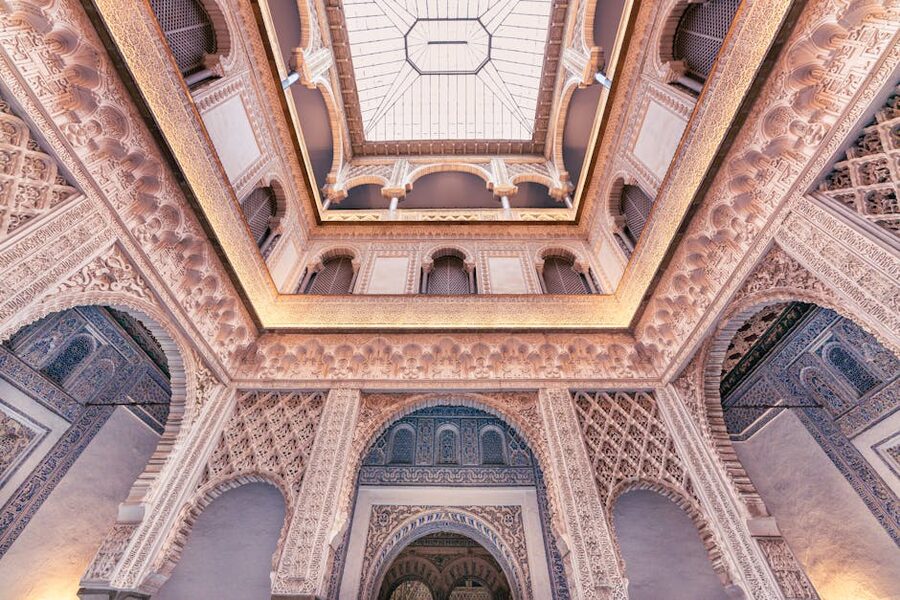
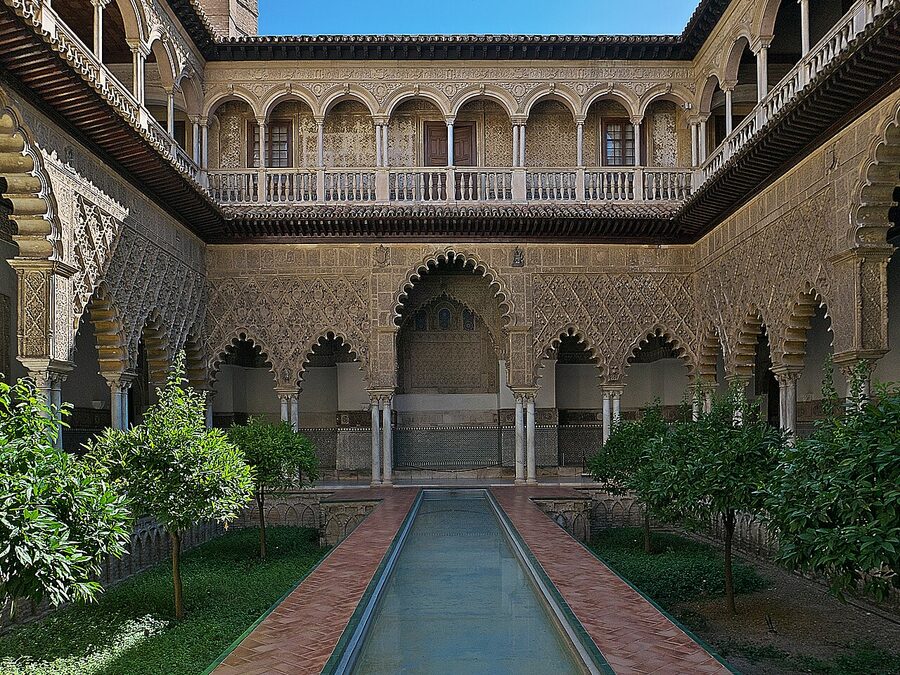
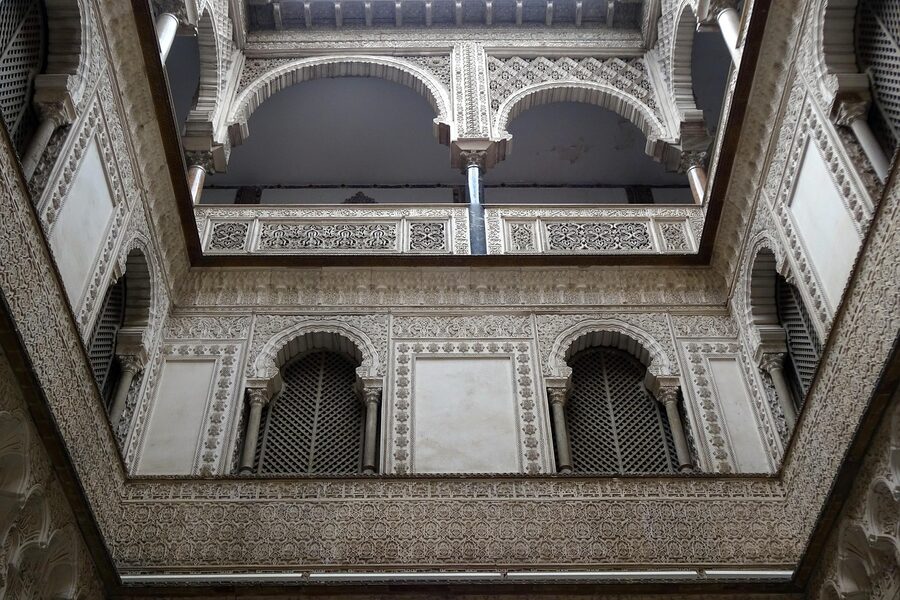
The Patio de las Doncellas, or Court of the Maidens, is the central courtyard of Pedro’s palace. The carved plaster work above the arches is some of the finest Mudéjar in Spain; the inscriptions in Arabic translate as praises to Allah and to King Pedro of Castile, in the same script, on the same building. That’s the whole story of Mudéjar architecture compressed into one detail.
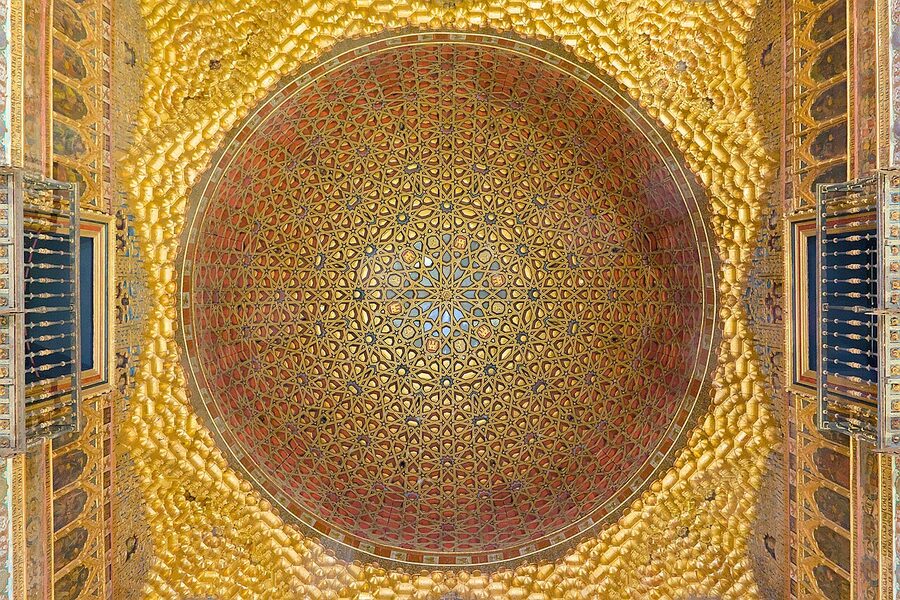

The Salón de Embajadores, the Hall of Ambassadors, is the throne room. The dome is the visual peak of the Mudéjar palace and the place where most guides spend their longest stop. The hall doubled as the throne room of Dorne in seasons five and six of Game of Thrones, which the guide will mention briefly and then move on, because the room earned its place in history about 700 years before HBO arrived.
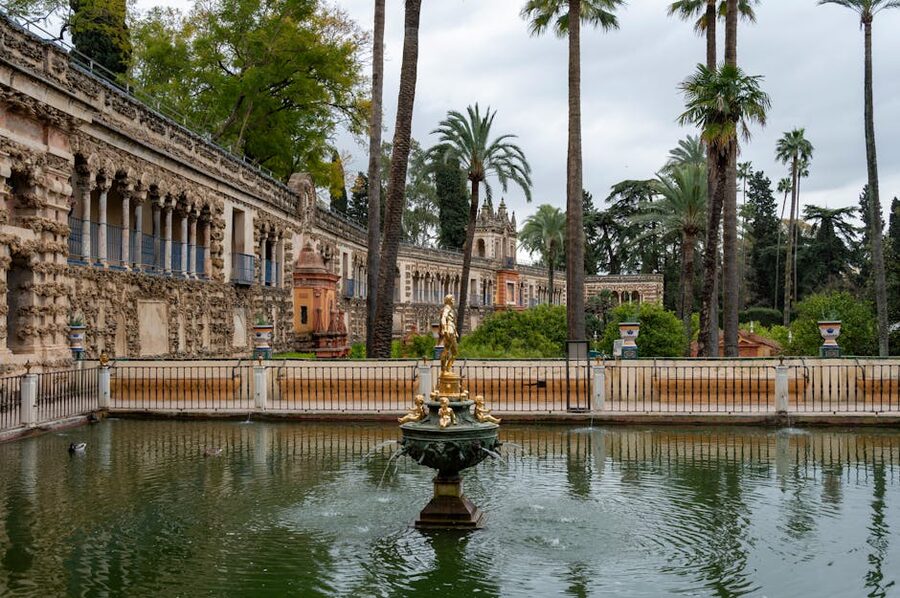
Then the gardens. Most tours spend 20 to 30 minutes in here and call it. That isn’t enough. The Jardín de las Damas, the Estanque de Mercurio, the Galería de Grutescos, the orchard with hundred-year-old palms; you can disappear in here for two hours if the heat allows. Combo-tour tickets typically let you stay in the Alcázar after the guide leaves, so plan to linger if you can.
Best time to do this
Two questions: what time of day, and what time of year.
Time of day: morning. Almost every combo tour starts between 9am and 11am. That’s deliberate. The Cathedral opens at 11am to the public on Mondays and at 10:45am the rest of the week, and combo tours get priority access slots earlier than that. By 11:30 the Cathedral is full of independent walk-ups and the Giralda climb has a queue at the bottom. Going before 11 means you’re up the tower before the crowd.
Time of year: April, May, October. Avoid July and August unless you have no choice. Seville hits 40°C routinely in summer, and the Patio de los Naranjos has no shade after 10am. The Cathedral interior is cool but the Alcázar gardens are exposed. If you must go in summer, take the earliest combo slot you can get and accept that the second half of the tour will be uncomfortable. Spring fits the city best; the bitter-orange trees in the Patio are flowering, the Alcázar gardens are at their peak, and you can sit outside afterwards without melting.
Christmas and New Year are an underrated window. Tickets are easy, queues are short, and the temperature is in the high teens during the day. Bring a jacket for evenings.
What the guide actually adds
If you’re comfortable navigating museums on your own, you might wonder whether the guided portion is worth it. My honest take: the Cathedral is fine to see solo if you have an audio guide. The Alcázar isn’t. The Mudéjar palace is dense with detail that doesn’t read as anything special unless someone is pointing at the right plasterwork and explaining what it says.
The other thing the guide adds is sequencing. Without one you’ll spend ten minutes wandering before you find the Capilla Mayor, another fifteen looking for the tomb, then double back for the Giralda. With a guide the route is plotted to hit the highlights in 75 minutes, which leaves 45 minutes of Alcázar before the gardens. Time is the resource you’re actually paying for, not just commentary.
A short history of why these two are paired
The Cathedral and the Alcázar exist on the same plaza because they were built as twin instruments of the same political project. After Ferdinand III took Seville from the Almohads in 1248, the Castilian crown had two problems: prove the city was now Christian, and prove the new rulers had the cultural sophistication of the people they had displaced.
The Cathedral was the answer to the first problem; they tore down most of the Friday mosque and built a Gothic basilica on the same footprint, deliberately keeping the minaret (now the Giralda) and the courtyard (now the Patio de los Naranjos) so the conquest was visible. The Alcázar was the answer to the second. Pedro I rebuilt the existing Almohad fortress in the 1360s using Moorish craftsmen, in a Moorish style, with Arabic inscriptions, and made it his royal residence. The result is a Christian monarch’s palace built by Muslim hands, with the same architectural vocabulary as the Alhambra in Granada, four years before the Alhambra’s most famous courtyards were finished.
That’s why a combo tour works. The two monuments are a single argument about power and continuity, and reading them in sequence with someone explaining the Mudéjar inscriptions is the difference between seeing two pretty buildings and understanding what Seville actually was in the 14th century.
Practical tips for the day
- Wear layers. The Cathedral interior is cool, the Alcázar gardens are hot. A light jacket or shawl handles both.
- Shoes. Some Mudéjar tile floors are slippery. Avoid hard leather soles in the rain (yes, it does rain in Seville, mainly between November and March).
- Camera and phone. Photography is allowed everywhere except the Cathedral chapels marked with no-photo signs. No flash. Tripods need a permit nobody bothers to enforce on a phone-sized stabiliser.
- Bag size. Both sites have airport-style security. Anything bigger than a small daypack will go through the scanner. The Alcázar has lockers near the entrance for €1.
- Water. Bring a bottle. The Cathedral has fountains in the Patio de los Naranjos; the Alcázar has them in the gardens. There’s no café inside the Alcázar that’s worth the price.
- Toilets. There are restrooms inside both monuments, but the Alcázar’s are inside the second courtyard, easy to miss. Use them before you head into the gardens because the next ones are 15 minutes’ walk away.
- Cancellation. Most GetYourGuide combo tours offer free cancellation up to 24 hours before. Check this on your specific booking page; it varies by operator.
If the combo isn’t right for you
Three reasons to skip the combo and book separately. First: you only want one of the two monuments. The Cathedral alone is a quick visit and can be done in an hour with the standard Cathedral entry ticket; the Alcázar deserves at least two hours and is best visited alone using the Royal Alcázar tickets if you don’t want a guided narrative.
Second: you’re booking three weeks out and don’t mind the legwork. At that distance the official ticket sites usually have plenty of slots and the per-ticket savings are real, even if modest.
Third: you’ve been to Seville before and want something less crowded. Try one of the smaller historic-centre attractions, or the rooftops walking tour. The combo is the right product for first-time visitors with limited time, not for repeat visitors who already know the site map.
Other ways to see Seville
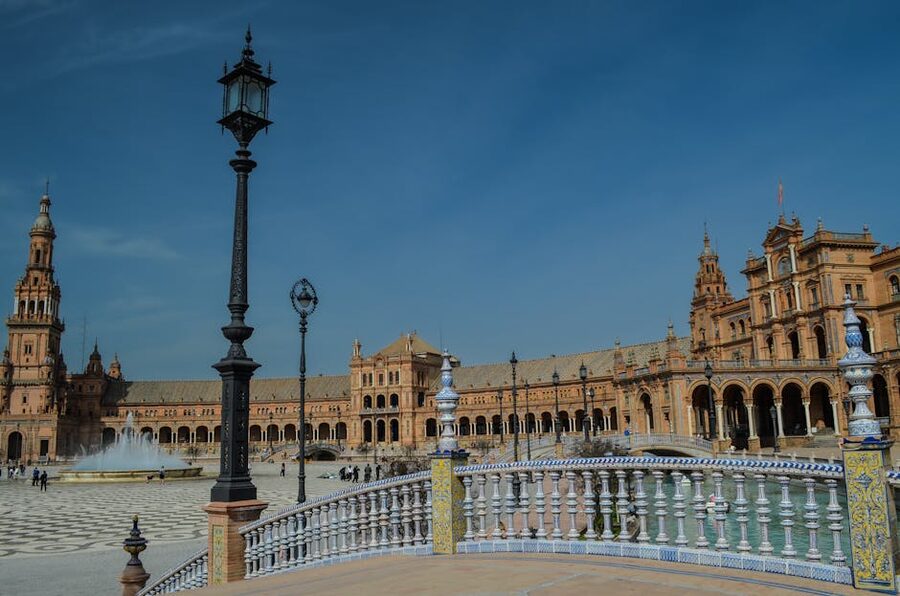
If a combo tour gets you the headline monuments in a single morning, the rest of Seville opens up by foot. A walking tour of the historic centre picks up where the combo leaves off, covering the Jewish quarter and the streets around the Cathedral that the guided combo doesn’t have time for. For a wider geographical sweep with no commitment to walking, the hop-on hop-off bus hits the Plaza de España, the Triana neighbourhood across the river, and the Tower of Gold in a 75-minute loop. If you’ve got a second day in Seville and want to step inside another major palace, Casa de Pilatos is the under-visited Andalusian-Renaissance counterpoint to the Alcázar, with film history (Lawrence of Arabia, Game of Thrones) and a courtyard that some travellers prefer.
For day trips, the Córdoba Mezquita is the obvious pair to the Cathedral combo: another converted-mosque-cathedral that puts Seville’s hybrid history in regional context. The Córdoba and Carmona day trip adds a Roman necropolis if you want depth without rushing. The white villages and Ronda route, or its specific Setenil and Ronda variant, takes you into the Sierra de Grazalema for a completely different Andalusian landscape. And if you’re routing through Madrid or Barcelona on the same trip, the Essential Madrid combo and Barcelona in one day are the analogues to this tour for those cities, with the same logic of bundling two big-ticket monuments under one guide.
Affiliate disclosure: some links above go to GetYourGuide. We earn a small commission if you book through them, at no extra cost to you. We only recommend operators we’d book ourselves.