
The cabin clears the lower station and the city drops away in one swing. Within ten seconds the cruise terminals shrink to thumbnails, the harbour fans out wider than you expected, and the cable car gives a small lurch as it crests the first support tower. You are pressed gently against the glass on the harbour side. Behind you a kid says mira, and that is when you notice Sagrada Família poking up through the rooftops in the far middle distance, brown and improbable against the sea light.
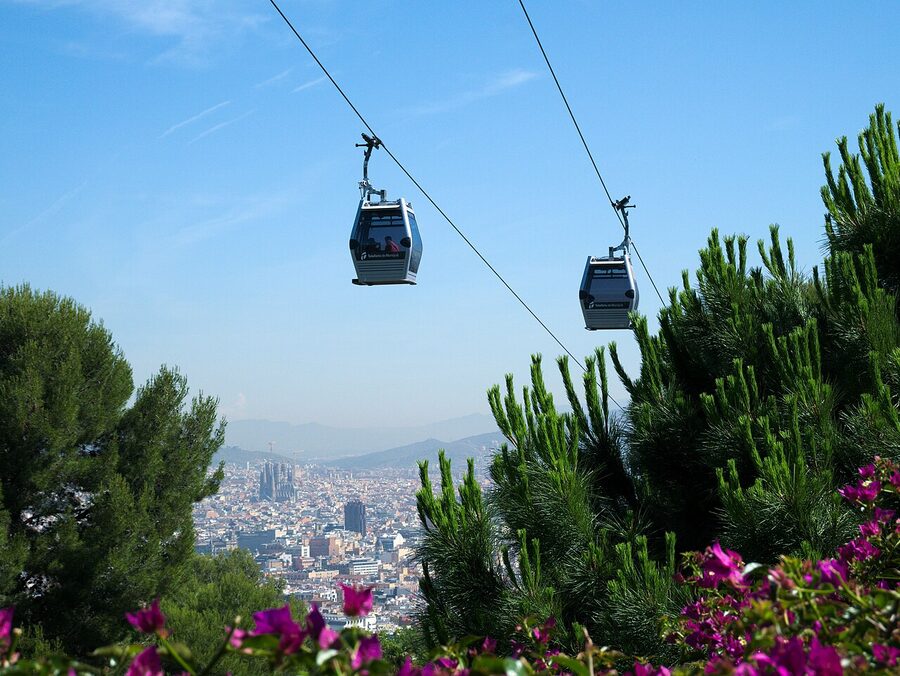

This is the Telefèric de Montjuïc, the gondola that swings you from a small park station up to the castle on the hill. Not the red one over the port, that is a different ride. This guide covers tickets, what the route actually looks like, how to get to the bottom station from anywhere central, and which version of the ticket is worth your money.
If you want the story: Montjuïc Cable Car with Audio Guide, $32. Same cable car, plus a self-guided audio tour of the hill once you reach the top.
Pair it with the hill: Read our full Montjuïc guide for everything else up there, the Magic Fountain, MNAC, Joan Miró, Olympic Stadium, and how to put a half-day together.
- How the cable car actually works
- Tickets, prices, and where to buy
- Two ways to ship the ticket: direct return, or with audio guide
- 1. Montjuïc Cable Car Roundtrip Ticket:
- 2. Montjuïc Cable Car Ticket with Audio Guide:
- Getting to the lower station from central Barcelona
- Opening hours change with the season
- What you actually see from the cabin
- What is at the top: Castell de Montjuïc
- The castle’s history (very brief, because the present is the better story)
- Do not confuse it with the Port Cable Car
- How long should you give the whole thing?
- Best time of day to ride
- Practical tips a friend would tell you
- Combining the cable car with the rest of the hill
- Other Barcelona tickets worth booking ahead
How the cable car actually works

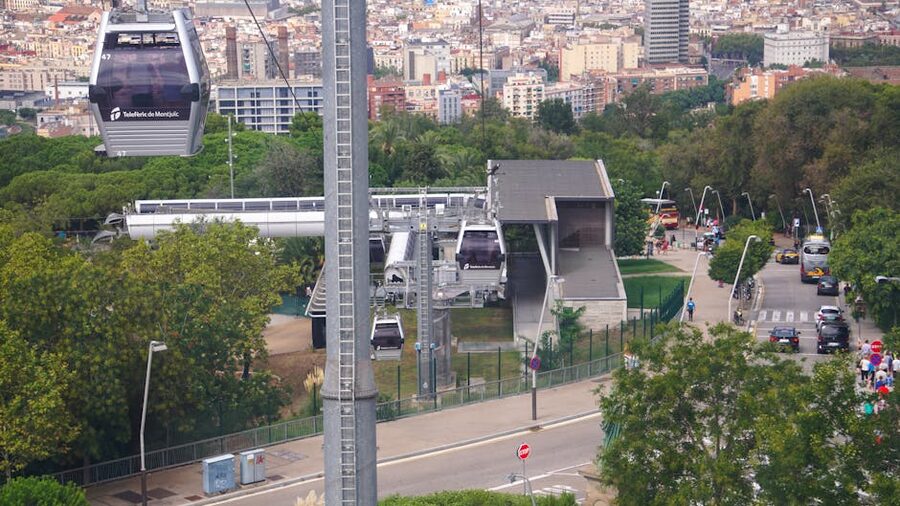
Three stations. The bottom one is called Parc de Montjuïc and sits at the upper end of Avinguda de Miramar, halfway up the hill. The middle one is called Mirador, and it only opens on the way down. The top one drops you outside Castell de Montjuïc, the old fortress at the summit.
The route covers about 750 metres horizontally and rises around 84 metres. End-to-end it takes roughly five minutes one way. Cabins are closed and air-conditioned, which matters in July when the hill cooks. You ride 8 to a cabin maximum and on quiet mornings you might get one to yourselves.
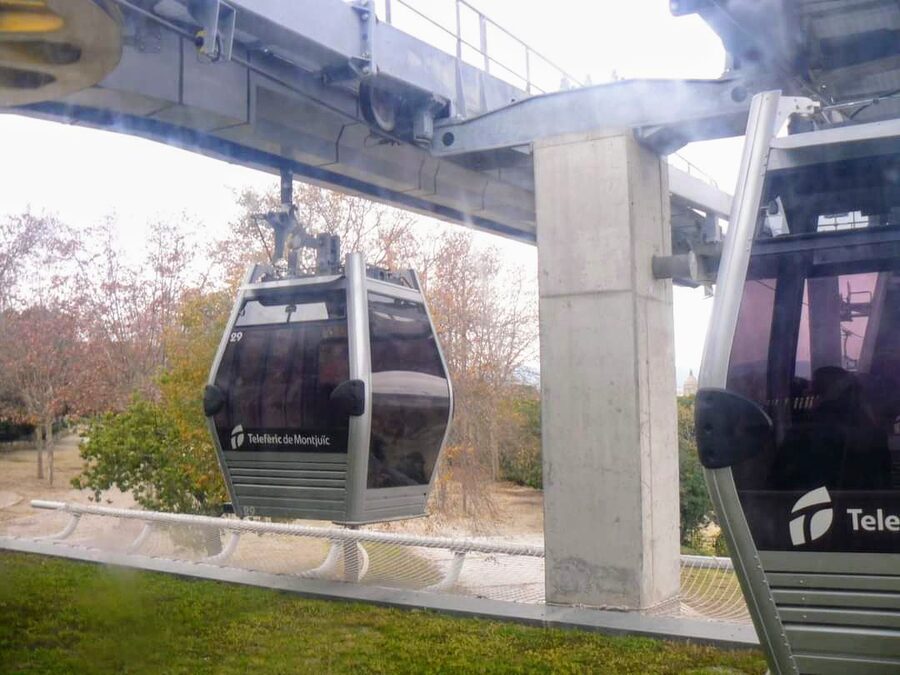
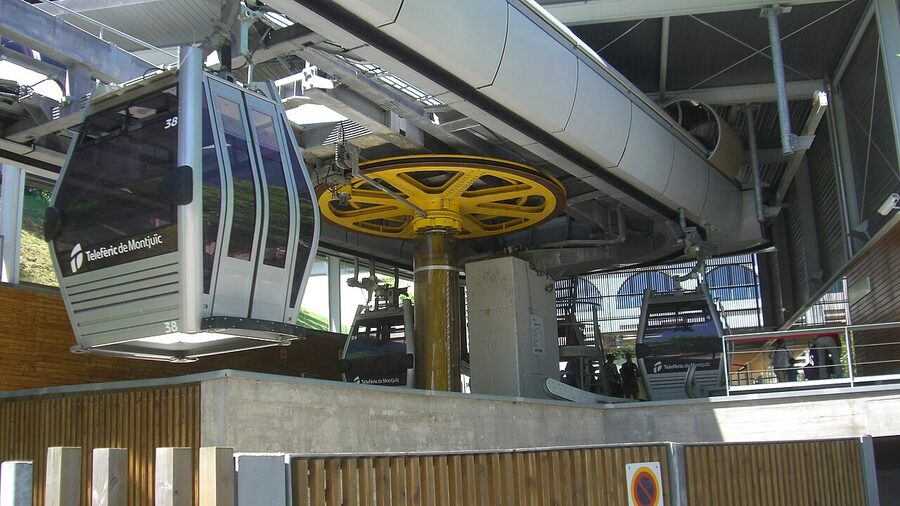
The line was completely overhauled between 2004 and 2007. Before that it had open cars and was, frankly, a bit of a relic. The current setup is a Leitner system, modern and quiet, run by TMB (the same operator as the Barcelona metro and the funicular). You will not feel the swing much except at the support towers, where there is a brief tilt as the cabin crosses each rope clamp.
Tickets, prices, and where to buy
You can buy tickets three ways. Each has its trade-offs.
At the box office on Avinguda de Miramar. The cheapest face value, around 12.00 EUR adult roundtrip on the day. The catch is the queue. In summer this can run twenty to forty minutes at peak (mid-morning and just after lunch are the worst), and there are two cashier windows for the entire operation. If you arrive on a hot day in July with kids, you will regret picking this option.
Pre-booked online via the operator at telefericdemontjuic.cat. Slightly more expensive than the on-the-day rate (closer to 15-17 EUR depending on flex), but you skip the line. You scan a QR at the turnstile and walk on. This is the locals’ move and it is the one I would default to if you have any flexibility.
Pre-booked via a third party like GetYourGuide or similar. Around 22 USD for the standard roundtrip. You pay a few euros more than booking direct, and in exchange you get instant cancellation up to a day or two out, English support, and a single inbox where all your Barcelona bookings live (handy if you are also booking Sagrada Família and Park Güell, which you should be doing in advance regardless). Most travellers I know default to this for booking convenience.
Children under four ride free. 4-12 years pay a reduced rate (around 10 EUR adult-equivalent on the operator site). Wheelchair access is good, every cabin has wheelchair space and the stations are step-free with lifts.
Two ways to ship the ticket: direct return, or with audio guide
Below are the two distinct cable car products worth recommending. Same cabin, same ride, different framing.
1. Montjuïc Cable Car Roundtrip Ticket: $22
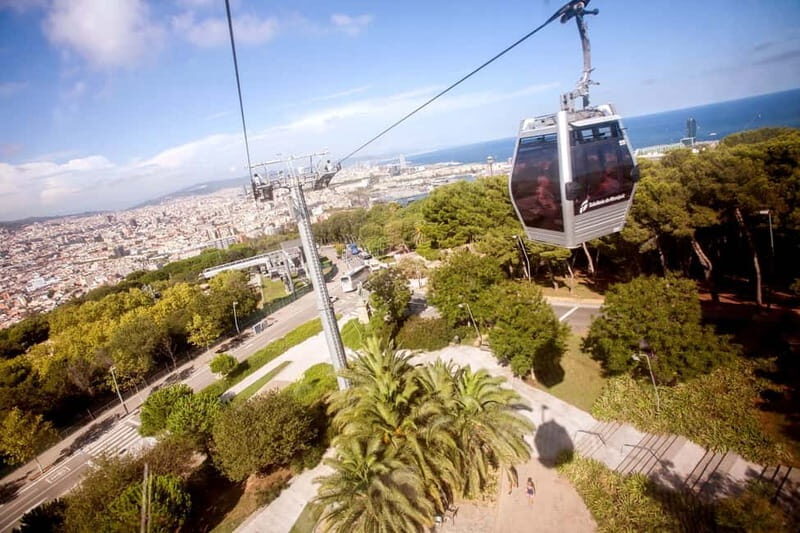
This is the headline ticket and the one most people should book. It is the most-reviewed Montjuïc cable car product on the market and it consistently delivers on the basics, fast online booking, friendly QR-scan boarding, and a return leg you can take whenever you feel like coming down. Our full review walks through the booking flow and a couple of edge cases (the funicular maintenance windows, what happens in high wind).
Check Availability
Read our full review
2. Montjuïc Cable Car Ticket with Audio Guide: $32
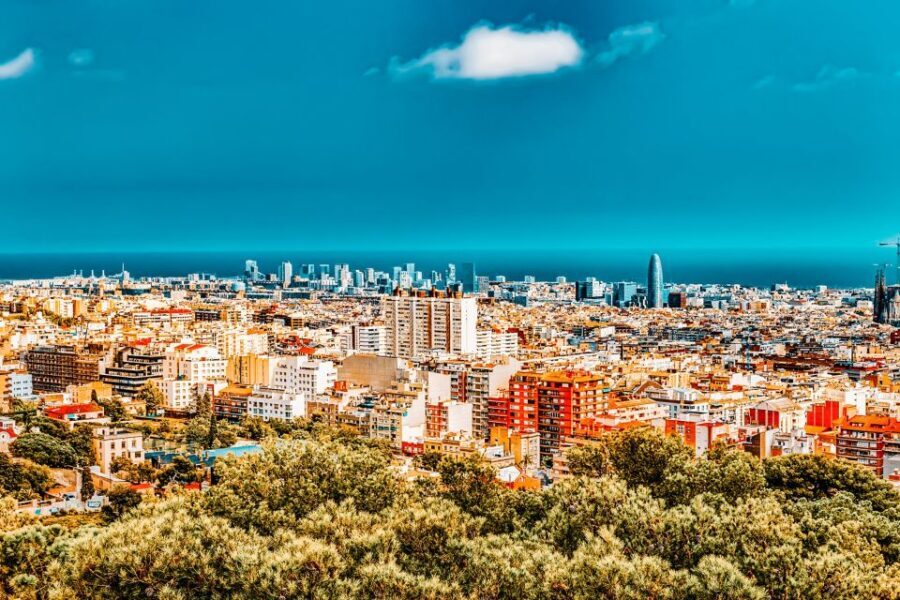
Pick this one if Montjuïc is more than just a quick up-and-down for you, the audio narration covers the castle, the Olympic ring, and the gardens you pass on foot, and most users spend two to four hours total with it. Our audio-guide ticket review goes into how the audio compares to a guided walking tour (short answer, it is fine for self-guided pacing but a real guide is still better if you want depth).
Check Availability
Read our full review
Getting to the lower station from central Barcelona
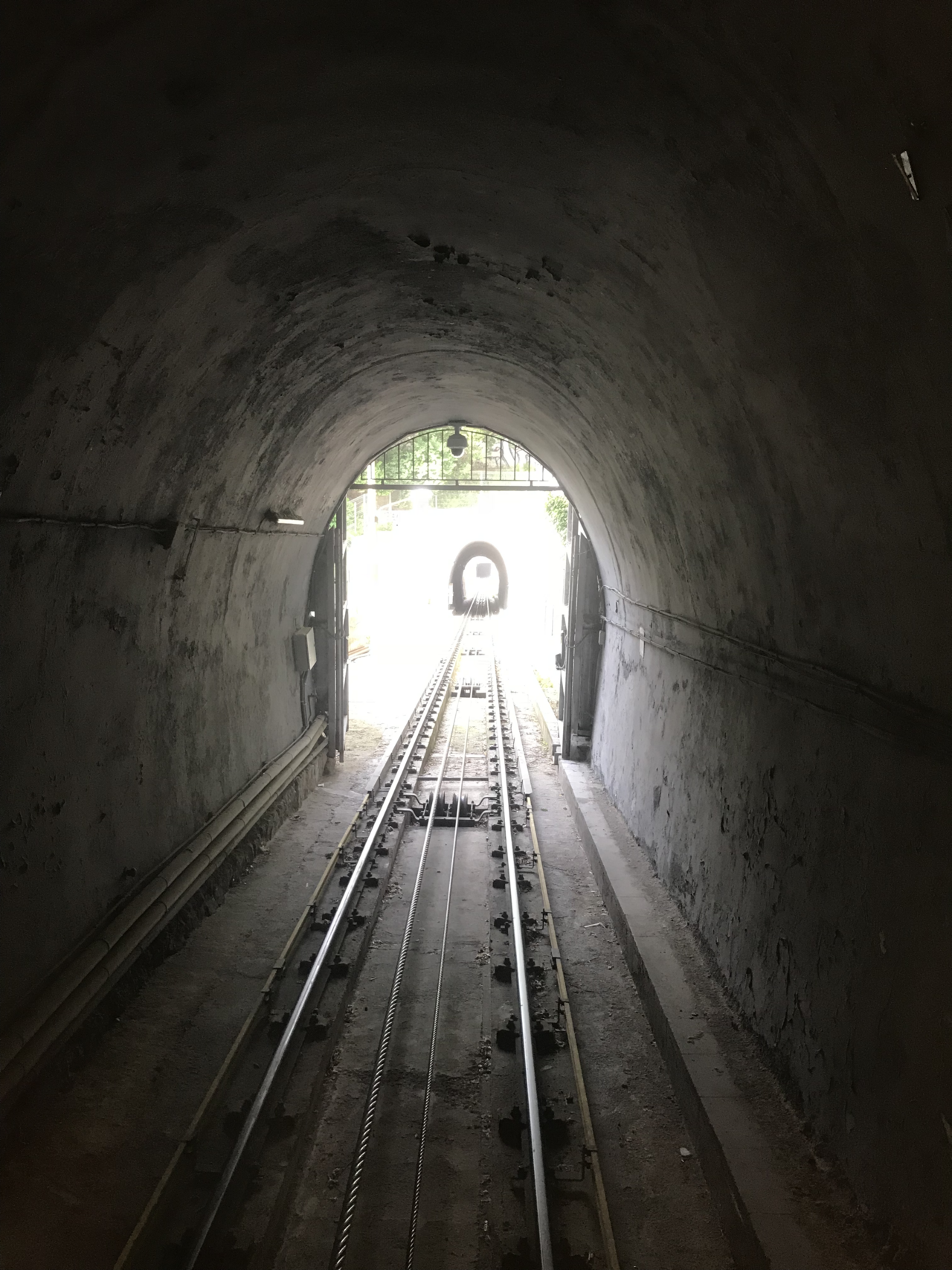

The cable car’s lower station sits halfway up Montjuïc hill, not at street level. To reach it you have two reasonable options.
Option 1, metro plus funicular. Take the metro (lines L2 or L3) to Paral·lel. From there, follow the signs for “Funicular de Montjuïc”. This is a short underground railway, completely separate from the metro tunnels but sharing the station. A standard metro ticket (T-Casual or single) covers the funicular ride, you do not need a separate ticket. The funicular drops you a five-minute walk from the cable car’s lower terminus. This is the option locals use and the one I would recommend for most people.
One thing the official site is not always loud about, the funicular shuts for maintenance at certain times of year, usually a stretch in winter. If you are travelling in January or February, check the TMB site before you make the trip out, and have a Plan B (the 150 bus, see below). I have seen multiple travellers caught out by this.
Option 2, the 150 bus. The 150 runs from Plaça d’Espanya right up the hill, stopping at the cable car lower station and continuing up to the castle. It uses standard Barcelona transit tickets. This is your fallback if the funicular is closed, and it is also your friend if you are travelling with anyone with mobility issues, the bus is straightforward.
Option 3, walk up. If you are coming from Plaça d’Espanya you can walk up via the Magic Fountain, MNAC, the Olympic Ring, and the Joan Miró Foundation. It is a steep but doable hike, twenty to thirty minutes. You will arrive at the lower station already a bit up the hill, having seen most of Montjuïc’s flat-side highlights on the way. Worth it on a cool morning, brutal in August.
Opening hours change with the season
This is one of those rides where opening hours genuinely matter, the cable car closes earlier in winter than most travellers expect.
Roughly:
- January, February: 10am to 6pm
- March to May: 10am to 7pm
- June to September: 10am to 9pm
- October: 10am to 7pm
- November, December: 10am to 6pm
“Closing time” is when the last cabin leaves the bottom station going up. The last cabin coming down is usually 15 to 30 minutes after that, but you should be on top of the hill by closing time at the absolute latest. There are also full-day shutdowns once or twice a year for maintenance, so if you are travelling in the dead of winter, double-check on the TMB site the morning of.
The line also closes in high winds. This does not happen often (the cable car is rated for fairly stiff weather) but it does happen, mostly in late autumn. If it is closed when you arrive, you have not lost your ticket, the operator and most third-party platforms will rebook or refund.
What you actually see from the cabin
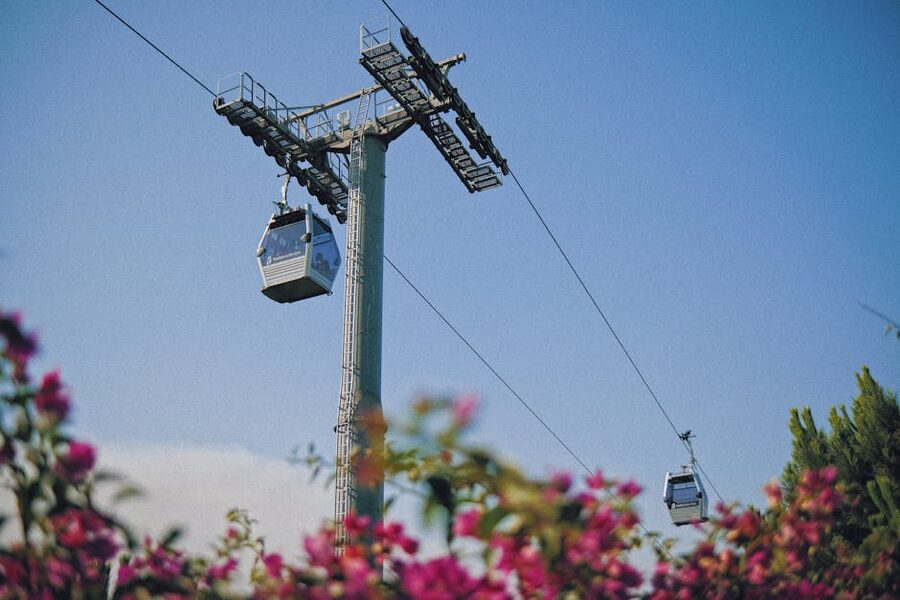
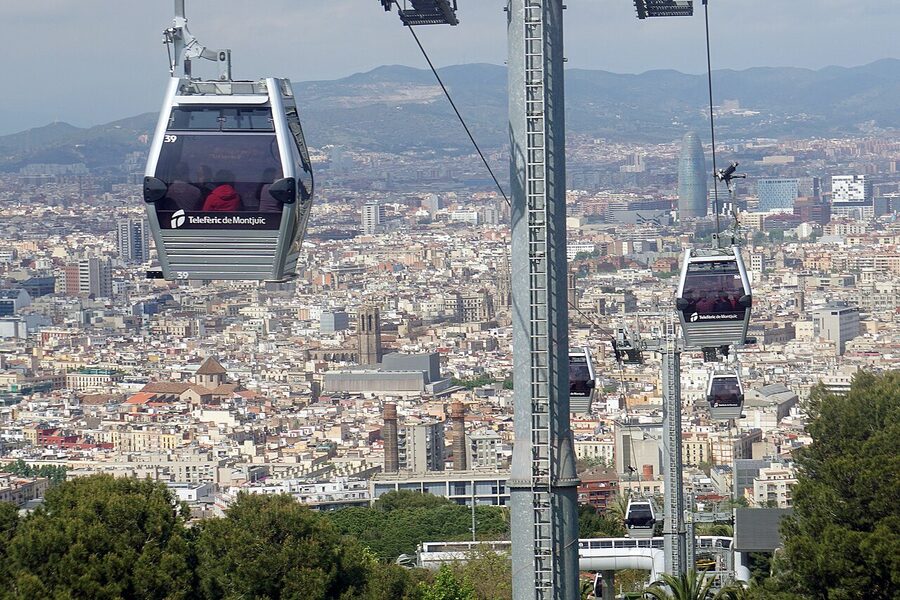
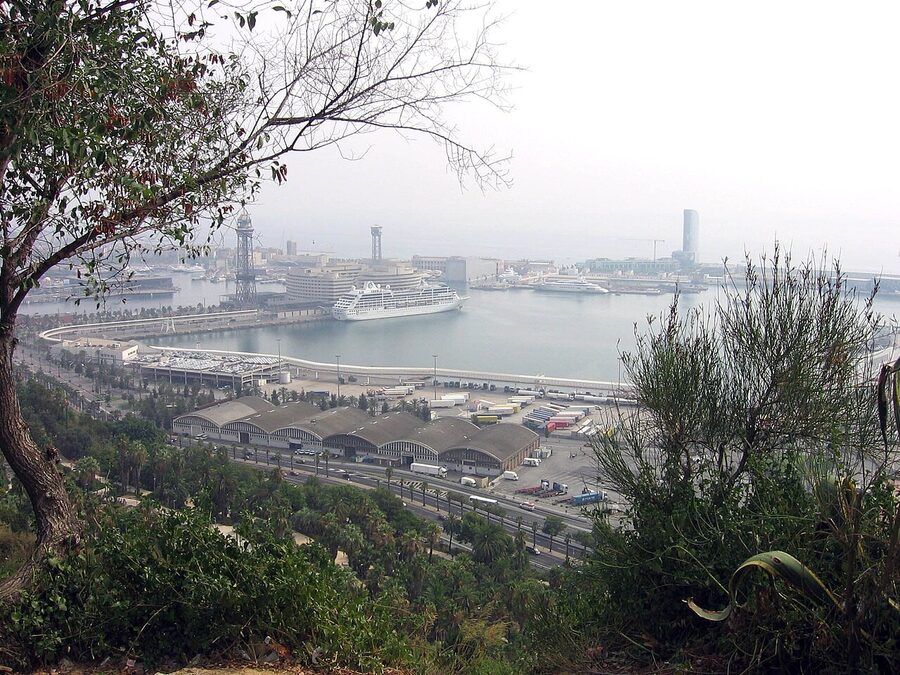
The first ten seconds you are still mostly looking at trees and the slope. Then the cabin clears the lip of the hill and the view opens up all at once, the harbour, the cruise terminals at the foot of Montjuïc, and the cargo cranes off to the right. On the left, the cathedrals and apartment blocks of the city centre stretch back inland to the foot of Tibidabo. On a clear day you can see the W Hotel sail-shape sticking out into the sea, and Sagrada Família rising mid-distance.
About a third of the way up the cable car makes a small but real direction change at one of the support towers. The cabin clamps off the cable, swings briefly through the tower’s pulley, and reattaches on the new heading. You feel a soft tug. First-timers often think something is wrong; it is not.
The middle station, Mirador (officially Jardins del Mirador de l’Alcalde), is the optional stopover. On the way up, the cabin passes through without stopping. On the way down, you can ask to alight there, get out, walk the small landscaped gardens, take photos, and catch a later cabin. There is no extra ticket needed, you just signal at the cabin door.
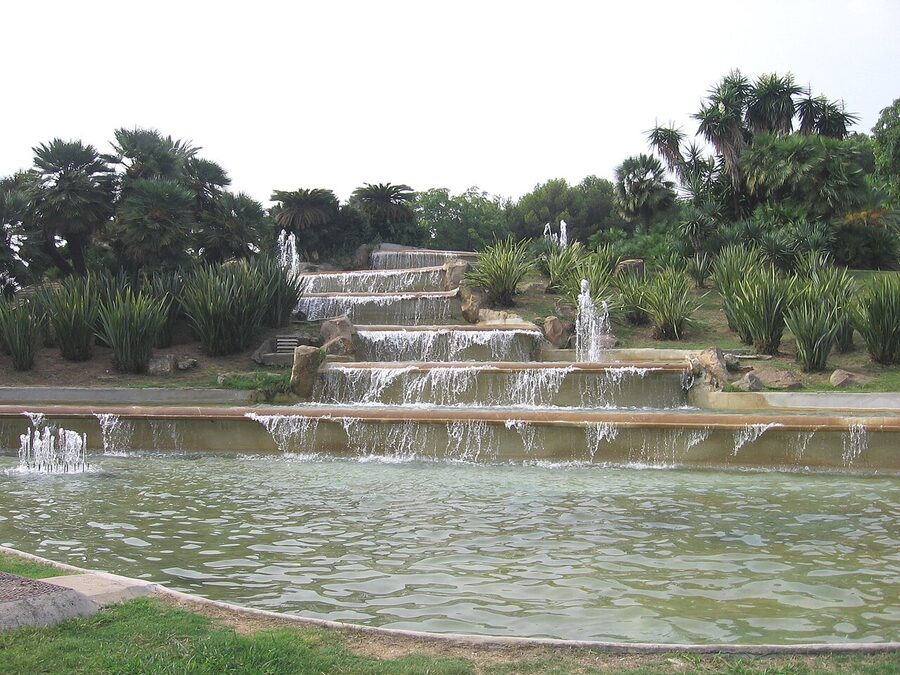

What is at the top: Castell de Montjuïc
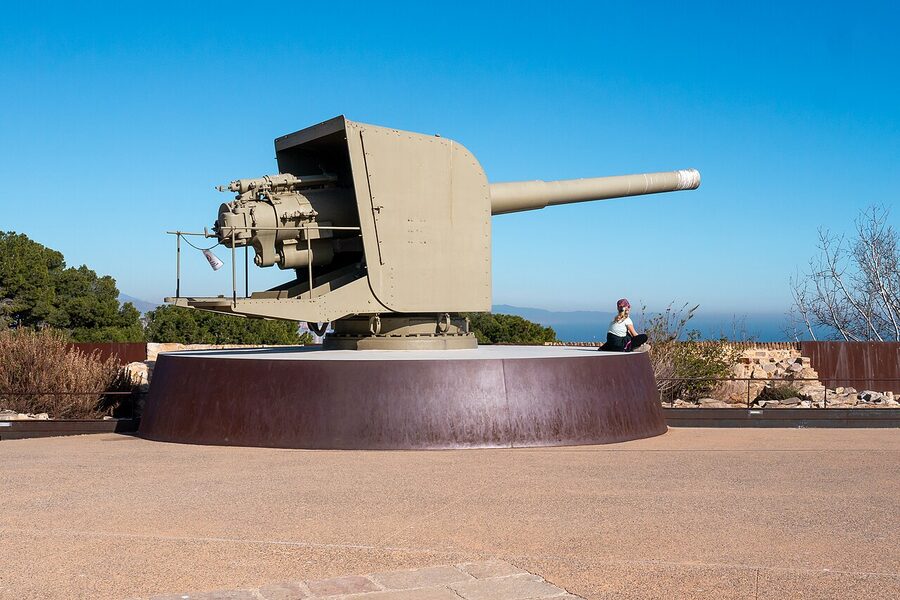
.jpg)
The cable car’s upper terminus opens onto a paved esplanade right outside the fortress walls. From here you can do as much or as little as you want.
Walk the outside. Free, no ticket needed. The walls and bastions, the moat (now dry, planted with cactus and agave), and the perimeter walk give you 360 degrees of view: city, port, sea, and the back side of Montjuïc dropping toward the Mediterranean. Allow forty-five minutes if you want to do this properly.
Go inside the castle. Adult ticket about 12 EUR. You get the courtyard, the museum exhibits on the history of the fortress, and access to the upper ramparts and roof. There is a separate exhibit on the castle’s role under Franco, dark but worth the time. Free entry on Sundays after 3pm, and the BarcelonaCard pass includes the castle entry.
If you want to skip the cable car and just visit the castle, the 150 bus from Plaça d’Espanya goes right to the castle gate. But you will be missing the best bit of the experience.
The castle’s history (very brief, because the present is the better story)
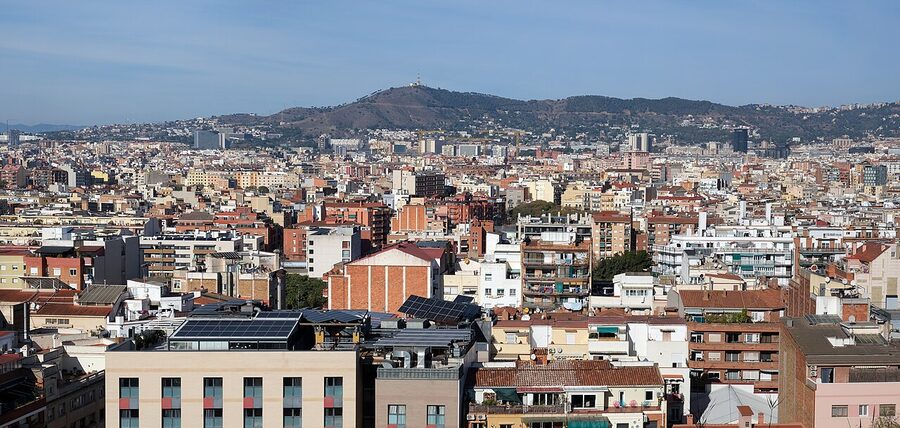

The fortress you see today went up between 1751 and 1779, designed by the military architect Juan Martín Cermeño. It replaced an earlier 1640s structure built around an old lighthouse during the Catalan Revolt. The four-bastion star plan is classic Vauban-influenced military engineering.
What makes this castle different from a lot of European fortresses is what happened inside it during the twentieth century. It was used as a political prison and execution site under General Franco. The most-cited name is Lluís Companys, the president of Catalonia, executed by firing squad in the moat in 1940 after being extradited from France by the Gestapo. There is a small memorial at the spot.
The castle was returned to the city of Barcelona only in 2007. The military museum that was here for decades was removed and replaced with a more honest historical exhibit. Walk the rooftop and you will pass plaques marking these things, easy to miss if you are mostly there for the views.

Do not confuse it with the Port Cable Car
This trips up a lot of first-timers, so worth being explicit. There are two cable cars in Barcelona and they go to completely different places.
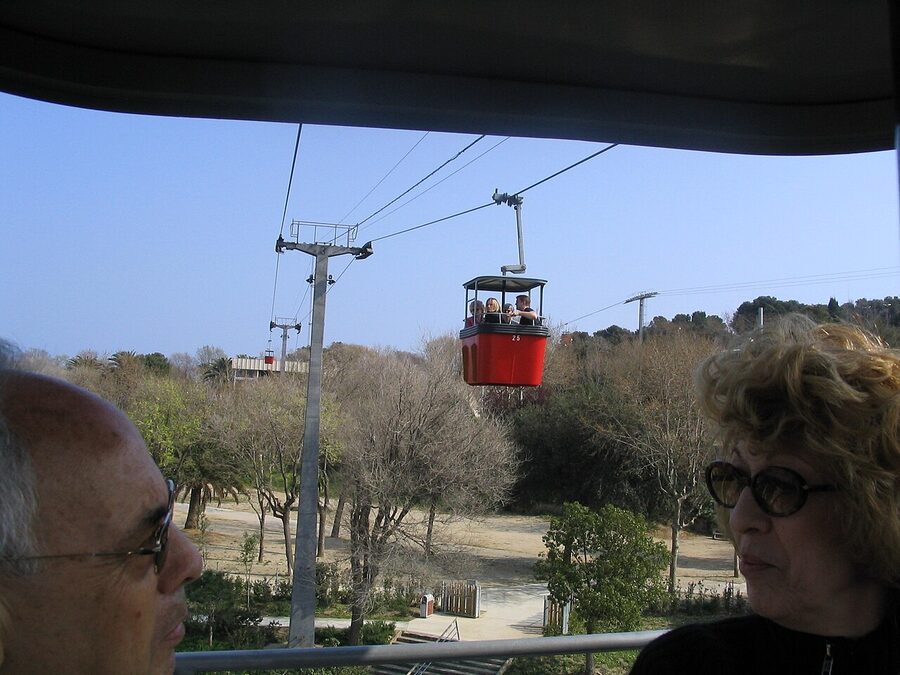
The one this guide covers, Telefèric de Montjuïc, runs from a station halfway up Montjuïc hill to the castle at the summit. Yellow and white closed cabins, eight passengers, operated by TMB.
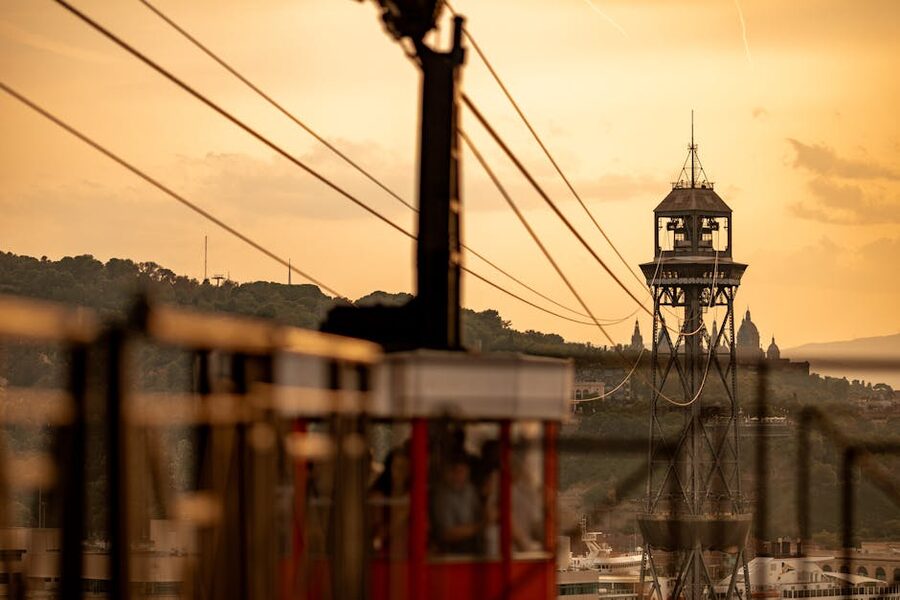
The other one, Telefèric del Port (also called Transbordador Aeri del Port, the harbour cable car, or “the old red one”), runs across the Barcelona harbour from Barceloneta beach to the lower flank of Montjuïc. Red cabins, twenty passengers, much older system (1931), and a separate ticket. It is a cool ride if you have time, but it does not connect to the castle and it is not what shows up on most “Montjuïc cable car” booking pages.
If your ticket says Telefèric de Montjuïc, you want the lower station on Avinguda de Miramar. If it says Transbordador Aeri or Port Cable Car, you want the Sant Sebastià tower at Barceloneta. Different rides, totally different journeys.
How long should you give the whole thing?
If you are doing the cable car as a quick two-stations-and-a-castle visit, plan on about three hours door to door from a city-centre hotel. That breaks down roughly:
- Metro plus funicular plus walk to the lower station: 30 minutes
- Queue plus boarding (with a pre-booked ticket): 5 to 10 minutes
- Ride up: 5 minutes
- Castle outside walk plus inside visit: 60 to 90 minutes
- Ride back down: 5 minutes
- Return journey to the centre: 30 minutes
If Montjuïc is your half-day, give it five to six hours and add the Magic Fountain show in the evening (free, runs Thursday to Saturday in summer, weekends only in shoulder season). Combine it with the Joan Miró Foundation or MNAC and you have a full day. Our guide to visiting Montjuïc walks through the half-day and full-day plans in more detail, and our hop-on hop-off bus guide covers the alternative way of getting around the hill if you want to combine multiple stops without walking the long uphill stretches.
Best time of day to ride
If you can pick your slot, late afternoon wins. The light is better for photos (the harbour goes gold an hour before sunset, the cathedrals and red-tile rooftops glow), the queue at the lower station thins out around 3 to 4pm, and you can ride down in the dusk. June through September the cable car runs until 9pm, which means you can be on the castle ramparts watching the sun set over the Mediterranean and ride down through the lit-up city.
If you are doing a half-day Montjuïc, the smart sequence is: walk up via Magic Fountain and MNAC in the late afternoon, take the cable car up to the castle for sunset, ride down, then return for the Magic Fountain show after dark.
The worst time is the middle of a hot summer day, 12pm to 2pm. The hill bakes, the queues are at peak, the cabin is air-conditioned but the walk between the funicular and the lower station is exposed, and the castle ramparts have minimal shade. If you must go midday in July, drink water on the way and be okay with sweating.
Practical tips a friend would tell you
Wear shoes you can walk in. The path between the cable car upper terminus and the castle entrance is paved but the perimeter walk is uneven, with steps cut into the rock in places.
Bring water. There is a small kiosk-cafe at the upper station with snacks and drinks, and another inside the castle, but both are tourist-priced and you will pay 4 EUR for a bottle of water that costs 90 cents at any street-side bodega. Fill up before you leave the bottom of the hill.
The wind at the top can be sharp even on a warm afternoon. The fortress is exposed on all sides and the breeze off the Mediterranean is constant. A light layer in your bag covers it.
If you are travelling with a stroller, the cabins fit one folded stroller plus passengers, and the stations are step-free. The funicular up from Paral·lel is also step-free. If you have a wheelchair user with you, every cabin has wheelchair space and the boarding staff are practiced at slowing the cabin to let you load.
Tickets do not expire on the day in some flexible booking flavours. If your day at Montjuïc gets rained out you can sometimes shift to the next day, depending on the booking type. Always read the cancellation terms.

Combining the cable car with the rest of the hill

The cable car is one piece of Montjuïc; the hill has more on it than you can do in a day. If you are already going to be up there, here is what is worth pairing.
MNAC sits on the hill below the cable car. It is the National Art Museum of Catalonia, with the world’s best collection of Romanesque frescoes (literally, peeled off church walls in the early 1900s and reinstalled here). Allow 90 minutes minimum. Our MNAC ticket guide covers booking and what to prioritise inside.
Joan Miró Foundation is the artist-designed museum dedicated to Barcelona’s other great twentieth-century painter. The building itself, by Josep Lluís Sert, is worth the visit. Our Miró guide walks through the layout.
Poble Espanyol is the open-air “Spanish village” architectural park, built for the 1929 World Expo, with full-scale replicas of buildings from across Spain. Touristy but charming if you have kids. See our Poble Espanyol ticket guide for opening times and what to skip.
Magic Fountain. Free, evenings only, weekends in shoulder season and Thursday to Saturday in summer. The classic finish to a Montjuïc day.
And the broader frame: our how-to-visit-Montjuïc guide covers the whole hill end-to-end, the Olympic Ring, the gardens, the historic Anella Olímpica, and how to sequence everything in a half day or full day.
Other Barcelona tickets worth booking ahead
If you are doing the cable car you will probably also be doing other booked-in-advance Barcelona experiences. The big-three lock-in-early ones are Sagrada Família (book three to four weeks ahead in summer, no exceptions), Park Güell, and the flamenco show for the evening you are not doing the Magic Fountain. If your trip is built around food, the tapas tour and the paella cooking class are the two strongest food experiences in the city. Music people should add Palau de la Música (the Modernista concert hall is jaw-dropping inside) and culture-completists should pencil in the Picasso Museum in El Born for an early-Picasso collection that is genuinely unlike the Picasso most tourists expect.
Affiliate disclosure: some of the links above are affiliate links. If you book through them we may earn a small commission at no extra cost to you. We only recommend tours and tickets we have used or vetted ourselves.