
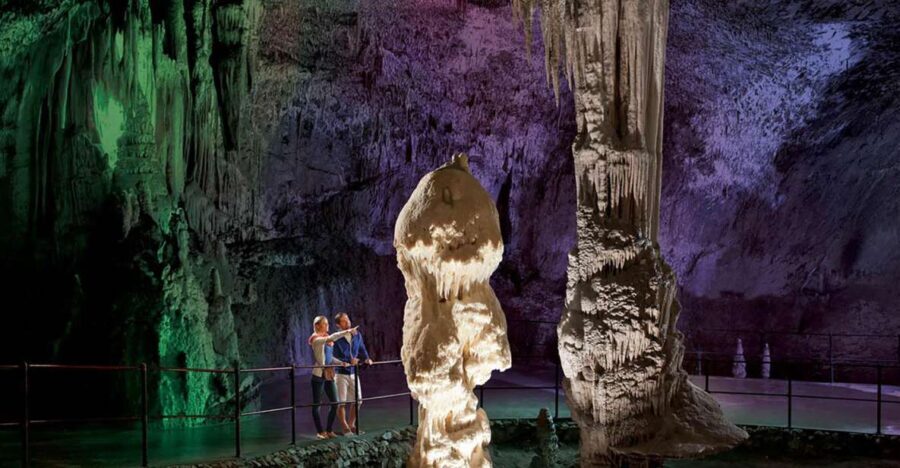
The train slows. The tunnel walls bow outward, then drop away, and you realise the rock above you isn’t a few metres of ceiling but an entire chamber the size of a parish church, lit pale gold from below. Carriages full of people stop talking at the same moment. In the quiet that follows you can hear the train’s brakes ticking, water dripping somewhere behind you, and the small hiss of cold air lifting off your shoulders. Out the side of the carriage stands a five-metre column of bone-white rock the locals call Brilliant. That’s the payoff. Everything else about a Postojna Cave and Predjama Castle day is in service of the moment the train glides into that one chamber.

.jpg)
Tightest schedule: Slovenia in One Day: Bled, Postojna and Predjama, $151. A long day, but the only legitimate way to see all three on a single visit.
Coming from Italy: Postojna Cave & Predjama Castle from Trieste, $133. Cross-border pickup, six hours, no need to swap to a Ljubljana base.
Two things are worth knowing before you book. First, you cannot visit Postojna Cave on your own. The cave is so big it has its own postal address inside it, and entry is only by guided tour with a fixed start time. Second, Predjama Castle is 9 km up the road from the cave entrance, not on the same site. The free shuttle between the two only runs in July and August, so any other month you either drive, taxi, or pick a tour that bundles them. That’s the practical heart of why combo tours sell: they solve the transfer problem you didn’t know you had.


- The Three Tours Worth Booking
- 1. Ljubljana: Postojna Cave & Predjama Castle Tickets and Tour: 5
- 2. Slovenia in One Day: Lake Bled, Postojna Cave and Predjama Castle: 1
- 3. From Trieste: Postojna Cave & Predjama Castle: 3
- What the Postojna Cave Tour Actually Looks Like
- The Olm: Why You Should Care About a Blind Salamander
- Predjama Castle: Renaissance Architecture, Robber-Baron Folklore
- Tickets, Times and What’s Actually Bundled
- How to Get There If You’re Doing It Independently
- What to Wear and Bring Underground
- When to Visit (And When Not To)
- Where to Eat at the Cave Park
- A Bit of History You Might Actually Want to Know
- Common Mistakes to Avoid
- If You’re Building a Slovenia Itinerary
- Postojna vs. Škocjan: Which Cave?
- Photography: What Works, What Doesn’t
- Continuing Your Slovenia Day-Trip Run
The Three Tours Worth Booking
I’ve kept this short on purpose. There are dozens of Postojna day-trip products in the market, but only three structures actually matter, and the rest are slight reshuffles. Pick by where you’re starting from and how much else you want to fit into the day.
1. Ljubljana: Postojna Cave & Predjama Castle Tickets and Tour: $115
If you only want one tour from this article, this is the one. Six hours, English-speaking guide, both sites, and the cave train sorted before you arrive at the chaotic ticket gate. The only thing it doesn’t include is a meal, which is fine because the food at the cave park is hamburger-and-fries territory anyway.
Check Availability
Read our full review
2. Slovenia in One Day: Lake Bled, Postojna Cave and Predjama Castle: $151
Run this only if you have a single full day in Slovenia and you’re not coming back. It’s a long day, you’ll be tired, and Bled in particular gets the short version. But for a one-shot visit it’s the only realistic way to do all three. The small-group cap of eight matters more than people realise on these big-itinerary trips, because every minute lost reboarding a 50-seater bus is a minute not at the lake.
Check Availability
Read our full review
3. From Trieste: Postojna Cave & Predjama Castle: $133
The pickup is by the Trieste cruise terminal or central hotels, and the border into Slovenia is now a non-event since both countries are in Schengen. Six hours, both sites, same cave train, just driven from a different direction. Cheaper than building a Ljubljana overnight if you’re already on the Italian side.
Check Availability
Read our full review
What the Postojna Cave Tour Actually Looks Like


You arrive at a grand-feeling visitor centre with a hotel, a couple of restaurants, the gift shop, and a long covered ramp that leads down to the cave entrance. From there the tour is structured in three pieces, and it’s the same structure on every guided tour you can buy.
The train ride in. Open carriages, no seatbelts, low ceilings in places. You duck reflexively even when you don’t need to. The 3.7 km journey takes about ten minutes and runs through tunnels and bigger halls, sometimes brushing past stalactites that look impossibly close to your head. The first time the train slows you’ll think “oh, this is the chamber,” and then it’ll slow again, and you’ll think “no, this is it,” and then a third time, and you’ll realise the cave is just like this end to end.
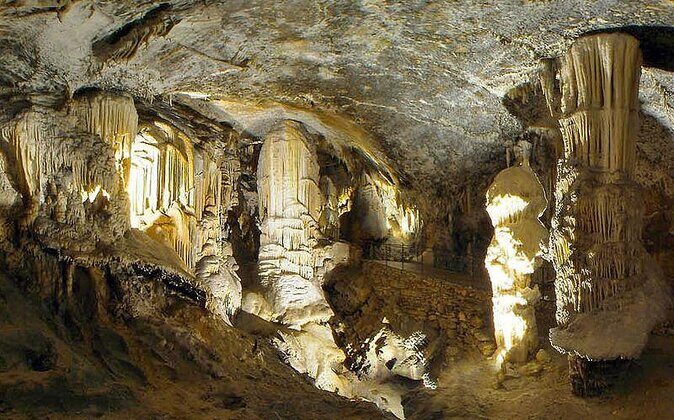
The walking section. About an hour on foot, through the cave’s signature areas. Concert Hall first, the largest single chamber on the route, big enough to host actual orchestras (and it does, around Christmas). After that you wind through the Beautiful Caves, with the tightest groupings of stalagmites and stalactites and the strangest fluted columns. Then a passage called the Spaghetti Hall, where thin stalactites hang in dense clusters that genuinely do look like dried pasta. The path climbs and dips but never feels strenuous. There are handrails everywhere.


Brilliant. The single most photographed object in the entire cave system, and the symbol of Postojna in tourism marketing since the early 1900s. It’s a bone-white stalagmite about five metres tall, almost translucent in the spotlight, sitting in its own small chamber near the end of the walking route. White because it’s almost pure calcium carbonate with no mineral impurities to colour it. The guide will give you about thirty seconds with it. Take the photo first, then look properly second, otherwise you’ll forget.


The walk ends at a small hall with the world’s only underground post office. You can post a postcard from inside the cave, with a special Postojna postmark. It’s tacky, you’ll do it anyway, and it’ll arrive about a week later in surprisingly good condition. Then a short train ride back to the entrance, and you’re done in about an hour and a half from the moment the train left.
The Olm: Why You Should Care About a Blind Salamander

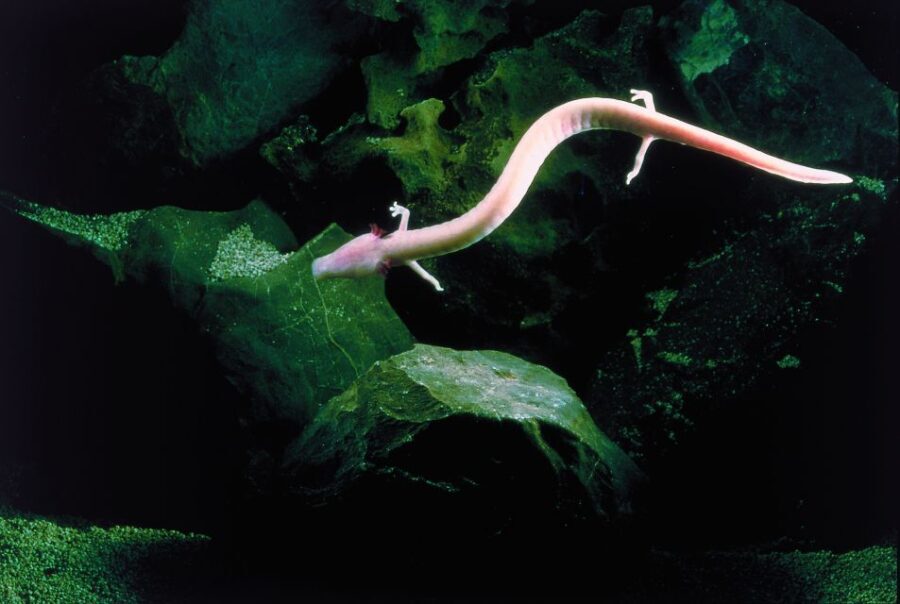
The cave has its own resident animal: Proteus anguinus, a blind aquatic salamander locals have called človeška ribica (the “human fish”) for centuries. They live only in the karst caves of Slovenia, Croatia, Bosnia, and a small bit of Italy. They are blind, almost entirely white, breathe through external gills, and live for about a hundred years. The first scientific description was written when villagers downstream of Postojna started fishing them out of springs after floods and decided they must be baby dragons washed out of the underground.
You’ll see live olms in the Vivarium, a small aquarium-style exhibit by the cave entrance that’s included on most combo tour tickets but worth confirming when you book. Don’t expect drama. They sit on the bottom of the tanks, hardly moving, and that’s exactly the point. Anything that lives a century in total darkness has earned the right to do nothing for as long as it likes. There’s also a small Expo Cave Karst museum next door that walks through how karst landscapes form, with a section on the cave’s tourism history that includes some startling Victorian photographs.
Predjama Castle: Renaissance Architecture, Robber-Baron Folklore

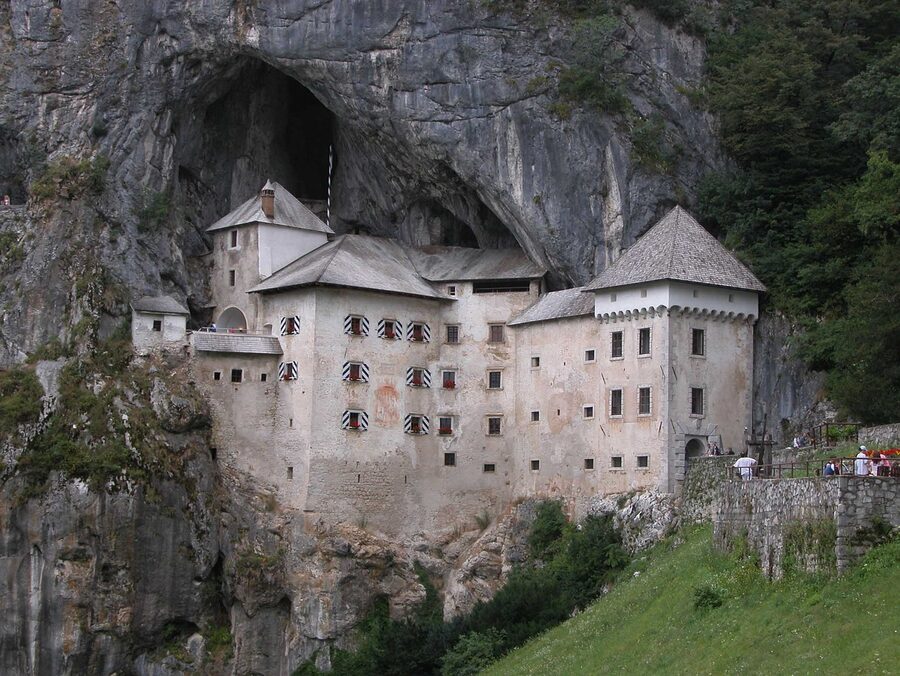
Nine kilometres up the road, the bus pulls into a small village and you walk maybe two minutes to a viewpoint, and the castle is there in front of you. It’s not the size that impresses, it’s the geometry: someone in the late Middle Ages decided to plug a cave with a four-storey Renaissance house, and then someone else in the 1500s decided to fortify and decorate it. The cave behind the castle is real. There are tunnels in the rock that connect to the cave system, and at one time those tunnels supplied the castle during sieges.
The most-told story is Erazem Lueger, a 15th-century knight, robber baron, and Slovenian folk hero. The Habsburgs besieged him here for over a year. The legend says he resupplied through the secret cave tunnels, taunting his besiegers by lobbing fresh cherries at them from the battlements. He was eventually killed, depending on which version you believe, when a servant betrayed him by signalling exactly when he was visiting the castle’s only stone toilet, allowing a perfectly aimed cannonball to find its mark. The story is almost certainly embellished. The toilet still exists.

Inside, the castle is a series of small rooms strung along the cliff cavity. A chapel, a kitchen, the chambers, the dungeon, the secret-passage entrance, all linked by stone staircases that twist around the natural rock. The audio guide is included with the ticket and is genuinely good, ten minutes of useful narration per room rather than the usual half-page repeated everywhere. The whole interior takes about 45 minutes if you’re going slowly.


Tickets, Times and What’s Actually Bundled
Standalone prices, before tour packaging:
- Postojna Cave entry, adult: €31.80
- Predjama Castle entry, adult: €18.90
- Combined cave + castle ticket: €44.90 (the savings only apply if you visit both within 30 days)
- Vivarium add-on: €9.90
- Family tickets are generous: two adults plus two kids works out roughly 25% cheaper than buying separately.
A full GetYourGuide or Viator tour from Ljubljana usually lands at $115–$135 once you fold in transport, guide, and the timed entries. So you’re paying roughly €30–60 over the door price for the convenience of not driving and the certainty of skipping the worst queues. It’s worth it on a busy summer day. It’s borderline in shoulder season, when the cave gates often have walk-up availability.

Tour times. Postojna runs cave tours roughly hourly in high season (every full hour 9 am–6 pm in July and August), every two hours in shoulder season, and three departures per day in winter (10 am, 12 pm, 3 pm). If you’re booking yourself, look up the timetable on the day of, because winter especially varies. If you’re on a packaged tour, this is one of the things the tour solves for you.
How to Get There If You’re Doing It Independently

From Ljubljana the cave is about a 50-minute drive on the A1 motorway. There’s a vast paid car park (€8 a day) at the visitor centre, and you walk in from there. Public transport works but isn’t ideal: there’s a train from Ljubljana to Postojna town (about 75 minutes) and then a 25-minute walk or short taxi to the cave park. The walk passes through pretty enough countryside but in winter or rain it stops being fun.
Predjama is harder by public transport. A free shuttle from Postojna runs in July and August only. Outside those months you’ll need a taxi (about €25 round trip from the cave park) or a rental car. This is the single biggest practical reason most people end up on a tour: the 9-km gap between the two sites is structured against independent visitors for two-thirds of the year.

If you’re driving from elsewhere: the A1 motorway also makes the cave easy from Bled (1 hour 15 minutes), Piran (1 hour 20 minutes), Trieste in Italy (50 minutes), and Rijeka in Croatia (1 hour 30 minutes). The motorway tolls in Slovenia work on a vignette system, not pay-per-use; if you’ve rented a car in Slovenia the vignette is usually included, if you’re driving in from Italy or Croatia you’ll need to buy one at the border.
What to Wear and Bring Underground


The cave sits at 10 °C year-round, with humidity around 95%. That’s not freezing but it doesn’t warm up either, and you’re in the cave for about 90 minutes. People underdress for this constantly. In July you’ll be in a t-shirt and shorts when you arrive in 32 °C heat, then you’ll spend an hour and a half in conditions that match a cool autumn evening in northern Europe. The cave park rents fleece jackets for €5 a head if you’ve forgotten one. They’re better than nothing.
What I bring:
- A long-sleeve fleece or light jacket. Not optional.
- Long trousers if you have them, but jeans work fine.
- Closed shoes with a sole that grips. Trail runners are perfect.
- A phone with cleared storage. You’ll take more photos than you think.
- One bottle of water for after the walk. The air is humid and your throat dries.
What to leave at home: tripods (banned), big bags (awkward in the chamber narrows), and any expectation of getting a perfect photo of Brilliant. The lighting is set up for the eye, not the camera, and your shots will be much darker than your memory.
When to Visit (And When Not To)
The cave runs year-round, but the experience varies sharply by season.
July and August. Both sites are at peak. The Predjama free shuttle is operating. The cave can be hot at the entrance and feels like a deep relief when you go in. The trade-off is the queues, which can hit 90 minutes at walk-up if you don’t have a pre-booked tour. Concert tickets for the Christmas Live Nativity, ironically held in summer rehearsals too, sell well in advance.
May, June, September, early October. The sweet spot. Crowds are manageable, the weather is mild for the drive, and tours run reliably. The cave behind Predjama is open through September. This is when I’d go if I had a choice.

November to March. The cave is still beautiful, and far quieter. But the cave behind Predjama Castle is closed for the bat colony. Tours from Ljubljana run with reduced frequency. If you visit in winter, the cave has a Live Nativity event around Christmas: actors and a choir staged inside the chambers, three nights only, and tickets need to be booked weeks ahead. It’s genuinely good and not as kitsch as it sounds.
Avoid. Christmas/New Year week if you don’t already have Live Nativity tickets, because the cave is half-shut for the staging. And the school-holiday weeks of late August, when the queues at the cave train can get genuinely grim.
Where to Eat at the Cave Park

The food at the Postojna cave park is fine but not great. Magdalena Food and Fun does serviceable burgers and very good fries. Jamski Dvorec, the restaurant set in a 19th-century mansion right by the cave entrance, does something closer to traditional Slovenian dishes, and the fixed-price tour menu at around €25 is decent if you’ve come in with a tour group that lunches together.
At Predjama the play is Gostilna Pozar, the village restaurant a short walk from the castle. Simple menu, fair prices, and a terrace with the castle in front of you. Pick that over the kiosk by the castle entrance, which is just snacks.
If you have a packed lunch from Ljubljana, there’s a small grass area near the cave park entrance where families spread blankets in summer. Nobody minds.
A Bit of History You Might Actually Want to Know

The cave was known to locals for centuries, but the first recorded “discovery” of the deeper sections is dated to 1818, when a local lamplighter named Luka Čeč crossed into the inner chambers ahead of a planned visit by the Habsburg emperor. The cave was opened to the public the next year. The first electric lighting was installed in 1884, making Postojna one of the first electrically lit caves in the world. The train arrived in 1872 as a hand-pushed cart system and converted to electric traction in the 1950s. The current rolling stock dates to 2019.
Predjama Castle’s history is more tangled. There’s been a fortified structure on the cliff since the 13th century, but the building you see today is a 1567 Renaissance reconstruction by the Kobenzl family, who owned it for two centuries. It was last lived in by the Windisch-Graetz family, who held it until World War II. The Slovenian government took it into public ownership in 1955 and it’s been a museum since 1990. The cave behind the castle has been studied by speleologists since the early 1700s, longer than the castle itself has been a tourist attraction.

Common Mistakes to Avoid
Things people regret almost universally:
- Underdressing for the cave. 10 °C and damp is no joke. Bring the layer.
- Booking Predjama as a separate independent visit without checking the shuttle dates. Outside July–August you’ll either taxi or skip it.
- Rushing through Brilliant. The guide gives you about thirty seconds. Plant yourself in front of it the moment you enter the chamber, take the photo, then look. Don’t try to do both.
- Bringing a tripod. Banned. Confiscated at the entrance. Use the railing as a brace if you really need stability.
- Doing the Slovenia One Day combo if you’re already on a multi-day Slovenia trip. You’ll see Bled later, properly, on a half-day. Don’t compress it. The combo is only worth it as a one-shot.
And one less obvious mistake: don’t book a Predjama-only tour from Ljubljana, even though they exist. Every operator that runs them is essentially driving past the cave to do half a day at the castle, which is a bad use of the drive. Either do both, or do neither.
If You’re Building a Slovenia Itinerary

For most Slovenia trips, Postojna and Predjama are the southern half of a triangle: Ljubljana north, Bled north-west, Postojna and Predjama south-west. Two full days will cover all three comfortably if you sleep one night in Bled and one in Ljubljana. If you also want the Soča Valley, which I’d argue you should, that’s another two-night detour around Bovec for river rafting in Bovec or canyoning. So Slovenia comfortably soaks up four to five nights of a longer trip without forcing pace on anything.
The other piece of the puzzle is a Lake Bled day trip from Ljubljana, which is the easiest single-day excursion north of the capital, and Ljubljana Castle for the half-day in the city itself. If you’re stitching it together yourself, those four pieces (Postojna+Predjama, Bled, Bovec, Ljubljana Castle) cover the country’s headline draws.
Postojna vs. Škocjan: Which Cave?
Slovenia has two big tourist caves about 40 km apart, and people who get on the wrong one feel slightly cheated.
Postojna is the “show cave”: train, lights, easy paths, big chambers, gift shop. Best for first-time cave visitors, kids, anyone who wants the spectacle without the effort. Three to four hours including the castle.
Škocjan is the UNESCO-listed canyon cave: a vast underground gorge with a river running through it, no train, no electric lighting in the same way, longer walking sections, and more genuine drama for people who already love caves. Two hours of walking minimum, more strenuous, no Predjama nearby. Better for cave enthusiasts.
If you only have one day, do Postojna. If you can do two, Škocjan on day two. They are not the same experience and they are not interchangeable.

Photography: What Works, What Doesn’t
Phone cameras with night mode handle the cave better than dedicated cameras without flash. The lighting is moody and yellow, calibrated for the eye, and a phone that takes a 3-second composite shot will pick up details a DSLR will miss without a tripod (and tripods are banned). Turn flash off. It’s not allowed, and even when sneaking it the result is flat and white.
For Predjama, the magic-hour shot is from the village viewpoint about 100 metres before the entrance ticket office. Late afternoon in summer or any time on a clear winter day, the cliff turns warm orange and the castle stands in pale relief.
Both sites have spots labelled “no photography” inside the buildings, mainly the castle’s chapel and a couple of reconstructed rooms. Respect those. Everywhere else is fine.
Continuing Your Slovenia Day-Trip Run
Postojna and Predjama are usually the second-best day trip travellers do from Ljubljana, behind Lake Bled. If you’re stacking a long weekend, the natural pairing is one cave day and one lake day: a Lake Bled day trip with the pletna boat to the island works as a softer counter to the cave’s drama. For something more active, head north-west to Soča River rafting in Bovec, which is the country’s adventure capital and the only place in Slovenia where the Julian Alps actually feel alpine. Back in the capital itself, Ljubljana Castle is the half-day you slot in around your other plans.
For other underground experiences in Europe, the closest comparisons are the Caves of Hams in Mallorca (a much smaller, more theatrical Mediterranean cave) and the Caves of Drach (the underground-lake-with-classical-concert variant). For something more active and city-bound, the Buda Castle cave tour in Budapest walks through World War II hospital tunnels rather than natural karst. None of them are quite like Postojna, which is why the train and the chamber and Brilliant stay with you. There’s only one of those in Europe.
Some of the links above are affiliate links. If you book through them we earn a small commission, at no cost to you. It helps keep this site running.