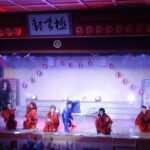
Taishu-engeki is a lively kind of popular Japanese theater, not a quiet display behind glass. At Gofukuza in Umeda, the program moves from a mini-show to a play and then a grand maiko performance, with expressive acting, elaborate costumes, music, and dance. The finale is the easiest part to enjoy without Japanese.
I like two things here: you get a glimpse of a theater experience that feels local rather than built as a tourist spectacle, and the performers bring plenty of energy to the stage. The audience can be part of the mood, too, cheering along with the action. The ticket is also modestly priced, starting at US$15.80.
The main caveat is language. Although the experience is described as non-verbal, the play includes Japanese dialogue, and there are no English subtitles or synopsis. If you expect a fully wordless traditional drama, you may be puzzled. Go for the visual performance and local atmosphere, not a plot you can easily follow.
- Three-part program: Expect a mini-show, a Japanese-language play, and a grand maiko finale.
- Best for a short visit: The finale begins around 14:00 for the daytime performance or 19:30 at night.
- A local theater atmosphere: You may see Japanese audience members cheering and responding to the performers.
- A visual treat: Costumes, hair, makeup, song, and dance are central to the appeal.
- Find the exact building: Look for Plaza Umeda Building, 5F, at 8-17 Taiyujicho.
- Plan for the practical limits: There is no luggage storage, and the venue is not wheelchair- or stroller-accessible.
- A local theater show, not a silent cultural exhibit
- What happens in the three parts
- The audience is part of the show
- What the non-verbal description really means
- Cost and how much time to set aside
- Getting to Gofukuza without the Umeda mix-up
- Who will enjoy it most
- Should you book the Taishu-engeki show?
- FAQ
- How long does the full performance last?
- What are the three parts of the show?
- Is the show really non-verbal?
- When does the grand maiko show begin?
- Where is the theater?
- How do I get there by train?
- What does the admission ticket include?
- Can I eat or drink inside the theater?
- Is the venue accessible, and can I store luggage there?
- The Best Of Osaka!
- More Tours in Osaka
- More Tour Reviews in Osaka
A local theater show, not a silent cultural exhibit
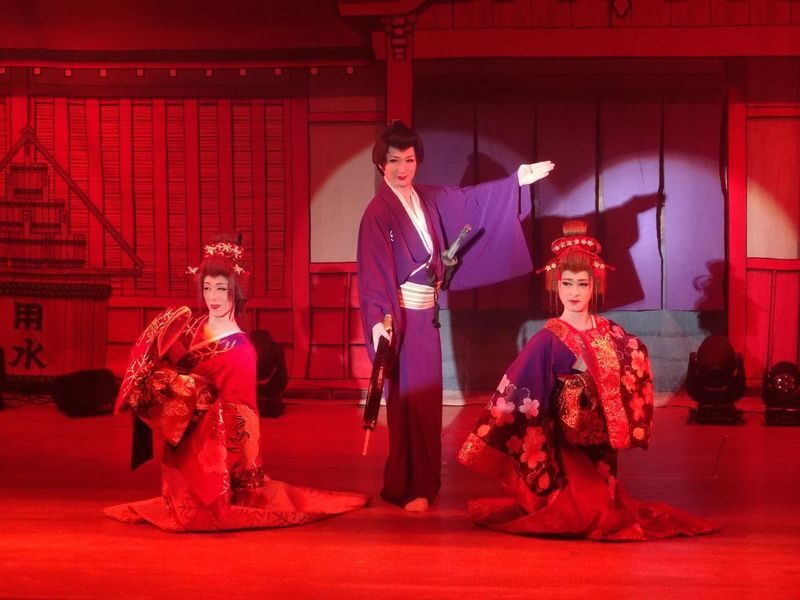
Taishu-engeki is best approached as live popular theater, with a mix of acting and dance rather than a formal lesson in Japanese performance traditions. The exact program can vary, but the advertised structure has three parts: a mini-show, a play, and the grand maiko show. Expect a full evening or afternoon if you stay for all of it.
This is a small-scale, audience-facing experience. The theater’s appeal lies in seeing performers work close to the audience, rather than in a grand stage or elaborate production effects. The show has been described as low-budget by some, so it is wise not to expect the polish of a major theater production. The performers’ expressive movement, costumes, and connection with the room are the draw.
One useful distinction: a Japanese theater experience does not automatically mean a traditional play in the style you may have imagined. The program combines drama with song and dance, and the dance portions can feel more like a lively stage revue than a history lesson. That variety is part of its charm, but it matters when you decide what kind of evening you want.
👉 See our pick of the The Top 15 Workshops & Classes In Osaka
What happens in the three parts
The first section is a mini-show. You may see comic acting and character performance, though the precise content can change. If you do not know Japanese, facial expressions, gestures, and audience laughter help you read the room, even when the dialogue itself passes by.
Next comes the play. This is the part most likely to depend on Japanese, and it can run long enough to test your patience if you cannot follow the story. You can still watch the actors’ expressions, costumes, and movements, but there are no English or Chinese subtitles and no play synopsis provided. Treat it as a visual performance, not a translated drama.
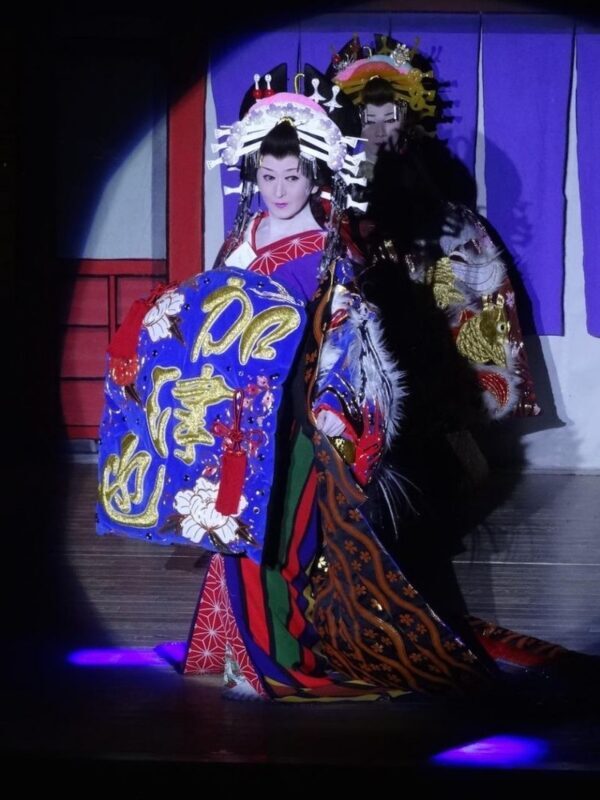
The finale is the grand maiko show, with dancing, music, and striking costumes, hair, and makeup. This section is the most accessible choice for visitors who do not speak Japanese, and it is the recommended part if you want to focus on movement and spectacle. The full program is scheduled for about three hours, but you can enter for the finale only. The approximate start times are 14:00 during the day and 19:30 at night.
The published program describes a mini-show, play, and grand maiko show, while individual performances may feel different in emphasis. Some have featured comedy followed by song and dance, with energetic group numbers and fan cheering. Think of the schedule as a useful outline, not a guarantee that every performance will unfold in precisely the same way.
You can also read our reviews of more tours and experiences in Osaka.


The audience is part of the show
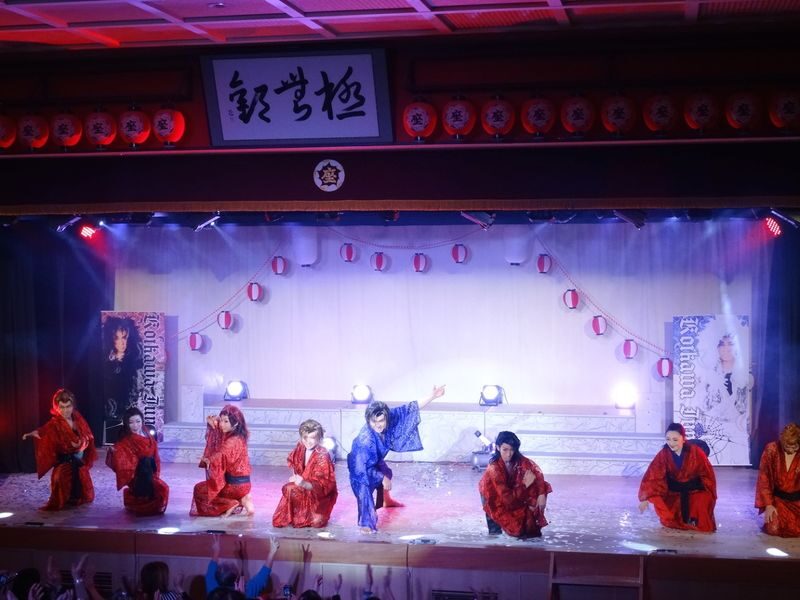
One of the most interesting parts of the experience is the room itself. This is not simply a stage facing a silent crowd. Audience members may cheer for performers, and that response can give you a sense of how local fans enjoy the show. Even if you miss the words, you can follow the shifts in energy between performers and audience.
That closeness is a real strength. The show can feel informal and personal, particularly compared with a large, formal theater. Some people have described meeting or speaking with performers at the end, but do not build your plans around that happening. The key point is that the performance has a direct, human scale.
The audience is often predominantly Japanese, so you are likely to be seeing the show in the setting it was made for, rather than in an English-language version for visitors. That is a genuine cultural plus, but it also explains why the show may not pause to explain a joke, character, or custom. A little patience goes a long way.
What the non-verbal description really means
The show is promoted as non-verbal, but you should not take that to mean that every part is silent or easy to understand without Japanese. The play includes spoken Japanese, and there is no translation. The dance and visual sections need less language, but the full three-hour program is not a wordless performance.
If you are curious about Japanese theater and comfortable enjoying movement, music, and acting without knowing the plot, the language barrier may be manageable. If you need a clear story to stay engaged, consider arriving for the final section instead. You will get the costumes and dancing without committing to the whole program.
I would also adjust expectations about the word traditional. The performance draws on Japanese theater culture, but it is not necessarily the formal, highly polished production a visitor might associate with a major classical theater company. One attendee specifically cautioned that this is not a traditional theater troupe in that sense. Come for a local popular-theater experience, not a definitive introduction to every form of Japanese stage art.
Cost and how much time to set aside
Admission starts at US$15.80, a reasonable price for a live performance that can fill three hours. You are paying for the show, not a meal, drink, photo session, or guided explanation. Food and beverages are not included, though eating and drinking inside the theater is allowed, including alcohol.
The ticket makes the most sense if you want an unusual evening in Osaka and are happy to watch without understanding every line. If you stay for all three sections, the price works out as inexpensive entertainment by the hour. If you only want the dance finale, it is still a relatively low-cost way to see the costumes and performance, though the value depends on whether that shorter segment is enough for you.
A kimono photo shoot is available for an additional JPY500. It is not part of the admission ticket. Photo and video rules are not consistent in the information available, so ask staff before taking pictures rather than assuming photography is allowed.
Getting to Gofukuza without the Umeda mix-up
The venue is at Plaza Umeda Building, 5F, 8-17 Taiyujicho, Kita Ward, Osaka. It is about an eight-minute walk from JR Osaka Station and about five minutes from Umeda Station. The building name matters: there are similarly named Umeda locations, and entering the wrong one can send you in the wrong direction.
Use the full address, including Plaza Umeda Building and the fifth floor, when mapping your route. Do not rely on a pin that simply says Umeda Building. Arrive with time to spare, especially if you are planning to see the opening section. The theater’s entrance and lobby have a display of traditional katana and hand fans, which gives you something to look at before the performance.
The daytime opening is listed as 12:30 to 15:30, and the evening session as 18:00 to 21:00. The voucher is valid only on the date and time you book. Present your mobile voucher at the venue. There is no luggage storage, so leave larger bags elsewhere before you arrive.
Who will enjoy it most
I would recommend this to you if you are curious about local Japanese entertainment, enjoy live dance, or want a break from Osaka’s food and shopping routine. It is also a good fit if you are comfortable with a show that may be hard to follow in detail. The lively audience and expressive performances give you plenty to watch, even when you do not understand the dialogue.
Families can attend, but keep the three-hour length and language barrier in mind. The venue is not stroller-accessible, and it is not wheelchair-accessible. If you are bringing children, the visual finale may hold their attention better than a long Japanese-language play.
Skip it if you are looking for a carefully explained cultural presentation, English subtitles, or a high-budget theatrical production. And if you are exhausted, do not schedule it after a full day of strenuous sightseeing. Three hours in a theater can feel longer when you are tired and cannot follow the dialogue.
Should you book the Taishu-engeki show?
Book it if you want an affordable, close-up taste of Japanese popular theater and can enjoy the performance without needing a translation. The costumes, dance, audience response, and informal atmosphere are its strongest points. For the best chance of enjoying it without Japanese, aim for the grand maiko finale around 14:00 or 19:30.
Pass if your priority is a plot you can understand, a formal classical theater production, or easy access for a wheelchair or stroller. Either way, verify the exact Plaza Umeda address before setting out. Finding the right fifth floor is a small part of the adventure, but it should not become the whole evening.
Traditional Japanese Performance “Taishu-engeki” in Umeda
“The atmosphere was great, the short play in the first part was very interesting, and the performance in the second part was also excellent.”
FAQ
How long does the full performance last?
The daytime and evening programs each run for about three hours. The listed hours are 12:30 to 15:30 and 18:00 to 21:00.
What are the three parts of the show?
The program has a mini-show, a play, and a grand maiko show. The final section is the most visual and is recommended if you are entering partway through.
Is the show really non-verbal?
Not throughout. The play includes Japanese dialogue, and there are no English or Chinese subtitles or play synopsis. The dance portions rely less on language.
When does the grand maiko show begin?
The approximate start is 14:00 for the daytime program and 19:30 for the evening program.
Where is the theater?
It is at Plaza Umeda Building, 5F, 8-17 Taiyujicho, Kita Ward, Osaka. Use the full building name to avoid confusion with other Umeda locations.
How do I get there by train?
From JR Osaka Station, it is about an eight-minute walk. From Umeda Station, it is about a five-minute walk.
What does the admission ticket include?
It includes admission to the Taishu-engeki show. Meals, beverages, personal expenses, and the kimono photo shoot are not included.
Can I eat or drink inside the theater?
Yes. Eating and drinking inside is permitted, including alcohol, but food and beverages are not included with admission.
Is the venue accessible, and can I store luggage there?
The venue is not wheelchair- or stroller-accessible, and it has no luggage storage facility.