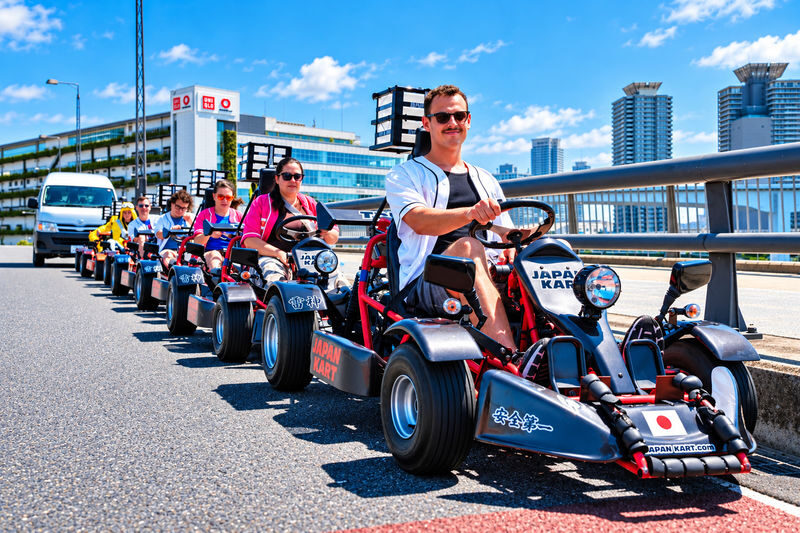
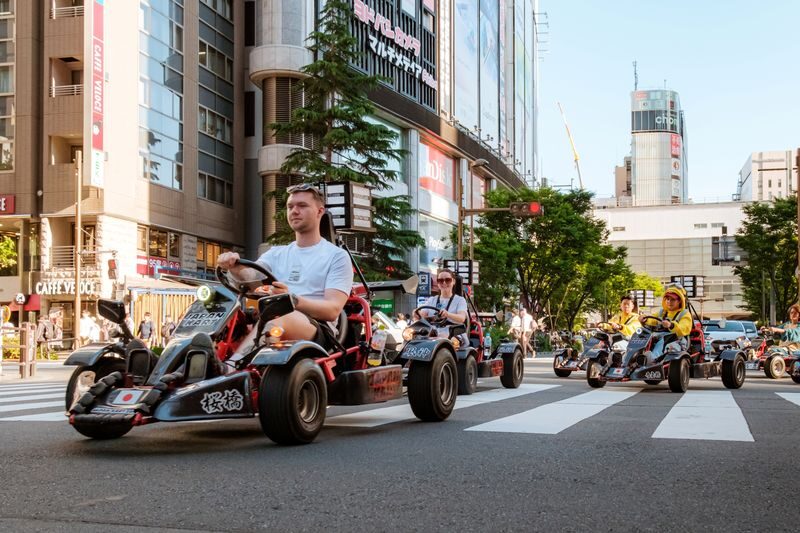
Tokyo looks different from a kart at road level: shop signs, traffic lights, and the city’s steady stream of cars become part of the ride. JAPANKART’s street-kart tour pairs you with a guide car at the front and a support car behind, then leads the group through East Tokyo. You can dress up for the ride, but this is real city traffic, not a theme-park track.
I like two things in particular: the guided convoy offers structure on unfamiliar streets, and the costume selection adds a playful note to a sightseeing trip. The option of a one-hour or two-hour ride also makes it easier to fit the outing into your plans.
The main catch is practical and important: you must bring the right physical driving documents, including an eligible international permit or Japanese translation, depending on your country. And because the karts share public roads, traffic can mean slow stretches rather than a fast, uninterrupted ride.
- A convoy, not a race: A lead car guides the group while a second car follows behind.
- East Tokyo on the route: Areas listed include Asakusa, Ueno, Akihabara, and Tokyo Skytree, though traffic and weather can change the schedule.
- Two ride lengths: Choose a one-hour Sky Tree Branch experience or a two-hour Asakusa Branch option.
- Costumes are included: Pick from the available outfits; winter jackets and pants are also offered at no extra charge.
- Driving documents are essential: Bring your passport, physical home-country license, and the permit or translation required for your nationality.
- Plan for road conditions: City traffic, rain, and traffic lights shape the pace and views.
- A city tour with a kart’s-eye view
- Choosing between one and two hours
- Costumes, briefing, and getting underway
- What the route feels like from the driver’s seat
- Safety, traffic, and weather
- The paperwork can make or break the booking
- Is the price worth it?
- Who should book this Tokyo kart ride?
- FAQ
- How long is the JAPANKART experience?
- Which Tokyo areas are included?
- What is included in the price?
- How old do I need to be?
- What driving documents should I bring?
- Is a paper copy of an international driving permit accepted?
- What happens if the weather is poor?
- How early should I arrive?
- The Best Of Tokyo!
- More Tours in Tokyo
- More Tour Reviews in Tokyo
A city tour with a kart’s-eye view
 1 / 8
 2 / 8
 3 / 8
 4 / 8
 5 / 8
 6 / 8
 7 / 8
 8 / 8
This is an unusual way to see Tokyo, but it is still a guided road tour. You drive your own kart in a group, follow the guide’s route, and share the streets with ordinary traffic. The appeal is the change of perspective: instead of looking down at a map or up from a sidewalk, you sit low to the road and watch the city pass at street level.
That distinction matters when you book. JAPANKART is not offering a racing circuit, nor does the information promise a stop at every listed district. The route is guided, and its timing may change with traffic and weather. Think of the ride as a moving city experience, with some stretches of scenery and some stretches of waiting at lights.
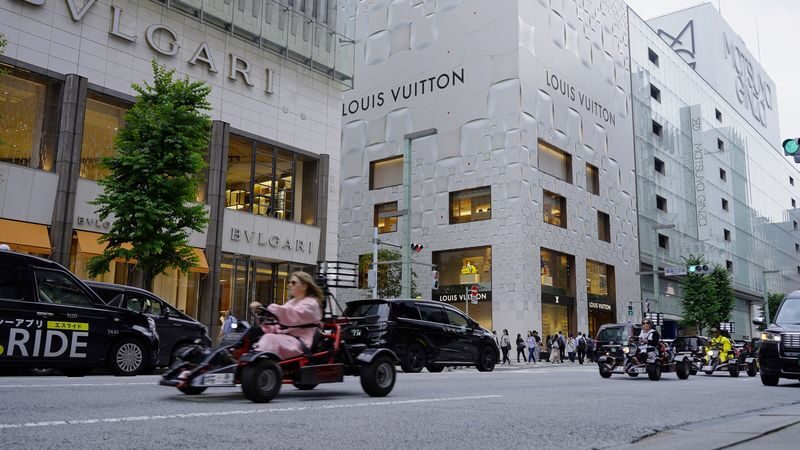
The listed highlights cover East Tokyo, including Asakusa, Ueno, Akihabara, and Tokyo Skytree. Some outings have also passed through Ginza. Your exact route depends on the selected package and conditions on the day, so treat these areas as route possibilities rather than a guaranteed checklist.

👉 See our pick of the Our Picks For The 11 Best Workshops & Classes In Tokyo
Choosing between one and two hours
The one-hour Sky Tree Branch ride is the shorter choice. It suits you if you want a taste of driving a kart on Tokyo’s streets without giving up a large part of the day. The package details describe a one-hour experience, while the supplied activity information also identifies a 60-minute ride as included.
The two-hour Asakusa Branch option gives you more time on the road and is the better pick if the kart ride itself is a major part of your plans. A longer outing can cover more ground, though it does not mean two hours of continuous movement. Traffic lights, congestion, and the group’s progress all affect how much you see.
Departure times listed for the activity are 10:00, 13:30, and 16:00, with availability depending on the package selected. Return times and branch details can vary by itinerary. Check the exact option and schedule shown at booking rather than assuming that every start time pairs with every return time.
You can also read our reviews of more tours and experiences in Tokyo.

Costumes, briefing, and getting underway
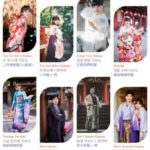
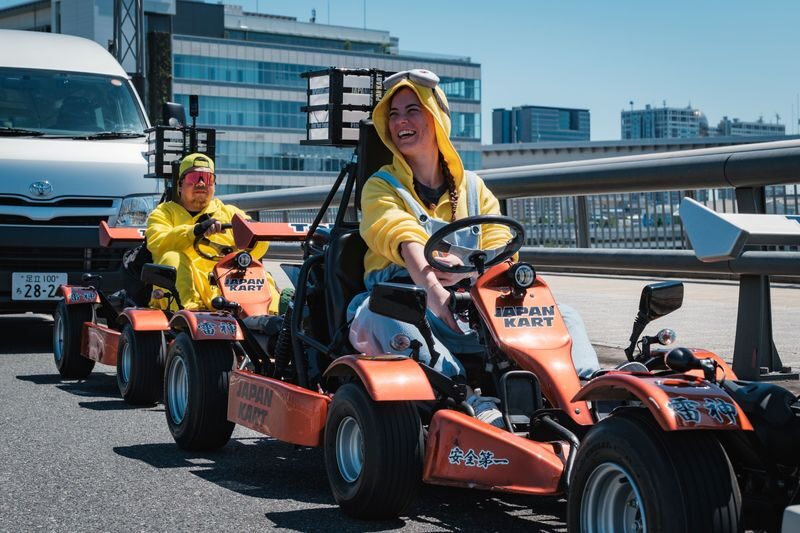
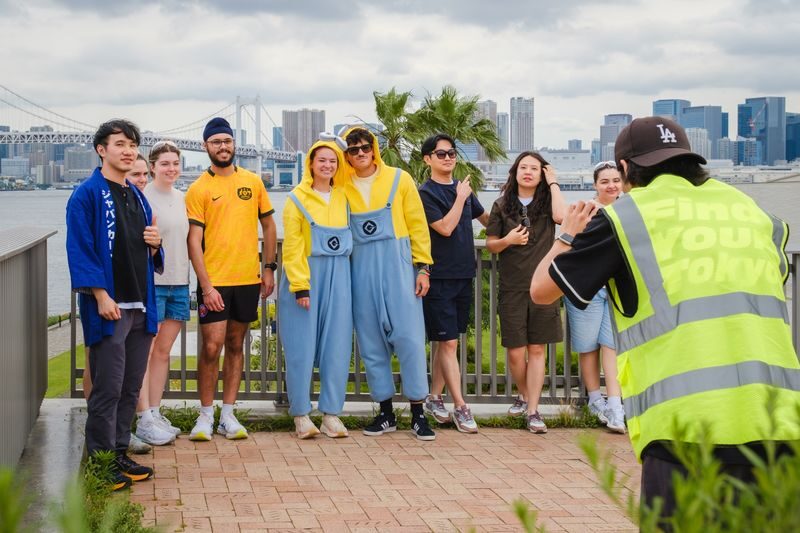
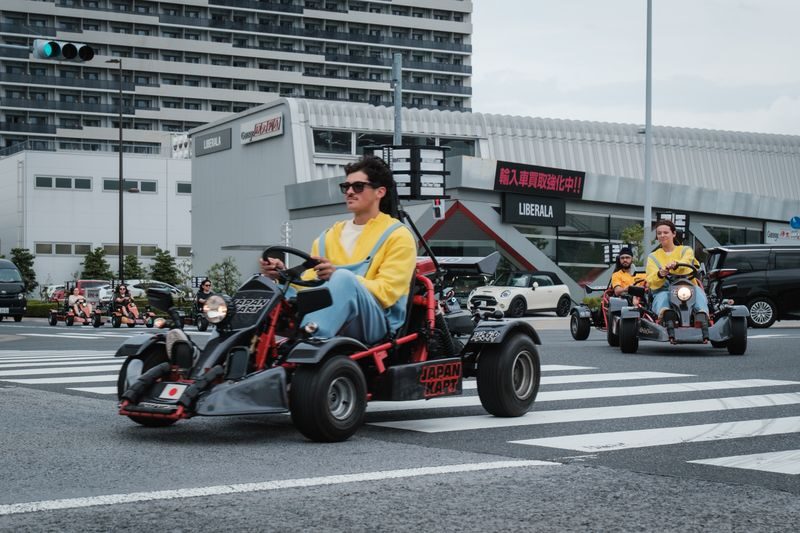
Costume rental is included, and you choose an outfit before setting off. The operator says the costumes are new and clean; winter jackets and pants are also available free of charge. Costumes help make the ride feel like an occasion, and they are part of why this activity is more playful than a standard city tour.
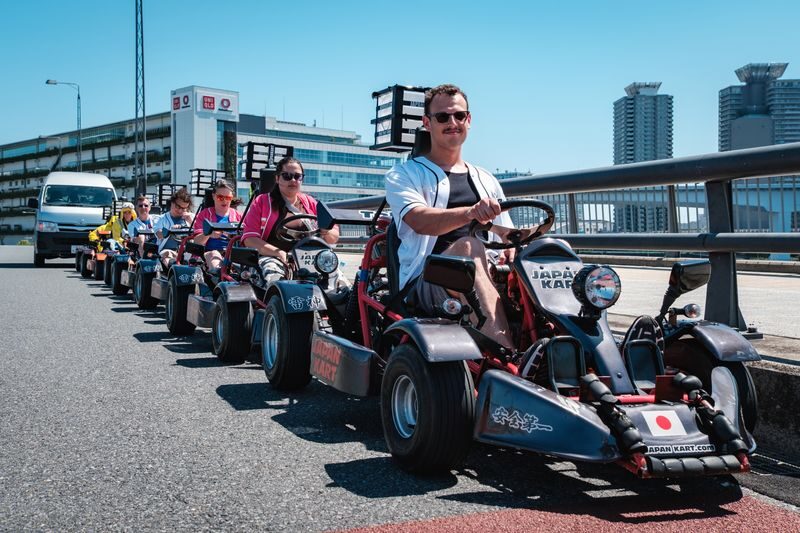
The team provides an English- or Japanese-speaking guide. Before you drive, expect instructions on operating the kart and following the rules of the road. The group then sets out with a guide car ahead and another vehicle behind. That arrangement gives the outing a clear structure and helps keep the group together, though it cannot remove the demands of driving in live traffic.
Staff members associated with the team include Raffy, Haroya, and Saitama, but the guide assigned to your session may be different. You can expect guidance and support during the ride; do not count on a narrated sightseeing tour. The activity does not promise commentary about each attraction along the route.
Photo shooting is included. An action camera rental is not, so if recording your ride matters to you, ask about equipment before booking. Some drivers have used phone mounts provided by staff, but that detail is not guaranteed for every session.
What the route feels like from the driver’s seat
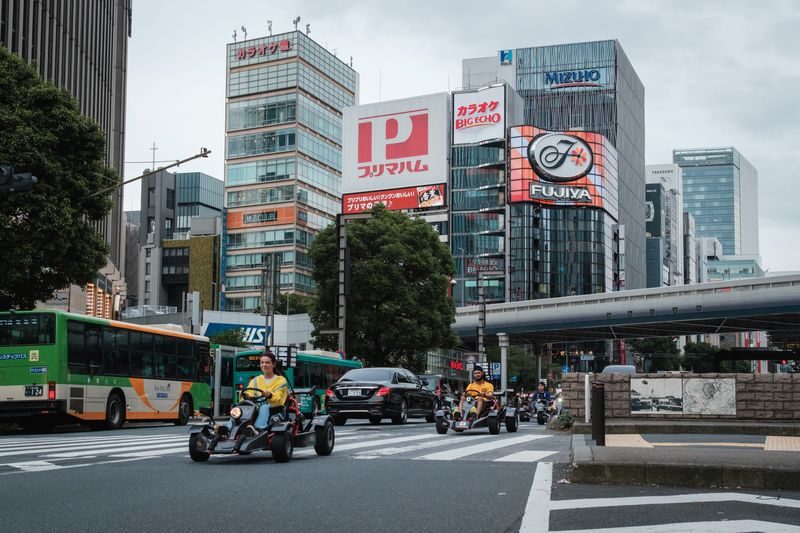
The listed route areas give you a sense of the East Tokyo focus. Asakusa offers the feel of an older riverside district, while Ueno and Akihabara bring different street scenes as the group moves through the city. Tokyo Skytree is a useful landmark on this side of town. The ride lets you link these places from the road, but it is not a stop-and-explore excursion.
Ginza appears in some descriptions of longer rides and rider accounts, but it is not listed as a guaranteed stop for every package. Likewise, the activity does not specify photo stops at attractions. You should expect to see places as you drive by, not to get out and tour them.
At night, illuminated streets can add a pleasing city glow, and several drivers have found evening rides memorable. There is a trade-off: darkness can make details harder to see, and one driver found a night outing a little dim. A daytime session may show more street detail, while an evening session offers city lights. Neither is automatically better; choose the mood you want, and remember that traffic still sets the pace.
The ride is not built around speed. On open stretches, you may get a chance to move along more freely, but in central Tokyo you can also spend time stopping and starting in traffic. One reported outing described average speeds around 20 to 30 km/h, with a brief maximum near 40 km/h. That is a useful sense of scale, not a speed promise.
Safety, traffic, and weather
A lead vehicle and a rear support vehicle are the main safety features described for the tour. Riders often value having staff at both ends of the group, particularly when driving in an unfamiliar city. Clear instructions and the chance to follow an established route can help settle first-time nerves.
Still, you are driving on public roads, so you need to be comfortable operating a vehicle among other traffic and obeying instructions. This is not a risk-free activity, and the convoy does not turn the road into a closed course. One rider reported a kart stopping several times, which is a reminder that mechanical issues can happen. The operator may cancel or change the schedule if there are mechanical problems.
Weather also affects the experience. The operator requires suitable conditions and may cancel for poor weather, offering another date or a full refund in that case. Some rides have gone ahead in rain, and wet conditions can mean a less comfortable outing; a rider caught in heavy rain advised wearing waterproof clothes underneath. Check the forecast and dress for the conditions, but do not assume a rainy ride will always run.
A few practical points help. Arrive with time to spare, follow the briefing, and do not take part if you have been drinking. The operator does not allow participation while under the influence of alcohol. Exhaust fumes may be noticeable on the road, so a mask is worth considering if you are sensitive to them.
The paperwork can make or break the booking
Do not treat the license rules as a detail to sort out after arrival. You must be at least 18 and bring your original physical driving license, passport, and the relevant permit or translation. For many nationalities, that means an International Driving Permit issued under the 1949 Convention, in its original booklet form. A paper printout is not accepted.
Rules differ by country. Drivers from Switzerland, Germany, France, Taiwan, Belgium, Estonia, and Monaco need their original license plus an official Japanese translation from an authorized organization and their passport. US, Canadian, and Australian passport holders need a valid IDP or SOFA license, as well as their physical home-country license and passport. Indian passport holders must obtain an IDP through one of the specified automobile associations in India.
The operator also says that residents of some countries, including China, Indonesia, Pakistan, Saudi Arabia, and Qatar, cannot drive in Japan. Check the current Japanese requirements for your license before paying. If your documents are invalid or incomplete on the day, you may be refused and will not receive a refund.

Is the price worth it?
The advertised starting price is $44.25, though the final cost depends on the selected package and booking details. For that price, the experience includes the kart ride, costume rental, an English- or Japanese-speaking guide, and photo shooting. Winter outerwear is also available without an additional charge.
The value is strongest if you want the activity itself: driving a small kart on city roads, wearing a costume, and seeing Tokyo from a low, unusual viewpoint. It is less compelling if you are mainly seeking a detailed history tour, photo stops, or fast karting. The longer option costs more time as well as money, but it may suit you if you want a fuller ride and the outing is a trip highlight.
One practical limit is that the fee does not include personal expenses or action-camera rental. Also account for travel to the departure point and the time needed to get there early. A missed start or invalid documents can wipe out the value quickly.
Who should book this Tokyo kart ride?
I would put this near the top of the list for confident drivers who want an unconventional activity, enjoy costumes, and are happy to treat traffic as part of the outing. It can also suit a mixed-age group of adults: the activity is open to people 18 and older, and the pace is governed by city driving rather than a racetrack.
It is a weaker fit if you dislike road traffic, want a calm sightseeing bus with detailed commentary, or expect a high-speed thrill. It may also be a poor choice if you are unsure about your driving documents, uncomfortable in rain, or not keen on being photographed while wearing a costume.
My practical pick: choose the one-hour ride for a compact novelty, or the two-hour outing if you want the kart experience to take a larger role in your day. Verify your paperwork first, then choose a time based on whether you prefer daylight or city lights. If you want a memorable way to see East Tokyo from the road and accept the stop-and-go rhythm, book it. If you want to explore attractions on foot, spend that money elsewhere.
Official Japan Go-Kart in TokyoBay&Ginza/Akihabara by JAPANKART
“Wonderful experience! The team was super friendly and very helpful, we had so much fun even though it was a rainy day. the costumes were great and…”
FAQ
How long is the JAPANKART experience?
The Sky Tree Branch package is a one-hour go-kart experience. The Asakusa Branch option is a two-hour experience.
Which Tokyo areas are included?
The listed areas are Akihabara, Ueno, Asakusa, and Tokyo Skytree. The route and schedule may change because of traffic or weather, so not every outing is guaranteed to cover every area.
What is included in the price?
The activity includes a guide who speaks English or Japanese, the go-kart experience, costume rental, and photo shooting. Personal expenses and action-camera rental are not included.
How old do I need to be?
You must be at least 18 years old to take part.
What driving documents should I bring?
Bring your physical home-country driving license and passport, plus the valid international driving permit or official Japanese translation required for your country. Check the rules for your nationality before booking.
Is a paper copy of an international driving permit accepted?
No. The information requires the original physical IDP in booklet form, issued under the 1949 Convention where applicable. A paper-form permit is not accepted.
What happens if the weather is poor?
The activity requires good weather. If the operator cancels because of poor weather, you can be offered another date or a full refund. The operator may also change or cancel the schedule because of mechanical issues.
How early should I arrive?
Arrive at the meeting point 15 minutes before your scheduled departure. Late arrival can mean you miss the ride, and latecomers or no-shows are not eligible for a refund.